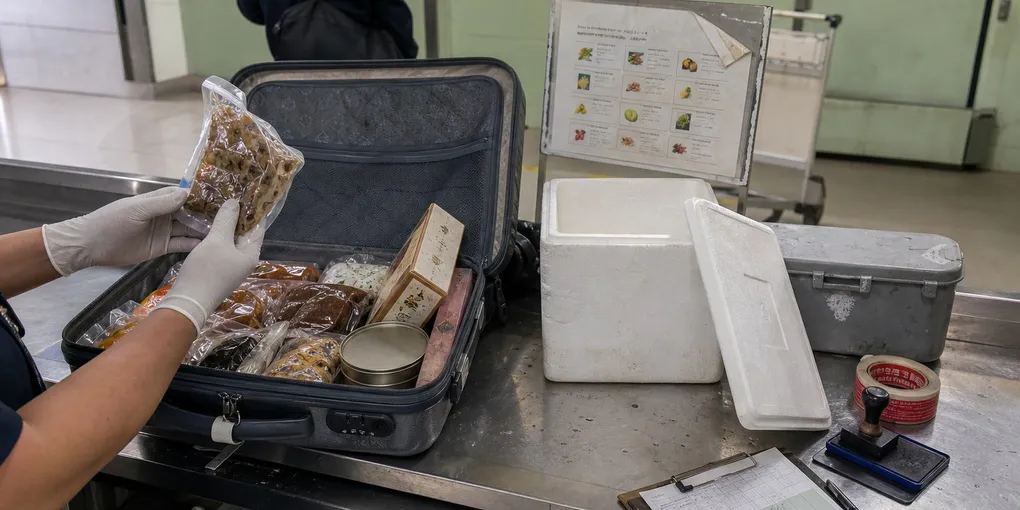
What's in this guide11 sections
Quick answer
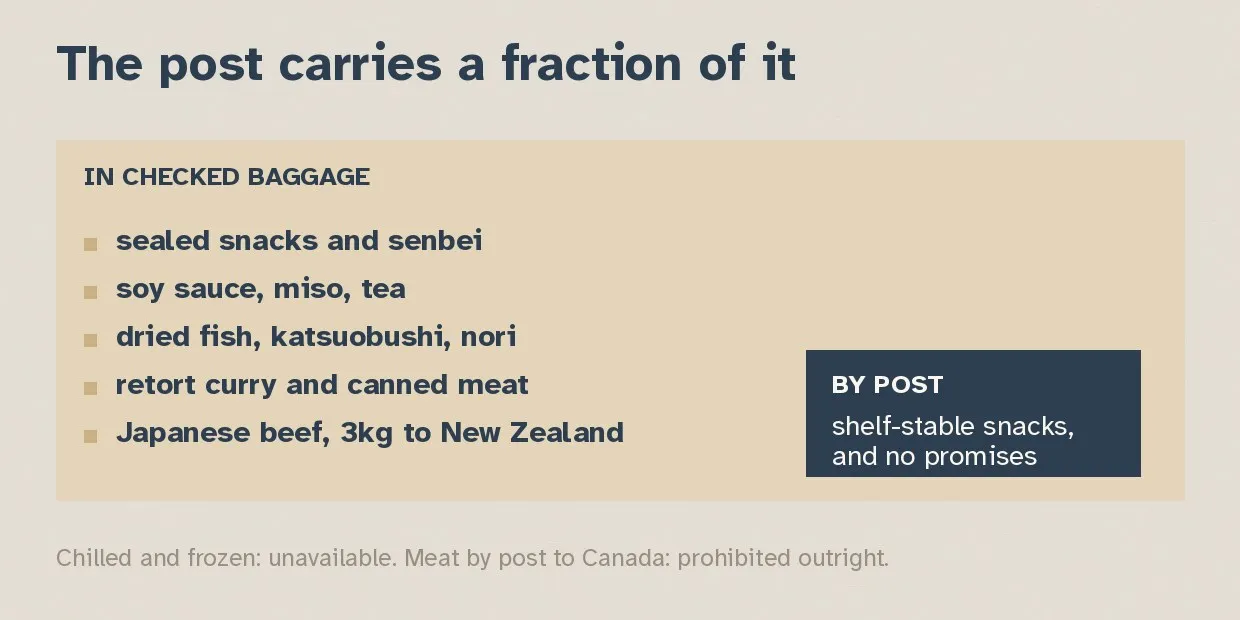
Most Japanese food goes home in your suitcase. Very little of it goes home in the post. In all six countries we checked (the US, UK, Canada, Australia, New Zealand and Singapore), factory-sealed snacks, soy sauce, miso, tea and dried seafood are admissible, and Japan is on the approved-origin or low-risk list for beef, pork and chicken in the US, Australia, New Zealand and Singapore. Shipping is where it collapses, for three unrelated reasons. Canada states that meat products and animal fat are "permitted only if accompanied into Canada by you (cannot be brought in by mail or courier)": the same tin, mailed, is refused. US APHIS treats anything mailed as "commercial" use rather than personal use, which moves it into a permit regime. And Japan Post's refrigerated service reaches Taiwan, Hong Kong, Vietnam, Thailand, Malaysia and Singapore only. There is no cold chain to the US, UK, Canada, Australia or New Zealand at all. Of the five proxy shopping services, three refuse chilled and frozen food in writing and two say nothing about food. One rule to carry with you: declare everything. In the US, the UK and Australia, declaring costs you the item at worst; not declaring costs money. As of August 2026.
There is a moment near the end of every trip to Japan when the suitcase is already full and the conveyor belt of things you meant to take home is still moving. A bag of Hokkaido cheese senbei. A tub of miso from a shop with a wooden sign. Four packets of dashi. The obvious solution presents itself: post it.
We looked at whether that works, across the same six countries we used for kitchen knives, and found the same shape of answer, except more extreme.
Carrying food home is largely fine. The rules are stricter than they are for a santoku, but they are survivable, and the vast majority of what a visitor actually buys is admissible.
Mailing it is close to hopeless. Not because of one big prohibition, but because three separate systems each remove a different part of the shelf, and what survives all three is a narrow list.
Below is where each line falls, taken from the government agencies that enforce it and the companies that would have to carry it.
Taking it home is easier than the internet suggests
The dominant belief among travellers is that meat is banned, full stop, and that anything containing it will be confiscated. That belief is roughly half right, and the half that is wrong is the half that matters.
Import rules for animal products are keyed to where the food came from, not to what it is. A country that is free of foot-and-mouth disease and classified as negligible-risk for BSE gets treated differently from one that is not, and Japan sits on the favourable side of that line in four of our six countries.
The US Department of Agriculture’s APHIS lists Japan among the regions declared free of foot-and-mouth disease (with the standing caveat that meat from those regions is still subject to the restrictions in 9 CFR 94.11) and among those of negligible BSE risk (APHIS region health status). Australia’s foot-and-mouth-free country list names Japan in the edition effective 18 March 2026 (DAFF FMD-free list); it is revised periodically, so it is worth re-checking before you fly. New Zealand’s Ministry for Primary Industries is more specific still: “Beef products from Australia, Canada, USA, European Union, UK, Switzerland, Norway, Vanuatu, or Japan: 3 kg” (MPI, bringing food to NZ). Singapore’s Food Agency names Japan as an approved source for beef, pork and poultry alike, with beef allowed to 5kg (SFA, list of foods allowed).
So “Japanese meat is banned” is not the rule anywhere except the UK. What varies is the packaging condition attached to it.
| Item | US | UK | Canada | Australia | New Zealand | Singapore |
|---|---|---|---|---|---|---|
| Factory-sealed snacks, senbei, KitKat | Admissible if meat-free; declare | Unlimited from any country: one of very few categories gov.uk says this about (fresh-cream and heavily dairy cakes excepted) | Must contain no meat; 20kg cap | Declare and expect inspection; biscuits and cakes fine except cheesecake | 2kg per item (1kg if it contains honey, egg or meat); must be free of soil and pests | Counts inside a combined 5kg / 5L and S$100 processed-food allowance |
| Soy sauce, miso, vinegar, cooking oil | Condiments, vinegars, oils and packaged spices permitted | Not on any restricted list, so admissible by exclusion | ”Condiments, dressings”: no restriction; 20kg cap | Commercially cooked, shelf-stable, sealed sauces and curry pastes permitted | Soy sauce named as an example of a permitted sauce; 1kg if it contains egg | Inside the same combined 5kg / S$100 allowance |
| Tea and coffee | Tea unlimited; roasted coffee unlimited; raw coffee cherries prohibited | Admissible by exclusion | ”Spices, tea, coffee”: no restriction; 20kg cap | Commercially packaged, 1kg limits on loose herbal teas | Green tea and roasted coffee permitted, 2kg per item | Inside the combined allowance |
| Meat: jerky, retort curry, instant ramen with meat | Boneless, commercially packaged, shelf-stable and cooked: admissible up to 50 lb. Note the conflict below | ❌ Prohibited from outside the EU with no canned or retort exception | Canned, jarred or retort-pouch only, commercially cooked and shelf-stable; beef from BSE-negligible-risk countries; 20kg cap: and carried by you, never mailed | Jerky permitted if pork-free, made in an FMD-free country, commercially packaged, unopened, under 1kg. Retort tins permitted on similar terms | Beef, goat, kangaroo, rabbit, lamb and venison if commercially packaged and unopened; Japanese beef named, 3kg; retort tins of other meats including chicken, 2kg. All pork products prohibited | Beef, pork and chicken from approved source countries only, 5kg. Japan is approved for all three |
| Dried seafood: katsuobushi, niboshi, nori | APHIS regulates almost no seafood; nori is neither fish nor animal product | Fish up to 20kg (processed must be dried, cooked, salted or smoked) | Dried fish 10kg, fish roe 1kg, other seafood 40kg. Pufferfish prohibited | Canned fish with bones up to 10kg. Nori not addressed on the page we read | Species must be identifiable; non-salmonid 20kg, shellfish 5kg | ”Fish products including dried fish”, unlimited from all countries |
| Fresh fruit, vegetables, seeds, raw rice | Fresh and frozen produce almost entirely prohibited. Rice discouraged as a pest risk rather than banned outright | ❌ Non-EU produce needs a phytosanitary certificate, with a short exempt list. Rice explicitly permitted without a certificate | Refer to the AIRS database per item and origin. We could not resolve Japan-origin produce | ⚠️ Raw rice is explicitly disposal-only. Fresh produce prohibited except dried, canned or pickled | Fresh produce prohibited. Unprocessed, unsorted seeds and grains prohibited | ✅ Fresh fruit and vegetables permitted from all countries, the only one of the six |
| Alcohol | No federal volume limit; the ceiling is set by the state you land in | Beer 42L; still wine 18L; spirits over 22% 4L; drinks at or under 22% 9L | 1.5L wine or 1.14L spirits or 8.5L beer, after 48 hours away | 2.25L, age 18+ | 4.5L wine or beer plus three bottles of spirits, age 17+ | One paired combination, e.g. 1L spirits + 1L wine, age 18+ after 48 hours away. Sake counts as wine; shochu and umeshu count as spirits |
Two practical notes that the tables above do not capture.
First, liquids are a cabin-baggage problem, not an import problem. A 500ml bottle of soy sauce is legal to import into all six countries and illegal to carry through security in most of them: the standard limit is 100ml per container. Australia’s Border Force goes further and warns that canned high-moisture foods (abalone, sardines, tuna) count as liquids too (ABF food page). The UK is the one country loosening: airports with the newer CT scanners are already running a 2L allowance, though gov.uk is explicit that this is not yet every airport (gov.uk liquids). Miso and sauces go in the checked bag.
Second, declaring is close to free and not declaring is not. The US, UK and Australia all state that if you declare an item and it turns out to be inadmissible, you lose the item and nothing else happens. The penalties in the next section apply only to people who did not declare.
The rule changes the moment you put it in the mail
This is the part that surprises people, and it is not a customs quirk. Two of the six countries have written it into the rule itself.
Canada is the blunter of the two. The Canadian Food Inspection Agency’s table of food for personal use carries, against animal fat or suet and again against meat products, the phrase:
Permitted only if accompanied into Canada by you (cannot be brought in by mail or courier)
The full clause for meat reads: “Only the following commercially prepared meat products are permitted and only if accompanied by you into Canada (they cannot be brought in by mail or courier)” (CFIA, bringing food for personal use). The phrase appears five times across the page. The tin of retort curry that clears the border in your suitcase is refused as a parcel: same tin, same contents, same 20kg allowance, different verb.
The US arrives at the same place by a different route. APHIS defines the boundary of “personal use” by the vehicle it travels in:
Commodities intended for “personal use” mean those in passenger baggage or passenger vehicles. Commodities sent by mail are regulated as “commercial” use.
That sentence sits on the meat, poultry and seafood guidance (APHIS travelling with agricultural products), and it is broader than meat. Anything posted stops being a souvenir and becomes an import, with the permits, certificates and inspection regime that implies.
This is the asymmetry in one line: the suitcase is a legal category, and the parcel is a different one.
It is the same split that decides what you owe on luxury goods: the duty follows the route, not the object.
Shipping runs into three separate walls
Even where the destination country would accept a mailed food parcel, the Japanese end has to be able to send it. Three systems sit between the shop and your door, and each removes a different part of the shelf.
Wall 1: there is no cold chain to your country
Japan Post runs a refrigerated international service, Cool EMS, which holds parcels between 0–10°C chilled or below −15°C frozen for 72 to 80 hours. It is a genuinely good service, used to send osechi, wagashi and live fish overseas, and an individual can send a single box.
It goes to six places: Taiwan, Hong Kong, Vietnam, Thailand, Malaysia and Singapore (Japan Post, Cool EMS). We checked the destination list on the page itself rather than the marketing copy, and it is those six.
Of our six countries, that is Singapore and nothing else. There is no Japan Post temperature-controlled route to the US, the UK, Canada, Australia or New Zealand. Hong Kong and Thailand are additionally suspended as of August 2026.
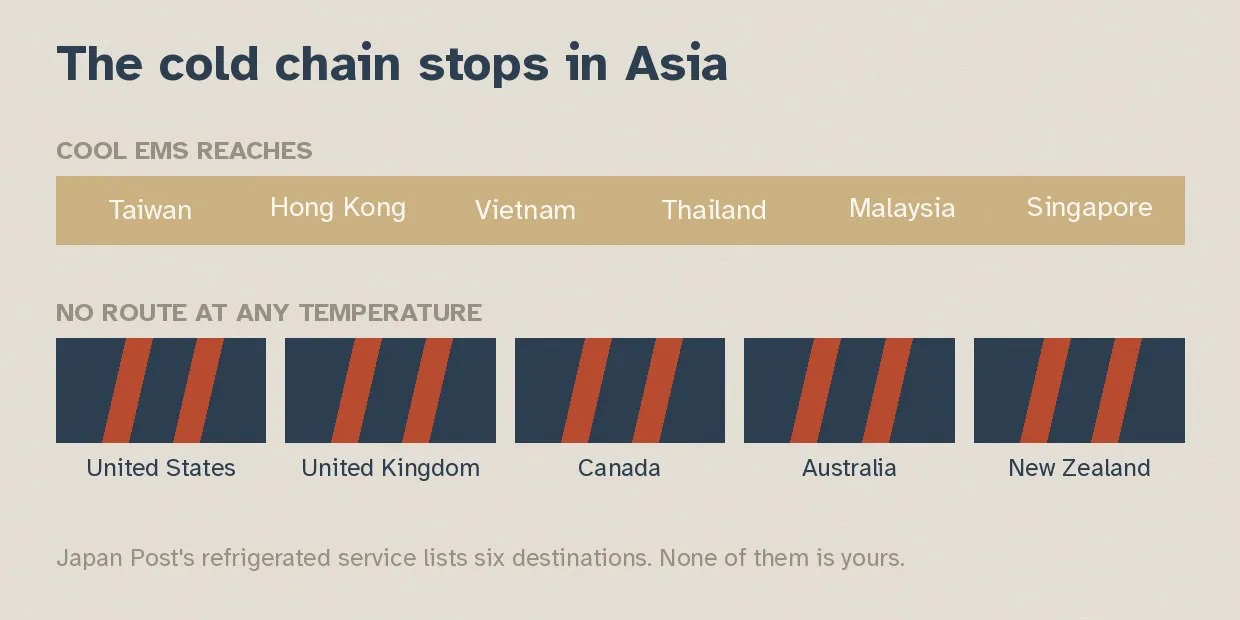
Anything that needs to stay cold is therefore not a shipping question for five of six readers. It is a suitcase question or it does not happen.
Wall 2: the courier the proxies use refuses food outright
The cheapest international courier in our own shipping measurements, ECMS, publishes a list of goods it will not accept anywhere, and it includes:
perishable food, and food or beverages requiring refrigeration, freezing or other temperature control
For the US and Australia, ECMS goes further and refuses food generally, without the temperature qualifier. The UK and New Zealand are not among ECMS’s fifteen destinations at all, so the question does not arise: a different carrier, at a different price, is the only option.
This matters because ECMS is the cheap tier. Losing it does not mean you cannot ship; it means the price of shipping food is set by DHL and EMS rather than by the cheapest line on the table.
Wall 3: the five proxy services do not agree, and two of them say nothing
Proxy shopping services exist to buy things in Japan and forward them to you, which makes them the obvious answer to “post it.” Their own prohibited-item pages tell a more divided story.
| Service | Chilled and frozen | Meat | Dairy and eggs |
|---|---|---|---|
| Doorzo | Prohibited, stated plainly: “Doorzo does not provide the necessary storage or shipping conditions for such products" | "meat products” listed as prohibited | ”fresh animal milk, eggs” prohibited |
| Neokyo | ”Frozen food & goods” and “Perishable goods” both prohibited | ”Food containing meat product or meat powder (Ramen, Soup, Sauce, Potato chips, etc.)”, the powder in a seasoning sachet counts | Not itemised separately |
| FromJapan | ”Items that require refrigeration” and “Fresh produce” prohibited | ”Meat products” prohibited | ”Raw milk and eggs” prohibited |
| Buyee | No food-specific statement. Dry ice is prohibited, which makes frozen shipping impractical in effect | Not stated | Not stated |
| ZenMarket | No food-specific statement found | Not stated | Not stated |
Sources: Buyee, ZenMarket, Neokyo, Doorzo, FromJapan.
Neokyo’s line is the one to read twice. Food containing meat powder captures instant ramen sachets, some crisp flavourings and a good deal of the instant-food aisle, categories most people would not think of as meat at all.
Silence is the harder case. Buyee and ZenMarket not listing food does not mean food is welcome; it means the policy is not published, and the decision lands on whoever handles your parcel. We are not going to read a permission into an absence.
The same divergence shows up in alcohol, where the two published thresholds are not the same number:
| Service | Threshold |
|---|---|
| Doorzo | Above 24% prohibited, with a note that below 24% may still be restricted by the destination |
| ZenMarket | Above 24% restricted to DHL only |
| FromJapan | Above 70% prohibited |
| Neokyo | ”Alcohols” listed under flammables, without distinguishing drinks from isopropyl |
| Buyee | ”Alcohol” listed among flammable liquids, same ambiguity |
The 24% figure lines up with import-regulation practice. It is the same threshold Japan Post applies to the UK. The 70% figure lines up with the dangerous-goods rules that treat high-proof spirits as a flammable liquid. They are answering different questions, and a bottle of 40% whisky is fine under one and prohibited under the other. Check the service you are actually using rather than the number you remember.
Four things people get wrong
“Canned or retort meat is fine everywhere.” It is fine in the US, Canada and Australia, on conditions. It is not fine in the UK, which prohibits meat and meat products from outside the EU with no exception for cans or pouches (gov.uk, bringing food into Great Britain). A retort curry pouch is the single most commonly mishandled item on a UK-bound flight, because every travel forum answer about it was written by someone flying to the US.
“Jerky is jerky.” Australia and New Zealand both allow beef and poultry jerky under commercial-packaging conditions, and both prohibit pork jerky and biltong absolutely. A mixed gift box does not get partial credit.
“Rice is just a grain.” Australia lists raw, uncooked rice as disposal-only. The US discourages it as a pest risk without an outright statutory ban. The UK, unusually, permits rice with no certificate at all. Three positions, three countries.
“You can bring one litre of spirits into the US.” There is no federal volume limit for alcohol in personal baggage. The ceiling is whatever the state you land in allows, and CBP says so directly (CBP alcohol). The one-litre figure people repeat comes from a separate duty-free allowance regime and does not transfer.
What it costs to guess wrong
The pattern across all six is the same: declaring is cheap, and the fine is for concealment.
| Country | If you declare | If you do not |
|---|---|---|
| US | Item seized, no penalty. APHIS states this explicitly | $300 first offence, $500 thereafter |
| UK | Item seized and destroyed, no penalty | Up to £5,000 or prosecution in England |
| Canada | Assessed at the border | Seizure plus a penalty of 25%–70% of the value |
| Australia | No penalty even if the item is refused | A$728 to A$7,280 on the spot (2 to 20 penalty units at A$364); serious cases run to A$99,000–A$396,000 |
| New Zealand | Assessed at the border | NZ$400 instant fine; smuggling up to NZ$100,000 or five years |
| Singapore | Red Channel declaration above the allowance | Fine or prosecution; no figure published that we could find |
New Zealand’s NZ$400 and Australia’s A$728 are instant fines issued at the airport, on the spot, for a packet of jerky someone forgot about. Both countries also state that a declared item costs you nothing but the item. There is no scenario in which not declaring is the better bet.
FAQ
Can I post snacks and sweets home from Japan? Probably, but nobody will promise it. None of the five proxy services lists shelf-stable confectionery as prohibited, and none lists it as permitted either. It survives by not appearing on a prohibition list, which is weaker than permission. On the destination side, factory-sealed meat-free snacks are admissible in all six countries. The realistic risk is not legality; it is a parcel handler making a judgement call.
Is instant ramen a meat product? For Neokyo, yes, its policy names ramen, soup and sauce containing meat powder. For New Zealand, a processed food is assessed as meat once meat or egg content exceeds 5%. For the UK, if it contains meat in any form it is prohibited from outside the EU. Assume the sachet counts.
Can I ship Japanese beef home? Not by post to any of the five countries without a cold chain, and not to Canada at all, Canada’s own rule requires meat to be accompanied by you. New Zealand allows 3kg of Japanese beef in your baggage. Singapore allows 5kg from approved sources, and Singapore is the one country where Cool EMS is an option.
What about sake? Sake travels as a checked-baggage item within the alcohol allowances above, and Singapore explicitly counts it against the wine allowance rather than spirits. For shipping, the constraint is the service’s own alcohol threshold, not the strength of the sake. At 15–16% it sits below both the 24% and 70% lines, so the question becomes whether the service handles alcohol at all.
The bottom line
Buy the food. Carry the food. The suitcase clears more than people expect: sealed snacks, soy sauce, miso, dashi, tea, dried seafood and, in four of six countries, commercially packaged Japanese beef. Put liquids and cans in the checked bag, and declare every edible thing on the form. In the US, UK and Australia a declared item costs you the item and nothing more.
Do not plan on posting it. Chilled and frozen are simply unavailable to five of these six countries, because Japan Post’s cold service does not go there. Canada forbids mailed meat in the rule’s own words. The US reclassifies anything posted as a commercial import. The cheap courier refuses perishable food outright and refuses food generally to the US and Australia. Three of the five proxy services prohibit chilled, frozen and meat in writing, and the other two have not published a position.
The narrow exception worth knowing: Singapore. It is the only one of the six that Cool EMS reaches, the only one that admits fresh fruit and vegetables from anywhere, and it treats dried fish as unlimited. If you are reading this in Singapore, most of the article above does not constrain you.
For everyone else, the shape is the same as it was for knives: the thing you assumed was hard is easy, and the thing you assumed was easy is where it stops.
Drink follows the same logic and takes it further. Alcohol is a dangerous good rather than a quarantine risk, so it is refused by every class of mail (surface included) and prohibited outright to the United States. What that leaves you is your own baggage, and an allowance measured in litres.
What we could not confirm
- Canada’s produce rules for Japanese-origin items. CFIA directs each item to the AIRS database with origin as a variable, which we could not resolve per item.
- Cabin liquid limits for Canada and New Zealand. The official pages did not return usable content on our attempts. We have assumed nothing; the 100ml figure quoted for other countries comes from their own pages.
- The US position on instant-noodle soup bases. An older CBP page treats processed foods containing meat as prohibited in general terms, while the current APHIS item pages set out conditions under which shelf-stable cooked meat is admissible. These are in tension and we have not resolved which governs.
- Nori into Australia, and rice and seeds into Singapore. Neither appears by name on the relevant agency page.
- Whether Buyee and ZenMarket will carry food. Neither publishes a food policy. Absence of a prohibition is not permission.
- Whether Neokyo’s and Buyee’s “alcohol” entries mean drinks or solvents. Both list it among flammables without distinguishing.
- Prices, allowances and country lists change. Australia’s FMD-free list dropped a country in March 2026. Re-check before you fly.