What's in this guide10 sections
Quick answer
Three things changed the math, and all of them are still in force. First, "under $800 is duty-free" no longer applies: an executive order suspended the US de minimis exemption worldwide on August 29, 2025, and in 2026 US Customs and Border Protection made that suspension indefinite. Second, two of the five major proxy services will not ship jewelry at all: Buyee and Neokyo prohibit gemstones and precious metals regardless of carrier, while ZenMarket's prohibited list contains no jewelry entry at all. Third, only Doorzo offers paid authentication with a published price list (¥5,000 per luxury item, ¥8,000 per piece of jewelry); ZenMarket and Neokyo both state they do not authenticate. For a ¥100,000 handbag to the US, budget ¥122,600–¥130,000 all in, including ¥19,000–¥22,500 of duty that a US buyer would not have paid before August 2025.
Search for how to buy luxury goods from Japan and you land on the same explanation everywhere. Register with a proxy service, send them the link, pay the item price plus domestic shipping and a commission, and have everything forwarded in one parcel. Anything under $800 arrives duty-free.
That last line stopped being true six days ago.
On 24 July 2026, a new US customs process for international mail took effect. On the same day, the 10% surcharge that had been sitting on top of Japanese goods expired by operation of law. One change raises your cost; the other lowers it. So they roughly cancel out. That would be the reasonable assumption. Except the surcharge was replaced the moment it lapsed.
Nothing got cheaper. The duty-free allowance is simply gone.
For luxury buyers this lands harder than for anyone else, because duty scales with price. And before duty enters the picture there is a plainer obstacle: the thing you want to buy may not be allowed to leave the country through your chosen service.
What changed on 24 July 2026
For decades the US operated a de minimis rule. Imports valued at $800 or less entered free of duty, tax, and fees. That allowance is what made casual personal importing viable.
It closed in stages. An executive order suspended the exemption worldwide on 29 August 2025. On 24 June 2026, US Customs and Border Protection issued interim final rules making the suspension indefinite, effective immediately for every mode of transport except international mail. For mail, a new informal entry process took effect on 24 July 2026. And under legislation passed in July 2025, the exemption is set to be abolished statutorily on 1 July 2027.
It is not coming back. Plan accordingly.
The surcharge didn’t disappear. It changed names
Additional duty on Japanese goods has been rewritten three times in eleven months.
| Period | Additional duty | Legal basis |
|---|---|---|
| Sept 2025 – 23 Feb 2026 | 15% | Reciprocal tariff under the US–Japan agreement |
| 24 Feb 2026 – 23 July 2026 | 10% | Temporary import surcharge under Section 122 |
| 24 July 2026 – present | 10–12.5% | New Section 301 duties |
Section 122 carries a hard statutory ceiling of 150 days. Congress did not extend it, so the surcharge lapsed automatically at 12:01 a.m. ET on 24 July 2026.
This is where the reasonable assumption breaks. If the surcharge expired, imports should be cheaper.
They are not. New Section 301 duties covering 80 countries (Japan among them) took effect at the same moment. The name and the legal authority changed. The surcharge on your parcel did not.
So what rate actually applies
For luxury goods, the rate comes in two layers: the base rate for the commodity, plus the additional duty of 10–12.5%.
Base rates for the categories that matter here are below. Bear in mind that the final assessment depends on the ten-digit classification your parcel receives at the border: leather versus coated fabric, precious metal content, and similar distinctions all move the number.
| Item | Base rate (approx.) | With additional duty |
|---|---|---|
| Leather handbags | 9–10% | 19–22.5% |
| Precious metal jewelry | 5.5–8% | 15.5–20.5% |
| Watches | Compound duty: separate rates for case, strap and battery, plus a fixed amount per unit | Not calculable (see below) |
Watches are a genuine exception. The US tariff schedule does not assess them as a simple percentage; it combines ad valorem components on individual parts with a per-unit charge. No official worked example showing how the additional duty applies to a compound rate could be located. If you are buying a watch, get a quote from a customs broker before you bid. Publishing an estimate here would be guesswork dressed up as guidance.
What the total actually comes to
Buying through a Japanese proxy splits your spending four ways: the item, the service’s commission, international shipping, and duty on arrival. Until recently that fourth line was blank for anything under $800.
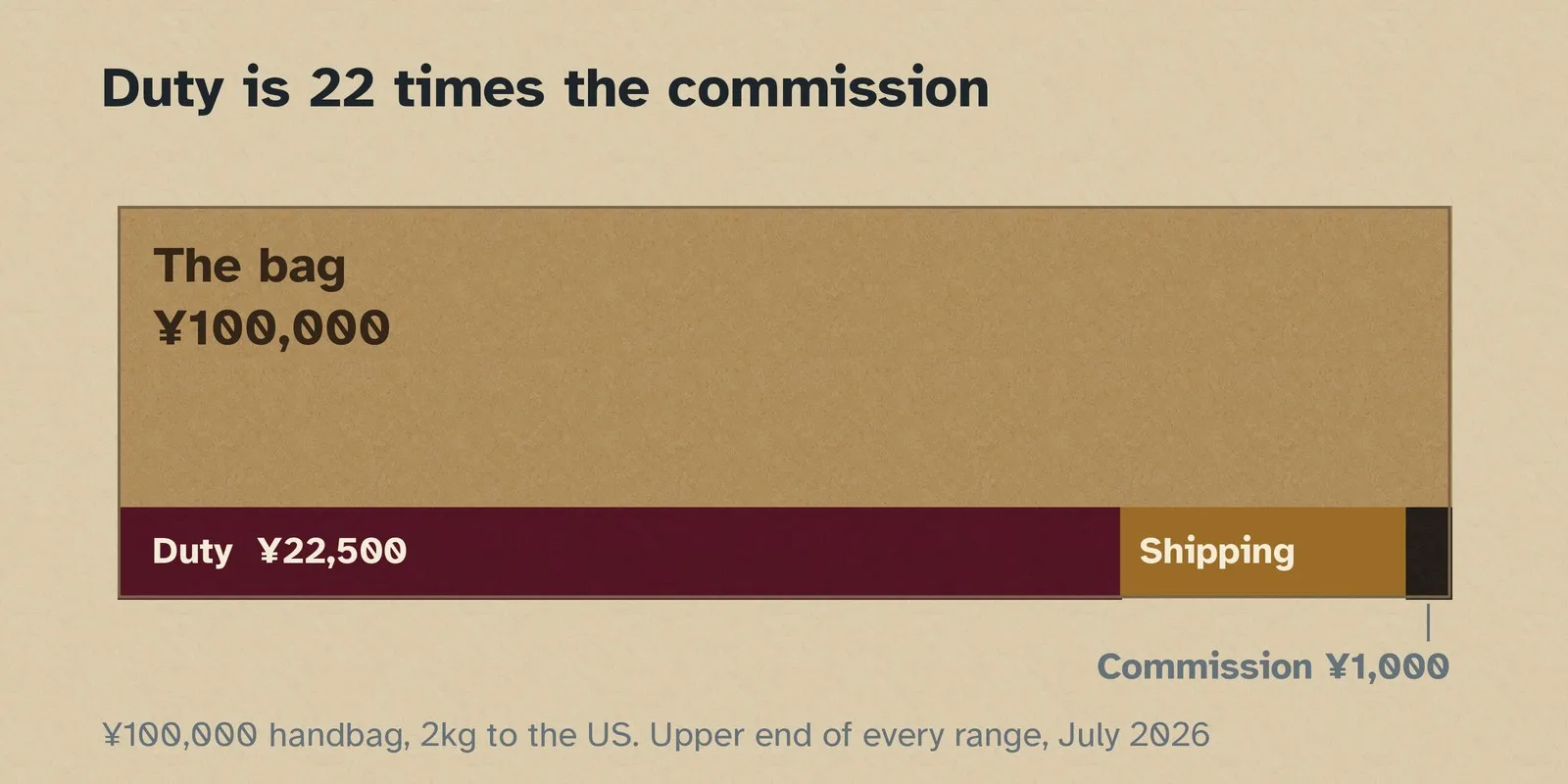
Here is a ¥100,000 handbag (roughly $612 at ¥163.5 to the dollar) shipped to the US. Shipping figures are the measured rates from our Buyee vs ZenMarket cost comparison and Doorzo vs Neokyo shipping tests, both run on a 2 kg parcel.
| Line item | Amount |
|---|---|
| Item price | ¥100,000 |
| Service commission | ¥300–¥1,000 (varies by service) |
| International shipping (2 kg, cheapest tier) | ¥3,290–¥6,409 |
| Duty (19–22.5%) | ¥19,000–¥22,500 |
| Total | ≈ ¥122,600–¥130,000 |
Under the old rules that duty line was zero, because $612 fell under the threshold.
Scale it up and the effect compounds. On a ¥500,000 piece, duty alone runs ¥95,000 to ¥112,500. Cross $2,500 in declared value and the parcel no longer qualifies for informal entry, which means formal customs clearance, more paperwork, and broker fees on top.
The higher the price, the less it matters which service charges ¥50 less in commission. What decides the outcome is duty, and whether the item can ship at all.
The item you want may not be allowed to ship
This is the trap. You compare commissions and shipping rates, pick a service, win the auction, and then discover the category is prohibited.
Checking all five services’ own documentation, they fall into three groups.
| Service | Diamonds | Gold, silver, platinum, other gemstones | Where it’s stated |
|---|---|---|---|
| Buyee | Prohibited | Prohibited | Listed under the heading “Prohibited Items for All Countries”: diamonds, precious metals, and jewelry all appear |
| Neokyo | Prohibited | Prohibited | Named in the blanket forbidden-items list |
| FromJapan | Prohibited | Prohibited via Japan Post (other carriers are not explicitly barred) | Terms article 22 forbids buying valuables for Japan Post shipping; diamonds appear separately on the export-restricted list |
| ZenMarket | Not listed | Not listed | The prohibited-items page covers only explosives and flammables, illegal goods, and flora and fauna. Jewelry and precious metals do not appear |
| Doorzo | Unclear | Unclear | Its prohibited-items page links out to Japan Post’s official guide rather than stating its own policy |
Bags, wallets, clothing, and shoes are fine everywhere. Gemstones and precious metals are where the wall sits.
And there is a gap in that wall worth knowing about. ZenMarket’s prohibited list does not contain a single jewelry entry. What it restricts is shipping via Japan Post. Choose a courier instead and a route to buying jewelry appears to remain open. Buyee and Neokyo bar it regardless of carrier, so the difference is substantial.
FromJapan is stranger still. Gold, silver, platinum, and gemstones are barred if you ship by Japan Post. Diamonds sit on a separate list (items restricted for export under Japanese law), and are closed off entirely. Same category of goods, two different doors, only one of them open.
None of this is visible while you shop. The prohibited lists live deep in the terms of service, and no warning appears at checkout. You find out after you’ve won.
Jewelry is not the only category where the five services disagree. Kitchen knives split them four ways too: one refuses blades outright, two name only swords, and two say nothing at all.
If you are buying gemstones, confirm both the category and the carrier with the service before bidding. The tables here reflect published policy as of July 2026, and terms change.
What you get back if it breaks
On expensive items, the compensation ceiling quietly becomes the real selection criterion. If a ¥500,000 piece is lost in transit, how much comes back?
The five services split cleanly into those that publish a number and those that don’t.
| Service | Compensation ceiling | How clearly stated |
|---|---|---|
| ZenMarket | Insured free of charge below ¥5,000,000 total; above that, special insurance is arranged case by case | States the figure |
| Neokyo | The declared content value is the ceiling; no fixed yen cap | Publishes the rate as well |
| FromJapan | With the paid Product Protection Plan (¥500/item) and a tracked service, the item’s actual cost is refunded in full. Damage caused by the service’s own negligence is capped separately at ¥50,000 (¥500 equivalent for its US operation) | States both tiers |
| Buyee | Paid plans (¥500 each, ¥300 for inspection) refund the equivalent of actual cost. No fixed ceiling stated | Ceiling not published |
| Doorzo | No insurance scheme of its own; it mediates damage claims with the carrier. No ceiling stated | Ceiling not published |
For a ¥500,000 purchase, ZenMarket’s “free below ¥5,000,000” is easy to reason about. With Buyee and Doorzo you cannot tell from their published pages whether there is no ceiling or simply no disclosure. On expensive items that ambiguity matters more than a commission difference.
How to check whether it’s genuine
Part of why Japan’s secondhand market is trusted abroad is institutional. The Association Against Counterfeit Product Distribution (AACD) runs a certification for authentication specialists, with a reported pass rate of 30–40% and renewal every five years. Not many markets train authenticators as a formal profession.
That trust attaches to buying in a Japanese shop, though. Put a proxy service in the middle and authentication becomes a question of what that service offers.
| Service | Authentication |
|---|---|
| Doorzo | Paid in-house authentication with a published price list: ¥5,000 per luxury brand item, ¥8,000 per piece of jewelry, ¥1,500 per trading card, ¥2,000 per pair of shoes, and 4% of item price for watches |
| Buyee | Authentication option available, expanded in October 2025. Limited to JDirectItems Auction, Mercari, and Rakuten Rakuma. Pricing shown per listing |
| FromJapan | Mediates Mercari’s own official authentication rather than performing its own |
| ZenMarket | Not offered. Detailed inspection explicitly excludes “checks a non-expert would spend more than three minutes on.” Photography only, at ¥500/item |
| Neokyo | Not offered. States that inspection and authentication are not part of the service |
ZenMarket and Neokyo saying plainly that they don’t do this is the honest position, better than implying a check that isn’t happening. It does remove them from consideration for high-value branded goods.
Payment can stop you before shipping does
Past certain amounts, how you’re allowed to pay changes.
- Buyee: bids and orders of ¥900,000 or more can only be settled through Buyee Wallet, which requires pre-loading funds via Wise. A card won’t complete the purchase.
- Neokyo: parcels above ¥100,000 may be required to ship by FedEx, DHL, or UPS, which closes off the cheaper Japan Post options.
- FromJapan: once monthly winning bids pass a certain total, payment is restricted to FJ Points or a prepaid deposit. The threshold is not published.
- ZenMarket: no per-order ceiling could be found. Deposits above ¥100,000 are recommended by international bank transfer as the cheaper route, though it isn’t mandatory.
- Doorzo: the payment and membership-tier pages are built as images, so the conditions could not be read as text.
Buyee’s ¥900,000 wall is worth knowing in advance. Discovering it after you’ve won an auction is an avoidable problem.
Which one to use
It depends on what you’re buying. For general shopping rather than luxury specifically, our comparison of seven Japanese proxy services covers fees and store coverage in full.
| If you’re buying | Use | Because |
|---|---|---|
| A branded bag or wallet, authenticated | Doorzo | The only service with a published authentication price list. Accept that its compensation ceiling isn’t disclosed |
| Something over ¥500,000, coverage first | ZenMarket | Insured free below ¥5,000,000. No authentication, though |
| Lowest shipping cost | Buyee or Doorzo | Measured 2 kg rates to the US: Buyee’s ECMS at ¥3,290 and Doorzo’s sea freight at ¥3,300. Doorzo’s Japan Post routes require an order total above $800 |
| Jewelry or precious metals | ZenMarket | The only realistic option: no jewelry entry on its prohibited list, and avoiding Japan Post appears to leave a route open. Confirm before bidding |
And duty applies either way. There is no threshold to stay under any more. Budget 19–22.5% for a handbag and treat it as part of the price.
Frequently asked questions
Is anything under $800 still duty-free? No. An executive order suspended the exemption worldwide on 29 August 2025. In 2026 US Customs and Border Protection made that suspension indefinite: for couriers from 24 June 2026, and for international mail from 24 July 2026. Parcels are subject to duty, tax, and fees regardless of value.
What additional duty applies to Japanese goods right now? The 10% Section 122 surcharge lapsed at its 150-day statutory limit on 24 July 2026. New Section 301 duties of 10–12.5% took effect at the same time. The additional layer continues under a different legal basis.
How much duty will I pay on a leather handbag? Roughly 19–22.5%, a base rate of 9–10% plus the 10–12.5% additional duty. The final figure depends on how the item is classified at the border.
How much duty will I pay on a watch? It cannot be stated as a percentage. The US tariff schedule assesses watches as a compound duty, combining ad valorem rates on separate components with a per-unit charge, and no official example of how the additional duty applies to that structure could be located. Ask a customs broker before buying.
Can I buy jewelry from Japan through a proxy service? It depends on the service. Buyee and Neokyo prohibit gemstones and precious metals regardless of carrier. ZenMarket’s prohibited list contains no jewelry entry, so avoiding Japan Post appears to leave a route open. FromJapan can ship gemstones by courier but bars diamonds entirely as an export-restricted item. Confirm with the service before bidding.
Can I have an item authenticated? Doorzo offers paid authentication with a published price list (¥5,000 per luxury item, ¥8,000 per piece of jewelry, and others). Buyee has an option limited to certain marketplaces. ZenMarket and Neokyo both state that they do not authenticate.