What's in this guide10 sections
Half of Japan’s online stores won’t sell to you. Mercari Japan (the country’s biggest flea-market app, not to be confused with Mercari US) won’t even let you register without a Japanese address. Most sellers on Yahoo! Auctions, Japan’s equivalent of eBay, ship domestically only. The workaround is a proxy shopping service: a company that buys the item for you, receives it at a warehouse in Japan, and forwards it overseas.
The problem is choosing one. Service fees range from ¥200 to over ¥900 per item. Trustpilot ratings run from 3.6 to 4.8. And every proxy’s own website will, naturally, tell you only the good parts.
So we did the cross-checking instead. This guide compares seven services (Buyee, ZenMarket, Neokyo, FromJapan, Doorzo, Remambo, and Japan Rabbit) using their official fee pages, Trustpilot scores, and what actual users report on Reddit. We have no financial relationship with any of them. Numbers and sources only.
Quick answer
For Yahoo! Auctions, ZenMarket is the community consensus pick. For Mercari Japan, Buyee is the official partner. The lowest service fees are Doorzo (¥200–300 per item) and Neokyo (¥350). For fragile or expensive items, Japan Rabbit has the strongest packaging reputation. Details and trade-offs below, as of July 2026.
The short answer: which proxy for which job
| Your use case | First pick | Why |
|---|---|---|
| Buying from Mercari Japan | Buyee | Official Mercari partner, but watch the stacking fees |
| Bidding on Yahoo! Auctions | ZenMarket | The community consensus favorite for auctions |
| Cheapest fees | Neokyo / Doorzo | ¥350 flat / ¥200–300 per item |
| Fragile or expensive figures | Japan Rabbit | Higher fees, but packaging reputation is unmatched |
| Combining many small orders | ZenMarket / Remambo | Free consolidation plus 60-day storage (twice Buyee’s window) |
You could stop at this table. But it can’t show you the traps: why the biggest service has the lowest rating, or how a cancellation fee can exceed the price of the item. For that, you need to see where the money actually goes.
How proxy shopping works, and everything you’ll pay for
Every proxy purchase has four stages: you pick the item, the proxy buys it in Japan, it arrives at their warehouse, and it ships to you internationally.
Your money splits at least four ways:
- The item price (plus domestic Japanese shipping)
- The service fee, charged per item or per order; this is where services compete loudest
- International shipping: set by weight and carrier (EMS, DHL, FedEx), roughly at cost with any proxy
- The quiet costs: currency conversion spreads, insurance, consolidation fees, storage overruns
Official sites advertise stage 2. User complaints cluster around stage 4. Most of this article is about stage 4.
Official fees compared (as of July 2026)
| Service | Purchase fee | Free storage | Consolidation | PayPal |
|---|---|---|---|---|
| Buyee | ¥500 per order, raised from ¥300 in April 2026 | 30 days | Free | Yes |
| ZenMarket | ¥500 per item (¥300 at recommended shops, ¥800 Mercari & Yahoo! Auctions) | 60 days | Free | Yes |
| Neokyo | ¥350 | 45 days | Free (¥500 packing fee on every parcel) | Yes |
| FromJapan | ¥500 per item | 60 days | Free (bundled in the plan) | Yes |
| Doorzo | 3% of the item price, with a ¥200 minimum and a ¥300 cap per item (up to ¥500 on Surugaya items) | 60 days | Free up to 10 orders, then ¥100 per order | Yes |
| Remambo | ¥500 per order | 60 days | Free | Not published |
| Japan Rabbit | 1.2–9.9% + $1 per item, $5 minimum | 45 days | Free within one order; $2.50 per package across orders (max $12.50) | No |
Purchase fees in this table were rechecked against each official page on September 28, 2026; Doorzo’s has changed since July.
On unit price alone, Doorzo and Neokyo win. So should everyone just use Doorzo? Not quite, because in this market, the cheapest fees and the best reputations belong to different companies.
One thing the fee column can’t show: Doorzo’s shipping calculator sits behind an account. We registered one and pulled the numbers (including an $800 order threshold that locks its cheapest route away from small orders) in Doorzo vs Neokyo. Every cost we could put a number to, including the second payment that isn’t priced until your parcel reaches Tokyo, is in our Doorzo review.
What users actually say: Trustpilot × Reddit
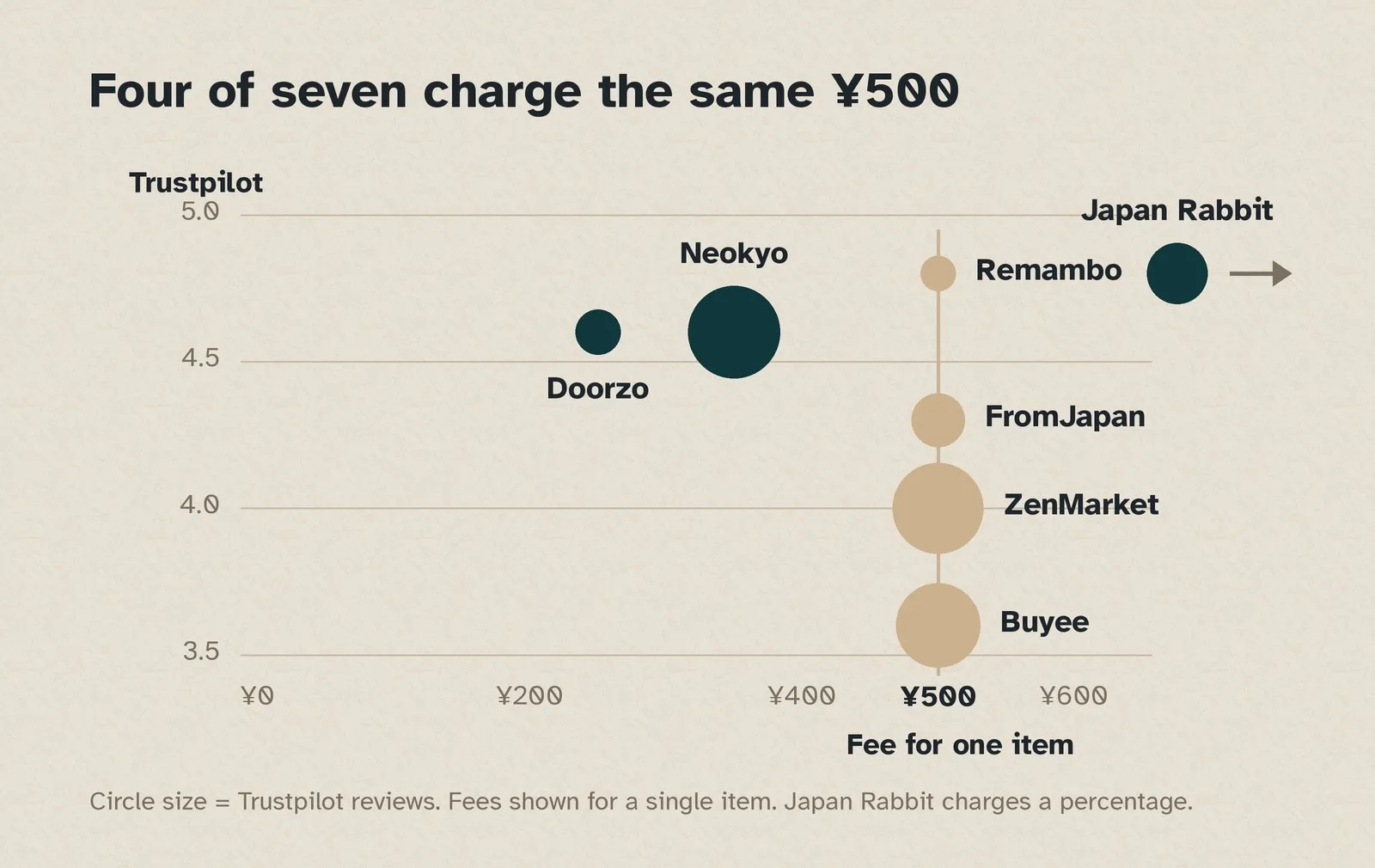
Line up the Trustpilot scores (checked August 24, 2026) and a different ranking emerges than the price table suggests.
| Service | Trustpilot | Reviews | What Reddit says |
|---|---|---|---|
| Japan Rabbit | 4.8 | 3,125 | Outstanding packaging; fees and DHL rates run high |
| Remambo | 4.8 | 426 | Too few data points to judge |
| Neokyo | 4.6 | 10,008 | No recurring complaint pattern, rare in this market |
| Doorzo | 4.6 | 1,161 | Easy to use; note the company itself is active on Reddit, so posts skew positive |
| FromJapan | 4.4 | 2,083 | Careful packaging; fees stack up on multi-seller orders |
| ZenMarket | 4.0 | 9,493 | Support quality praised; cancellation fees and repacking delays criticized |
| Buyee | 3.6 | 8,005 | The biggest name, the lowest score |
The headline here is Buyee: the most-searched proxy service in the US sits at the bottom of the table. Dig into user reports and the complaints collapse into three patterns:
- Currency conversion spread. We have since measured this across all seven services. Three convert at their own rate (4.88% to 5.04% above market), and two add nothing at all because they bill in yen. Buyee’s own page carries both the market rate and the customer rate side by side.
- The insurance gap. Buyers with insurance report refunds far below their actual loss: in one documented case, ¥250 back on a ¥3,500 loss.
- Fee stacking. Per-order fees plus protection plans plus packing options can exceed the price of the items themselves. (Consolidation itself has been free since December 2022.)
ZenMarket’s 4.0 needs a footnote too. The top complaints are cancellation fees that can exceed the item price and repacking delays when you change shipping methods, yet its customer support is praised as “worth paying a bit more for.” If your priority is not getting stonewalled when something breaks, that trade reads differently.
A worked example: three Mercari items, one box
Fee tables don’t convey much until you run a purchase through them. Say you buy three ¥2,000 items on Mercari Japan and have them consolidated into one box. Service fees only, item prices and international shipping excluded:
| Service | Calculation | Total fees |
|---|---|---|
| Doorzo | ¥200 × 3 + free consolidation | ¥600 |
| FromJapan | ¥500 × 3 + free consolidation | ¥1,500 |
| Buyee | ¥500 × 3 + free consolidation | ¥1,500 |
| Remambo | ¥500 × 3 + free consolidation | ¥1,500 |
| Neokyo | ¥350 × 3 + ¥500 packing fee | ¥1,550 |
| ZenMarket | ¥800 × 3 (Mercari rate) + free consolidation | ¥2,400 |
| Japan Rabbit | Sliding scale, not calculable ($5 minimum) | — |
Assumes one item = one order, per each service’s Mercari terms. International shipping adds roughly ¥2,000–5,000 by weight with any service, so fees are only part of the total.
One item = one order is not a quirk of the table above. It is structural to Mercari (individuals list one item each, so five items means five sellers), and it is why flat-per-order pricing saves real money on Yahoo! Auctions and almost nothing on Mercari. Mercari also launched its own overseas route in June 2026, which publishes no fee at all; we measured it at a flat $4.65 per item plus a 6.2% currency spread.
Same shopping cart, up to a ¥1,800 spread in fees. But cheap doesn’t automatically mean right: ZenMarket’s ¥2,400 buys free consolidation and the best-regarded support in the group, while Doorzo’s ¥600 comes with a reputation that’s harder to independently verify.
The seven services in brief
Buyee, Official partner of Yahoo! Auctions and Mercari Japan, with the widest site coverage (30+ marketplaces). The interface is the easiest entry point for beginners. But the 3.6 Trustpilot score reflects real friction: compensation disputes and stacking fees. Note the fee rose from ¥300 to ¥500 in April 2026. Read our full Buyee review for the complete fee table and how to use it cheaply.
ZenMarket: “No hidden fees,” free consolidation, 60-day storage. The community consensus pick for Yahoo! Auctions. Mercari and Yahoo! Auctions cost ¥800/item here (the highest in this comparison) and read the cancellation policy before you bid. Read our full ZenMarket review for what the ¥800 includes and how the deposit system works.
Neokyo: ¥350 flat and the only service in our research with no recurring complaint pattern. Users praise the bubble-wrap-and-waterproof packaging and fast Discord support. Shipping options for oversized items are limited.
FromJapan: In business since 2004. ¥500 per item, bundled: the fee carries 60-day storage, free consolidation, an inspection check and both domestic and international shipping insurance. Multiple units of the same item count as a single fee, but separate items each pay ¥500, so the per-item price is not the multi-item bargain it looks like. Packaging gets good marks.
Doorzo, The lowest fee band and a genuinely simple ordering flow. One caveat: the company participates actively in its own Reddit community, so discount the enthusiasm accordingly. Start with a small test order.
Remambo: Free consolidation, 60-day storage, discounted EMS. The catch: outside its 426 Trustpilot reviews, user voices are scarce. For people who buy on terms, not testimonials.
Japan Rabbit, Formerly White Rabbit Express, running since 2005. The $5 minimum stings, but the community verdict is consistent: for fragile, expensive items, this is the one. Claims to handle nearly any Japanese site. No PayPal.
Head-to-head: which two are you choosing between?
Almost nobody compares seven services. You narrow it to two and then stall. Here is where each pairing lands, using the same 2kg-to-the-US quotes we pulled from every official calculator in July 2026.
Buyee vs ZenMarket: Buyee wins on total cost to the US, and not narrowly: the identical 2kg parcel came out ¥3,119–6,199 cheaper, which swamps ZenMarket’s higher per-item fee entirely. ZenMarket keeps the edge on Yahoo! Auctions bidding and 19-language support. Full breakdown with three worked examples.
Doorzo vs Neokyo: Doorzo’s fee is lower (¥200–300 against a flat ¥350), but its cheapest shipping (¥3,300 surface mail) is locked behind an $800 order minimum for US addresses. Neokyo’s DHL Express at ¥4,998 is the cheapest courier rate of any service we measured. Full breakdown.
Doorzo vs ZenMarket, Not close on cost. Doorzo’s fee tops out at ¥300 where ZenMarket charges ¥800 for Mercari and Yahoo! Auctions, and Doorzo’s ECMS air quoted ¥4,278 against ZenMarket’s ¥6,409 for the same parcel. ZenMarket’s case is service depth: insurance inside the fee, free consolidation, 60-day storage, a documented auction deposit system. One hard constraint decides it for some buyers: only Doorzo carries Amiami, Lashinbang and Book Off. One number sits outside both fee tables: Doorzo bills Japan domestic postage separately, and on two Book Off listings at the same ¥8,800 price we saw ¥600 and ¥1,000. Full breakdown, and the cart types that flip the winner.
Doorzo vs Buyee, The closest of these matchups. Buyee’s ECMS at ¥3,290 is the cheapest air route we found anywhere, ¥988 under Doorzo’s. Doorzo answers with a lower fee ceiling, ten orders consolidated free, and ¥3,300 surface mail once an order clears $800. Then it comes down to catalogue: Buyee’s 30+ marketplaces and official Mercari partnership against Doorzo’s grip on anime and second-hand hobby stores. Then the currency reverses the ranking: Buyee marks up the exchange rate by 4.88%. Full breakdown.
Buyee vs FromJapan: Both charge ¥500, and on a single uninsured item the totals land thirty cents apart. Two things separate them. FromJapan’s ¥500 is a protection plan with 60-day storage, consolidation, an inspection check and shipping cover inside it, where Buyee sells the equivalent as a ¥500 plan on top of its fee. Then the unit decides it: FromJapan charges per item and Buyee per order, so five items from one store is ¥2,500 against ¥500. Full breakdown of both reversals.
Doorzo vs FromJapan, The fee gap is narrower than the tables suggest. Doorzo’s ¥200–300 excludes protective packing (¥100–300 inner by weight plus ¥200 outer), so one item runs ¥500–800 against FromJapan’s flat ¥500, and at Doorzo’s ceiling the cheaper fee is the dearer total. Shipping then splits them in opposite directions: Doorzo’s ECMS is ¥475 under FromJapan’s, but its DHL is ¥2,000 over, and on DHL FromJapan takes the total outright at one and three items. Storage inverts as well: FromJapan’s 60 days cannot be extended and ends in disposal, while Doorzo’s drops to 15 once consolidated but sells 30 more back at ¥50/kg/day. And what FromJapan’s ¥500 insures excludes secondhand condition by name. Full breakdown.
FromJapan vs Neokyo: Neokyo’s ¥350 is the lower fee until you find the packing line: ¥500 on every parcel, so one item costs ¥850 against FromJapan’s flat ¥500. Neokyo overtakes at the fourth item, and again on order value. It bills in yen where FromJapan marks the rate up 5.04%, so past roughly ¥14,500–24,500 of goods Neokyo wins regardless. What each ¥500 buys is the inversion: Neokyo’s includes insurance and tracking but its fee page states it does not inspect or authenticate, where FromJapan’s does include an inspection. And the one selling inspection gives you seven days to claim damage against Neokyo’s five months. Full breakdown.
Looking for a ZenMarket alternative?, The usual reason is shipping. ZenMarket quoted ¥11,334 for 2kg by DHL where Neokyo quoted ¥4,998 and Buyee ¥5,135, more than double either. If cost is what’s pushing you out, Buyee is cheapest on air freight and Neokyo cheapest on express courier. If it’s something else, be aware that ZenMarket’s included insurance and free consolidation are genuinely hard to replace at the ¥350–500 tier. We ran the full head-to-head, fees, shipping and protection, in ZenMarket vs Neokyo.
Five rules before you order
- Compare totals, not fees. Get the full quote (international shipping and payment rate included) before judging any service cheap.
- Read the cancellation policy first. Especially for auctions: assume a winning bid cannot be undone.
- Check what insurance actually covers. “Insured” does not mean “made whole.” Confirm the ceiling and the covered cases.
- Calendar your storage deadline. Free periods (30–60 days) roll into daily extension charges.
- Start small. One cheap test order tells you more about fit than any review, including this one.
FAQ
What is the cheapest Japan proxy service? By fee per item: Doorzo (¥200–300), then Neokyo (¥350), with Buyee, ZenMarket, Remambo and FromJapan all at ¥500. Always compare the full quote including international shipping and consolidation, the fee is only part of the total.
Is Buyee legit? Yes, it’s the official proxy partner of Yahoo! Auctions and Mercari Japan, not a scam. But its Trustpilot score (3.6 from 8,005 reviews as of August 2026) is the lowest of the seven services we compared, with complaints centering on compensation amounts and stacking fees.
Which proxy is best for Yahoo! Auctions Japan? The consistent community answer is ZenMarket, with FromJapan as runner-up.
Which proxy is safest for expensive figures? Japan Rabbit has the strongest packaging reputation among users, at a higher price.
Doorzo or ZenMarket, which is cheaper? Doorzo, on both axes. Its fee tops out at ¥300 against ZenMarket’s ¥800 for Mercari and Yahoo! Auctions, and its ECMS air quoted ¥4,278 for a 2kg parcel to the US against ZenMarket’s ¥6,409. ZenMarket earns its price on service depth: insurance inside the fee, free consolidation, 60-day storage. Note that only Doorzo carries Amiami, Lashinbang and Book Off.
Doorzo or Buyee, which is cheaper? It depends on the route. Buyee’s ECMS at ¥3,290 for 2kg to the US is the cheapest air freight we found from any service, ¥988 below Doorzo. Doorzo’s fee ceiling is lower (¥300 vs ¥500 per order), it consolidates ten orders free, and ¥3,300 surface mail opens up once your order value clears $800.
What is a good alternative to ZenMarket? Usually the reason for switching is shipping cost. ZenMarket quoted ¥11,334 for 2kg by DHL, where Neokyo quoted ¥4,998 and Buyee ¥5,135. Buyee is cheapest on air freight, Neokyo cheapest on express courier. If you’re switching for another reason, ZenMarket’s included insurance and free consolidation are hard to match at the ¥350–500 fee tier.
The bottom line
Choosing a proxy isn’t about finding the single best service, it’s about matching one to your cart. Mercari-heavy, auction-heavy, fragile grails, bulk hauls: go back to the table at the top and find your row. All figures here are as of July 2026, and fees do change (two services raised theirs in the last three years). Confirm on the official quote screen before you buy.
One caveat this table does not cover: if you are buying expensive goods, the selection criteria change entirely. Compensation ceilings, authentication, and (since July 2026) duty on every parcel regardless of value matter more than the fee per item. See our guide to luxury proxy shopping from Japan for those figures.
A second caveat: the cheapest route may not carry your item at all. ECMS (the ¥3,290 air route quoted above as the cheapest we found anywhere) will not accept knives to the US, Australia or Canada, and Japan Post lists every blade, cooking knives included, as a prohibited article for the United Kingdom. See shipping a knife home from Japan for the six-country breakdown, and for the case where buying direct from the shop beats a proxy outright.
Alcohol is the one category where none of this helps: Japan Post files it as a dangerous good and refuses it by every class of mail including surface, and it is prohibited outright to the United States. Why whisky has to fly home in your luggage sets out what is left.
A third caveat, and the one that catches most people: for some categories a proxy is not the shortest route. Japanese denim is the clearest case. Four of the seven mill brands run their own English store, one Japanese specialist retailer beat the brands’ own international prices in 56 of 57 matched products, and two brands state they will or may cancel an order routed through a forwarder. Which Japanese denim brands ship internationally works the same jean through all three routes to the amount that leaves your card.
Knives and alcohol are the two categories people check. The lists these services publish run much wider, and they do not agree with each other: perfume, aerosols, nail polish, loose batteries, and at one service disposable body warmers and hair dye. What Japan proxies won’t ship sets five of those lists side by side, and traces the numbers on them back to Japan Post.
Electronics add a fourth problem, and it is not about shipping at all: the manufacturer’s warranty stops at a Japanese address, and no service here checks that the item works before it goes in the box. What happens when a Japanese gadget breaks reads the manufacturers’ terms alongside the proxies’.
Ceramics are a third case, and a stranger one: nothing in the rules stops them, yet every carrier excludes damage arising from the item’s own nature, and the five services here answer the question in five different ways, one of them by declining to buy fragile goods at all. Who pays when pottery breaks reads all six sets of terms side by side.
Food is stricter still. ECMS refuses perishable goods to every destination and food generally to the US and Australia; three of the five services here refuse chilled and frozen items in writing; and Japan Post’s refrigerated service does not reach the US, UK, Canada, Australia or New Zealand at all. What food you can actually bring home sets out which of the two routes (suitcase or parcel) each category survives.
Batteries draw a line of their own, and it falls in a place most buyers never check. Japan Post carries lithium cells only when they are built into the device, and it will not carry them to the United Kingdom by any class of mail, EMS, airmail or surface. A courier still will, which makes the choice of carrier the whole question. Whether Japanese gadgets work abroad goes through the voltage question as well, and finds that only three products in twenty need a transformer.
Those last four cases share a shape. None of them is decided by the service you picked, which is why moving to another one leaves them exactly where they were. We separated the problems a switch solves from the ones it cannot in Japan proxy alternatives: what switching actually fixes.
And if you have the service picked but not the item yet: our 20 Japanese gifts with live prices and 20 Japanese gadgets from $6 to $970 both list stores that ship worldwide: along with the things no store will sell you at all, like regional-exclusive KitKats and Ichiban Kuji prize figures, which only a proxy can reach.