What's in this guide12 sections
Quick answer
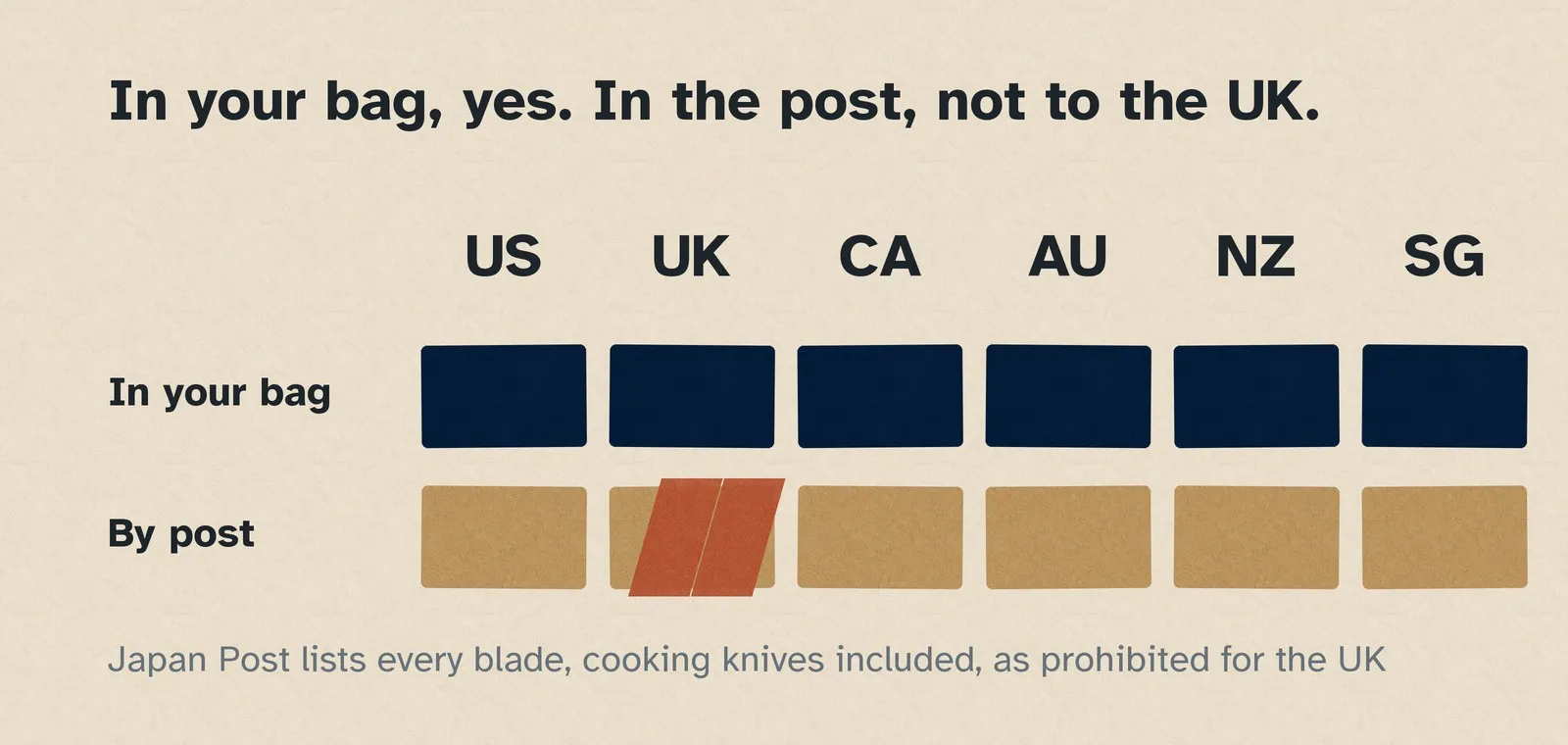
Carrying a knife home is easy. Shipping one is not. In all six countries we checked (the US, UK, Canada, Australia, New Zealand and Singapore), a kitchen knife is not a prohibited weapon, and it travels legally in checked baggage. Cabin baggage is refused everywhere, without exception. Shipping is a different story, and it fails for three unrelated reasons: Japan Post lists every blade, cooking knives included, as a prohibited item for the United Kingdom across ordinary mail, parcels and EMS; ECMS (the cheapest courier in our own measurements at ¥3,290) will not accept knives to the US, Australia or Canada; and the five main proxy shopping services do not agree with each other, with two of them saying nothing about blades at all. If a shop ships internationally, buying direct usually beats a proxy: Kama-Asa ships free to the US over $200 and pays the customs duty itself. As of August 2026.
Knives cannot go in cabin baggage. Every traveller knows this, which is why the person holding a newly bought santoku reaches the same conclusion within about four seconds: fine, I’ll have the shop mail it.
That instinct has the order backwards.
Carrying it home turns out to be the easy path. In all six countries we checked, a cooking knife is not on the prohibited weapons list, and checked baggage settles the matter.
Mailing it runs into three walls. One country refuses blades in the post. The cheapest courier refuses them to three countries. And the proxy services that exist precisely to ship things out of Japan have not agreed on what to do with a knife.
Below is where each wall sits, taken from government statutes and the companies’ own published pages.
Taking one home is the easy part
Travel forums are full of confiscation stories, and they leave people with the impression that Japanese blades need an export permit.
From the Japanese side, they do not. Japan’s Firearm and Sword Control Law regulates swords: defined as blades of 15cm or longer for swords, spears and naginata, or 5.5cm or longer for daggers and switchblades. The Cabinet Office states plainly that cutlery which falls outside that definition, such as cooking implements, is “not regulated” for possession (Cabinet Office). A santoku, a gyuto and a yanagiba all sit outside it.
The question is what the receiving country says. Read the statutes, and they are more relaxed than their reputations.
| Country | Kitchen knives | Source |
|---|---|---|
| United States | Not restricted. Federal law bans only blades that open automatically by button or spring | 15 U.S.C. §1241 |
| United Kingdom | Not on the prohibited list | gov.uk, offensive weapons |
| Canada | Automatic, centrifugal and push-dagger knives are prohibited; fixed-blade kitchen knives are not | CBSA |
| Australia | Import controls cover daggers, blowpipes, throwing stars and similar. Cooking knives are not in the list | ABF |
| New Zealand | Prohibited schedule covers flick knives, butterfly knives, bayonets and concealed blades. Kitchen knives are absent | Offensive Weapons Order 2021, Sch. 2 |
| Singapore | Police guidance names “Domestic / Culinary / Kitchen Knife” as “Not regulated by Police” | SPF guideline, 26 Dec 2025 (PDF) |
Singapore was the surprise. It has a reputation for severity with blades, and the severity is real, but it is aimed narrowly. Flick knives, butterfly knives and throwing knives are Type 1 weapons, barred from import and possession outright. Machetes, parangs and hunting knives are Type 3, permitted only against specific exemption criteria. The knife you cook with is in neither tier.
The UK statute is the one worth reading twice. Its prohibited list includes an entry for “stealth knives,” which sounds ominous until you reach the definition: a blade not made of metal and not made for domestic, food-preparation or toy use. The exemption is buried inside the definition rather than stated separately, so skimming the list produces the opposite of its meaning.
One caveat applies regardless. Not being prohibited is not the same as requiring nothing. New Zealand obliges arriving travellers to declare all weapons to Customs, and a knife that is legal to import is still a knife you must declare.
Cabin baggage: no. Checked baggage: yes, with one exception
Statutes and airport security are separate systems, and they do not always say the same thing.
On cabin baggage, all six agree: no. The US TSA sends every blade except a round-ended butter knife to checked baggage (TSA). Singapore’s CAAS refuses knives in the cabin “regardless of the reason” (CAAS). Australia’s aviation security rules name “Knives,” “Meat cleavers” and “Metal cutlery” as prohibited items (Home Affairs).
Australia is instructive because those two rules live in different legislation. Under border control, a kitchen knife is not a weapon. Under aviation security, it is a prohibited cabin item. Both are correct at the same time. Read only the ABF page and you will conclude Australia is relaxed about knives, then get stopped at the gate.
Checked baggage is permitted almost everywhere. One country changes its answer depending on where you are flying.
Canada. Under CATSA rules, knives with blades of 6cm or less may travel in the cabin on domestic flights and on international flights, except flights to the United States, where no knife of any length is permitted in the cabin (CATSA). If your route home connects through a US airport, the 6cm allowance does not help you.
New Zealand draws the same 6cm line, but without the destination split: over 6cm goes in checked baggage, under 6cm may travel in the cabin (CAA).
No kitchen knife comes close to that line anyway. A standard santoku blade runs 165–180mm; a gyuto is often 210mm. In practice every rule above collapses into a single instruction: the knife goes in checked baggage, with the edge protected by a saya, a sheath or packing material. The TSA asks for that protection explicitly.
Shipping runs into three separate walls
So far the knife is an easy souvenir. Now the difficulty starts.
Suitcase full. Bought it on the last day. Or (the most common version) you got home and remembered the one you did not buy. This is the point where shipping becomes the plan, and the point where you discover it is harder than carrying.
Wall 1: Japan Post will not carry blades to the UK
Japan Post publishes prohibited items country by country. The United Kingdom entry reads:
Item: Blades Applicable services: Ordinary mail, parcels, EMS Classification: Prohibited article Detail: Anything with a blade. Items with a blade used for cooking, hobby, trade, gardening, farming or any other purpose (including replicas).
Ordinary mail, international parcels and EMS, all three. And “cooking” is named (Japan Post, UK conditions).
British law, as we saw, does not list cooking knives as prohibited. Carry one through the airport and nothing happens. Post the same knife and it cannot be sent. The same object flips from allowed to forbidden depending on how it moves.
The US and Australian entries carry no equivalent blanket ban. The American list covers sharp implements for cockfighting and a conditional allowance for switchblades; the Australian list has no blade entry at all.
This wall belongs to the UK specifically. For British readers it is the binding constraint of the whole article.
Japan Post also runs a two-tier packing rule. Items meeting the legal definition of a sword require a special “weapons label” plus a sheath (Japan Post). Kitchen knives, scissors and box cutters need no such label. Protective packing in a sheath or case is enough (Japan Post). Even in the postal rules, a knife is treated more lightly than a sword.
Wall 2: The cheapest courier does not take knives
Proxy services let you pick a carrier, and one of them (ECMS) is frequently the cheapest.
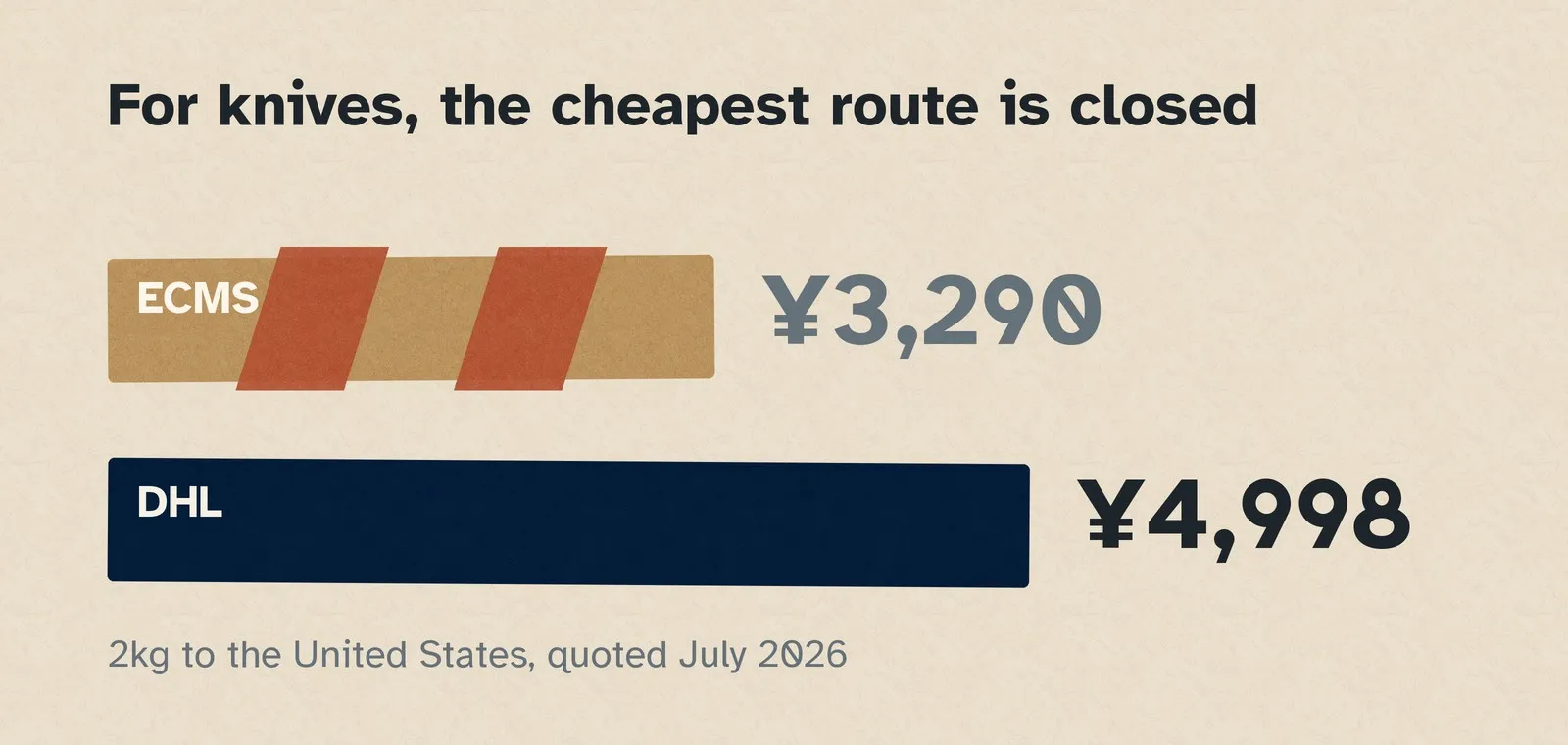
Here is what we measured in July 2026, quoting an identical 2kg parcel to the United States through each service’s own calculator. (The full working is in our Doorzo vs Neokyo comparison.)
| Service | ECMS | DHL | FedEx |
|---|---|---|---|
| Buyee | ¥3,290 | ¥5,135 | ¥5,405 |
| ZenMarket | ¥6,409 | ¥11,334 | ¥8,612 |
| Neokyo | — | ¥4,998 | ¥6,589 |
Buyee’s ECMS at ¥3,290 is the floor across all four services we priced.
Then read ECMS’s own list of goods it will not accept. Under the United States: “Blades in general”, with the note “including kitchen knives.” Australia and Canada are refused too, under “knives and weapons.” Korea alone draws a length line (no blade over 6cm), which no kitchen knife survives (ECMS Japan, prohibited items).
The cheapest option disappears specifically for knives. What remains is DHL or FedEx, and on our 2kg measurement the best of those is Neokyo’s DHL at ¥4,998, ¥1,708 above the floor. That is small against the price of a good knife. The more useful fact is that “proxies are cheap to ship with” stops being true for this one category.
Two carriers we could not pin down. A DHL document that appears to be written for the UK market lists “bladed items including but not limited to knives and cutters” among goods it will not carry, but we could not retrieve DHL Express Japan’s own page to confirm the same rule applies to shipments leaving Japan. FedEx’s prohibited-items page blocked automated access entirely. We are not going to state a rule for either.
Wall 3: The five proxy services do not agree
The last wall is the services themselves.
Five companies doing the same job (buy in Japan, ship abroad), and no two of them handle blades the same way.
| Service | What the official page says | What it means |
|---|---|---|
| Neokyo | Lists “Weapons (Swords, blades, guns, etc.)” as prohibited. Adds a separate ban on “Knives, Camping Knives, Survival Knives” for EU and European destinations by FedEx | The clearest refusal of the five |
| FromJapan | Lists “Fake swords / Swords” as export-prohibited. The word knife never appears | Swords are out. Kitchen knives are not addressed |
| Doorzo | Prohibits “imitation knives, and all types of swords” | Replicas and swords. Real cooking knives are not named |
| Buyee | No blade entry. “Sword Replica” and “Airguns” appear. Country pages defer to Japan Post’s prohibited list | The decision is delegated to the carrier’s rules |
| ZenMarket | No blade entry. We read the full page and found no knife-specific condition and no length threshold | The page does not answer the question |
Sources: Neokyo, FromJapan, Doorzo, Buyee, ZenMarket.
Only Neokyo refuses in plain words. The rest stop at “swords,” or say nothing.
Buyee’s structure explains some of the vagueness. Its country pages hold no independent standard and link straight to Japan Post’s per-country prohibited list, the decision is delegated to the carrier. On that logic, UK-bound knives are automatically out and US-bound knives go through. In theory. Our Buyee review covers how the rest of its rules work.
User forums, though, carry repeated reports of Buyee declining knife shipments. Those are accounts of individual support decisions, not a published rule, and Buyee’s own pages state no general position. Official text and actual practice may diverge here. That is as far as the evidence goes.
So how do you actually ship one?
Stack the three walls together and the proxy route narrows considerably. The UK is closed by post, the cheapest carrier is out, and the services themselves are unreadable.
There is another route: buy from the shop and let the shop send it.
Kama-Asa in Kappabashi runs an English storefront. Its shipping policy states:
- United States: free shipping on orders over $200
- United States customs duty: covered by Kama-Asa
- Other countries: shipping calculated at checkout, duties paid by the customer
- EU customers directed to a separate store
For an American buyer that is not a close contest. A proxy order carries the item price plus a purchase fee, domestic postage, international shipping from ¥4,998, and 10–12.5% duty on arrival. Buy direct above $200 and both the shipping and the duty go to zero.
We write proxy service comparisons for a living, and this is still the honest answer: for US-bound knives, buying direct wins. Proxies earn their fee when a shop does not ship abroad at all, or when the thing you want is second-hand, listed on an auction, or sold only through a domestic marketplace. For a new knife from an English-speaking specialist shop, there is no gap for a middleman to fill.
The conditions are narrow, though. For every country other than the US, shipping is charged and duty falls on the buyer, and the advantage evaporates. For the UK and the EU, Japan Post is unavailable in any case, so everything depends on which courier the shop uses: and, as noted above, we could not confirm how DHL and FedEx treat blades out of Japan.
Other shops differ. Tsubaya in Kappabashi ended its “free shipping over ¥30,000” offer on 30 June 2026, citing freight and packaging costs; the replacement rates are not published and require an enquiry (Tsubaya). Tsukiji Masamoto ships internationally by EMS, priced by weight, quoted case by case (Tsukiji Masamoto).
Tax-free shopping changes on 1 November 2026
Since we are talking about buying in person, the consumption tax is worth a paragraph, because it is about to work differently.
Today, and until the end of October 2026, tax-free shops sell to visitors at the pre-tax price on the spot. From purchases made on 1 November 2026, Japan switches to a refund model: you pay the tax-inclusive price in the shop, have the goods verified by Customs when you leave the country, and receive the consumption tax back afterwards (National Tax Agency, Japan Tourism Agency).
The same change removes the split between “general goods” and “consumables.” The current rules set general goods at ¥5,000 and up, and consumables between ¥5,000 and ¥500,000 with mandatory sealed packaging. From November both collapse into a single ¥5,000 threshold with no packaging requirement (Ministry of Finance).
Which category a knife falls into is not stated anywhere we could find. The consumables definition covers food, drink, medicine and cosmetics (things consumed), so a knife should be general goods. That is an inference from the definition, not a confirmed classification.
What it means in practice depends on when you travel. Arrive in October 2026 and you pay the pre-tax price at the till. Arrive in November and you pay the full 10% first and claim it back on departure, the same money in the end, but more of it out of your pocket while you are still in the country.
Where to buy
Knife shopping in Japan concentrates in a few places: Kappabashi and the Tsukiji Outer Market in Tokyo, and Sakai in the Kansai region.
Kama-Asa (Kappabashi) has the English site and the international shipping terms described above. Tsubaya (Kappabashi) states that English-speaking staff are on hand and ships abroad, though the free-shipping threshold is gone. Kamata Hakensha (Kappabashi) maintains English pages and engraves names by hand at no charge (Kamata).
In Tsukiji, Tsukiji Masamoto sits in the outer market, engraves free of charge (on the centre of the blade for Japanese knives, on the bolster for Western ones), and has a record of shipping overseas.
Sakai comes with a naming trap. Sakai Ichimonji Mitsuhide carries the Sakai blade tradition, but its main shop is not in Sakai. It is in Chuo-ku, Osaka, on Doguyasuji, five minutes from Namba Station (Ichimonji). For a shop actually inside Sakai City, the Sakai Densho-kan is the address (Sakai Densho-kan). Worth knowing before you build a day around the trip.
One thought on engraving. A knife with your name on it cannot be returned or resold. That is no obstacle if you are carrying it home. If you are shipping it to a country where it might be stopped, settle the question of whether it can arrive before you have it engraved.
FAQ
Can I bring a knife back from Japan?
Yes, in checked baggage. In all six countries we checked (the US, UK, Canada, Australia, New Zealand and Singapore), a kitchen knife is not a prohibited weapon. Cabin baggage is refused everywhere. Protect the edge with a sheath or packing material; the TSA requires this explicitly.
Can I bring a knife back from Japan to the UK?
In your luggage, yes, UK prohibited weapons rules do not list cooking knives. By post, no. Japan Post classifies every blade, cooking knives included, as a prohibited article for the United Kingdom across ordinary mail, parcels and EMS.
Can I put a Japanese knife in my carry-on?
No. Every country we checked refuses knives in cabin baggage, and a standard santoku blade of 165–180mm is far beyond the 6cm allowance that Canada and New Zealand apply to small knives. Note that Canada bans knives of any length in the cabin on flights to the United States.
Do I need a permit to take a knife out of Japan?
No. Japan’s Firearm and Sword Control Law covers swords: blades of 15cm or more for swords and spears, 5.5cm or more for daggers and switchblades. The Cabinet Office states that cutlery outside that definition, such as cooking implements, is not regulated for possession.
Can a proxy service ship a knife to me?
It depends on the service and the destination, and the services do not agree. Neokyo prohibits blades outright. FromJapan and Doorzo name swords and replicas but not kitchen knives. Buyee and ZenMarket say nothing about blades at all, and Buyee defers to Japan Post’s country rules. Separately, ECMS (usually the cheapest carrier) refuses knives to the US, Australia and Canada.
Is it cheaper to ship a knife or carry it home?
Carrying it costs nothing beyond the space in your bag. Shipping through a proxy runs from ¥4,998 for a 2kg parcel to the US by DHL, plus fees and 10–12.5% duty. If the shop ships internationally, buying direct is often cheapest of all: Kama-Asa ships free to the US over $200 and covers the duty.
When does Japan’s tax-free system change?
On 1 November 2026. Purchases from that date use a refund model: you pay tax-inclusive in the shop and reclaim the consumption tax after Customs verification on departure. The general goods and consumables categories merge into a single ¥5,000 threshold at the same time.
The bottom line
Carrying a knife home from Japan is simple. Six countries, no legal obstacle, checked baggage, edge protected. Done.
Shipping is where it gets difficult. The UK is closed by post. The cheapest courier refuses blades to the US, Australia and Canada. The five proxy services have five different positions, two of which are silence. The three walls have nothing to do with each other, so clearing one just puts you in front of the next.
Which sets the order of operations. If it fits in the suitcase, put it in the suitcase. If it does not, buy from a shop that ships internationally, for US buyers that is very likely the cheapest route available. Reach for a proxy service when the shop will not ship, or when what you want is second-hand or on an auction. Our breakdown of proxy fees covers what that route costs once every charge is counted.
The same suitcase-first rule turns out to hold for Japanese food, and for a blunter reason: Canada forbids meat by post in the wording of the rule itself, and no refrigerated postal route leaves Japan for any of these six countries except Singapore.
One thing we could not settle. Singapore added machetes to its regulated list under legislation that took effect in July 2025, and we could not determine from official sources whether a long yanagiba falls within that classification. If you are taking a Japanese blade of 240mm or more into Singapore, ask first.
What we could not confirm
Shipping figures are from July 2026 for a 2kg parcel to the United States, quoted on each service’s own calculator. A single knife weighs closer to 1kg once packed, so real quotes should come in below these numbers. The ranking between carriers is the durable part, not the absolute values.
Open questions: whether FedEx accepts blades out of Japan (its site blocked all automated access); whether DHL Express Japan applies the same blade restriction as the UK-market document we found; whether Buyee’s published silence on knives matches its actual practice; whether a kitchen knife is formally classified as “general goods” for tax-free purposes; whether Singapore’s machete rules reach long Japanese blades; and the current shipping rates at Tsubaya following the end of its free-shipping offer.