
What's in this guide14 sections
Quick answer
Three of the seven major Japan proxy services convert your money at their own rate, and none of them publish the spread. Buyee's own page carries both numbers side by side: a market rate of ¥157.48 to the dollar and a customer rate of ¥150.15, a 4.88% spread. ZenMarket and FromJapan sit at ¥150.00 and ¥149.93. Neokyo and Remambo charge nothing on currency because they bill in yen and let your card or Stripe do the conversion. Japan Rabbit bills in USD only and states plainly that it cannot guarantee the rate, so the spread cannot be measured at all. The practical consequence: the three services charging ¥500 (Buyee, ZenMarket and FromJapan) all bill in foreign currency, and on a ¥30,000 order their totals land at $203.13, $203.33 and $203.43, thirty cents apart. Neokyo and Remambo bill in yen and come in at $195–199, more than eight dollars cheaper. The ¥500 fee is about $3.16; the difference in how the currency is handled is 2.6 times that. Fees verified 11 August 2026; rates measured 3 August 2026, 12:27 JST. Shipping and duties are on top of every number here.
Buyee charges ¥500 per order. It says so on its fee page, and we put that number in our seven-way comparison.
Say you buy a ¥30,000 item. That ¥500 works out to $3.33 at the day’s rate.
On the same order, the exchange rate added $9.30. Nearly three times the fee.
The fee page says nothing about that $9.30.
Two exchange rates, on the same page
We found it by accident.
We had Buyee’s Mercari listing page open to work out how prices are rendered. Twenty-seven currencies are embedded in the page. That much is unsurprising, the site switches display currency, so it needs rates.
But there were two of them.
| Field | Value |
|---|---|
oandaRate | ¥157.48 per USD |
rate | ¥150.15 per USD |
OANDA is a foreign exchange data company. So the first is the market rate, and the second is what customers are charged.
The gap is ¥7.33, or 4.88%.
This is not an estimate. Buyee puts both numbers on its own page.
Three ways proxies handle your currency
We checked all seven the same way. We expected a ranking of who charges most. What came out was a different shape.
The seven do not disagree about the size of the spread. They disagree about whether to have one.
- Convert at their own rate: Buyee, ZenMarket, FromJapan
- Bill in yen: Neokyo, Remambo
- Bill in USD only and do not publish the rate: Japan Rabbit
The first group is where that 4.88% lives. It rides on the item price itself, so it never appears in a fee column. All three sit within twenty-two sen of each other: ¥150.15, ¥150.00, ¥149.93. Measured against one reference (the ¥157.48 OANDA rate Buyee publishes on its own page), those are spreads of 4.88%, 4.99% and 5.04%. The three are nearly identical.
The second group takes nothing on currency. Your card issuer or Stripe sets the rate, and the proxy is not part of it.
The third is the awkward one. There is no yen figure to check, because you cannot pay in yen. The conversion happens on their side, and you cannot see the rate before you commit.
The fee is identical. The total is not.
All three charge ¥500, Buyee per order, ZenMarket and FromJapan per item. Buy one thing and the fees are identical to the yen.
The rates are not. Buyee applies ¥150.15, ZenMarket ¥150.00, FromJapan ¥149.93, spreads of 4.88%, 4.99% and 5.04% against the same reference.
On a ¥30,000 order those three spreads separate the totals by thirty cents. The fee is no longer a tiebreaker, and neither is the spread. What decides it is a line drawn somewhere else entirely.
FromJapan is also the only one that documents where its rate comes from:
"rate":"0.00663",
"rate_upd_date":"2026-08-03 12:20:05",
"rate_upd_method":"oanda.com"
Updated seven minutes before we read it. Source: oanda.com.
Buyee’s market reference was OANDA too. Both start from the same feed and mark it up independently.
What you actually pay
Fees and currency spread, added together.
For the two that bill in yen, we show a range: card issuers typically charge 1.6–3% on foreign transactions, and that applies instead of a proxy spread.
On a ¥30,000 item
| Service | Billed in | Fee | Total you pay |
|---|---|---|---|
| Neokyo | Yen | ¥350 | $195.14–197.83 |
| Remambo | Yen | ¥500 | $196.11–198.81 |
| Buyee | Foreign | ¥500 | $203.13 |
| ZenMarket | Foreign | ¥500 | $203.33 |
| FromJapan | Foreign | ¥500 | $203.43 |
At the market rate, the item alone is $189.85.
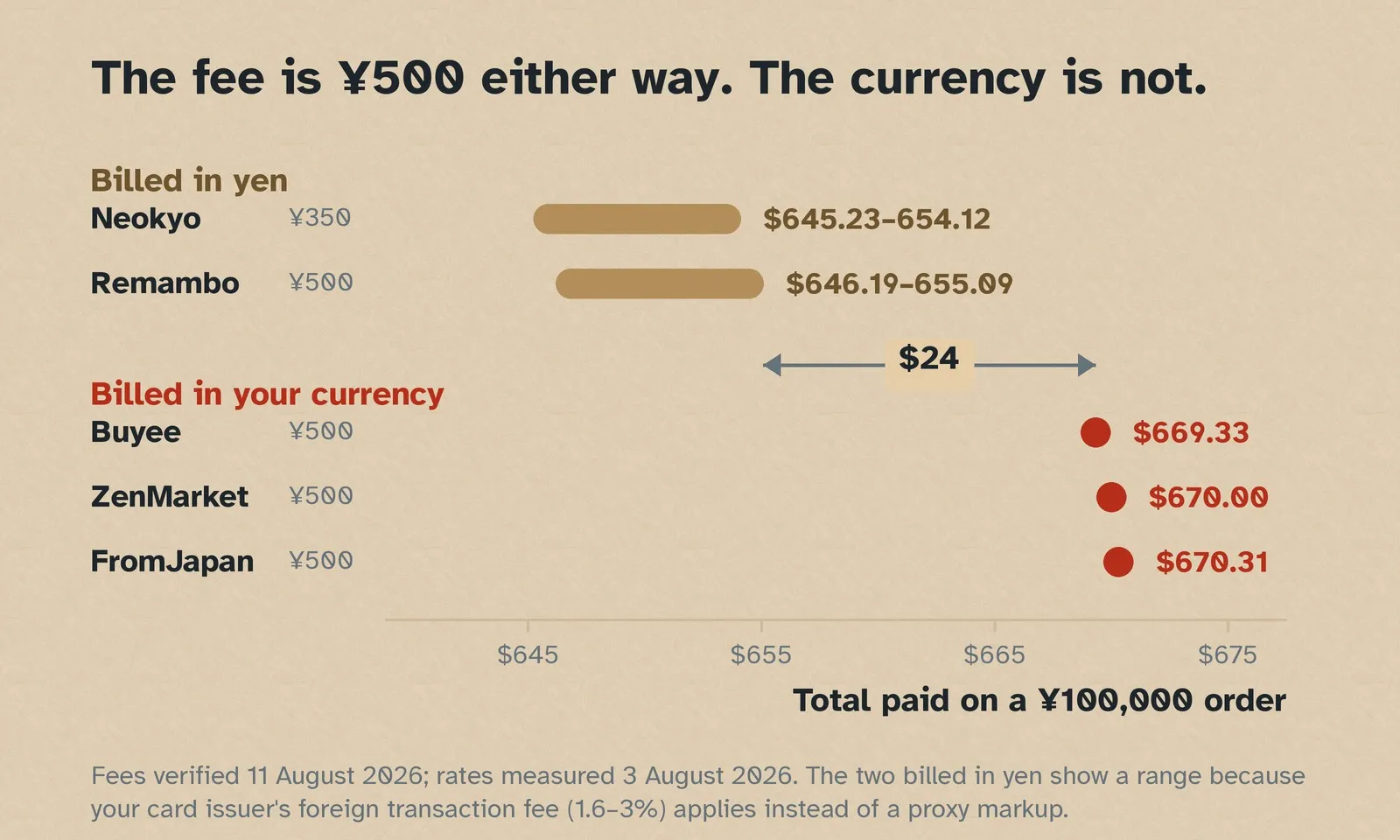
Both services that bill in yen beat all three charging the same ¥500, by eight dollars.
On a ¥100,000 item
| Service | Total you pay | Gap to cheapest |
|---|---|---|
| Neokyo | $645.23–654.12 | — |
| Remambo | $646.19–655.09 | +$0.96 |
| Buyee | $669.33 | +$24.11 |
| ZenMarket | $670.00 | +$24.77 |
| FromJapan | $670.31 | +$25.09 |
Twenty-five dollars (about ¥3,800) on a single order. Three of the five charge exactly the same fee.
The gap between the three services charging ¥500 is one dollar. The gap to the two that bill in yen is twenty-four. The fee column and the total column are answering different questions.
Buying five items reorders everything
The totals above assume one item. Change that and the ranking rearranges, because the seven do not agree on what a fee is charged against.
| Service | How the fee is charged |
|---|---|
| Buyee | ¥500 per order |
| Remambo | ¥500 per order (multiple items from one shop count as one) |
| FromJapan | ¥500 per item (multiple units of the same item count as one) |
| Neokyo | ¥350 per item |
| ZenMarket | ¥500 per item |
Five items from one shop, ¥6,000 each
| Service | Fee | Total you pay |
|---|---|---|
| Remambo | ¥500 | $196.11–198.81 |
| Buyee | ¥500 | $203.13 |
| Neokyo | ¥1,750 | $204.14–206.96 |
| ZenMarket | ¥2,500 | $216.67 |
| FromJapan | ¥2,500 | $216.77 |
Neokyo was the cheapest option on a single item. At five items it has fallen to third, because ¥350 has been charged five times. Buyee has not moved (its ¥500 covers the whole order), so it climbs from third to second.
ZenMarket and FromJapan end up ¥2,000 behind on fees alone. That gap is the whole argument in our Buyee vs FromJapan head-to-head, where the two services start out identical on one item and separate on the second.
The currency spread is fixed; the fee structure is not. Which one dominates depends on how many things you are buying, and that is why a single ranking cannot be right for everyone.
One caveat worth knowing: this only works when the items come from the same shop. On Mercari, where every listing is a different private seller, five items means five orders at almost every service, the per-order pricing stops helping.
British buyers pay more than Americans
Lining up all twenty-seven of Buyee’s currencies produced something we did not expect.
The spread is not uniform.
| Currency | Spread |
|---|---|
| British pound | 6.37% |
| Singapore dollar | 6.26% |
| Swiss franc | 6.25% |
| New Zealand dollar | 6.21% |
| Euro, Canadian dollar, Australian dollar + 20 more | 6.1–6.2% |
| Hong Kong dollar | 5.50% |
| US dollar | 4.88% |
| Chinese yuan | 3.71% |
Only the US dollar, the yuan, the Hong Kong dollar and the Taiwan dollar sit below the pack. Everything else is pinned at roughly 6%.
We measured on three separate days. The absolute numbers move slightly; the shape does not. Buyers in the US and greater China are given a better rate, and everyone else pays a flat premium.
Same item, same service, same day, and what you pay depends on where you live. A buyer in London pays 1.5 points more than a buyer in New York. On a ¥30,000 order that is about ¥430.
Why those four currencies, we do not know. It may track trading volume in each market. Buyee does not say.
The two that don’t touch your currency
Neokyo’s fee page:
All transactions on Neokyo are made in Yen. This conversion is for information purposes only. The actual exchange rate will be determined by your payment agency.
The dollar figures on screen are indicative. The real rate comes from whoever processes your payment.
Remambo says the same thing:
We accept only Japanese yen … The rate for available currencies is provided by Stripe payment gateway.
You pay in yen, and Stripe converts. The proxy takes no cut.
This is not free, though. Being billed in yen means your card issuer applies its own foreign transaction fee: typically 1.6–3%, usually below Buyee’s 4.88%, but it depends on the card.
If your card charges close to 5%, the advantage disappears. Worth checking the foreign transaction fee on the card you plan to use.
The one you cannot check
Japan Rabbit does not accept yen.
we are unable to process payments in Japanese yen or any other currency … We cannot guarantee that the exchange rate will remain the same by the time your payment is captured.
Everything is displayed in USD, Japan Rabbit performs the conversion, and it states that the rate is not guaranteed. There is no way to establish the spread before ordering. Its fee is a sliding scale starting at a $9.00 minimum.
We are not calling this unfair. Rates do move. But the fact that it cannot be verified is itself worth recording. Of the seven, this is the only one where the spread could not be calculated at all.
Its Trustpilot score is 4.8 out of 5 across 3,122 reviews, the highest of the seven. A high rating and a visible cost structure are separate things.
On Doorzo we have nothing to report. The site is built in a way that prevented us from reading its cost pages programmatically. Three approaches failed. What that missing number does to a head-to-head is the subject of our Doorzo vs Buyee comparison.
What you can check before you order
- Choose a service that bills in yen and the proxy’s markup disappears. What remains is your card’s fee, which you can look up
- Do not compare fee tables alone. Past roughly ¥10,000, the currency gap outgrows the fee gap
- Look up your card’s foreign transaction fee. At 1.6%, paying in yen wins comfortably; near 5%, the margin is thin
- Switch the display currency and compare. If a service shows both yen and your currency, dividing one by the other gives you its rate
Method and limitations
Rates were read directly from each service’s own pages on 3 August 2026 at 12:27 JST, using one request per site. The market reference is open.er-api.com, which updates once daily. Where Buyee’s own oandaRate was available we used that instead, since comparing a company’s own two figures is stronger than comparing against a third-party feed.
What we could not establish:
- ZenMarket displays ¥150.00 per USD, but we could not confirm that this is the rate applied at payment. ZenMarket runs on a deposit model, so conversion happens when you fund your balance. Whether the displayed rate is the funding rate would require completing an order
- Doorzo’s currency handling is unknown
- Japan Rabbit’s spread cannot be measured without completing a payment
- Whether FromJapan and ZenMarket also vary the spread by currency is unknown. Their currency switchers could not be driven from outside, so the per-currency finding is Buyee’s alone
- The totals above exclude international shipping and customs duties, both of which vary by service and route
- Rates move daily. The structure held across three measurements; treat the absolute figures as a snapshot of 3 August 2026
FAQ
Do Japan proxy services add a markup to the exchange rate?
Three of the seven do. Buyee applies ¥150.15 per USD against a market rate of ¥157.48 (a 4.88% spread) with ZenMarket at ¥150.00 (4.99%) and FromJapan at ¥149.93 (5.04%). Neokyo and Remambo bill in yen and add nothing. Japan Rabbit bills in USD but does not publish its rate. None of the three that mark up disclose the spread on their fee pages.
Which Japan proxy is cheapest overall?
On a ¥30,000 item, Neokyo at $195.14–197.83 total, followed by Remambo. Both bill in yen, so the range reflects your card’s foreign transaction fee of 1.6–3%. Buyee, ZenMarket and FromJapan all charge ¥500 and land at $203.13, $203.33 and $203.43, thirty cents apart, and more than $8 behind the two that bill in yen. Shipping and duties are separate.
Why do UK buyers pay more than US buyers on the same service?
Buyee’s spread varies by currency: 6.37% on the British pound against 4.88% on the US dollar. Only the US dollar, Chinese yuan, Hong Kong dollar and Taiwan dollar sit below roughly 6%. On a ¥30,000 order the difference between a London and a New York buyer is about ¥430. Buyee does not explain the tiering.
Is paying in yen cheaper than paying in dollars?
Usually. Being billed in yen replaces the proxy’s spread with your card issuer’s foreign transaction fee, typically 1.6–3% against Buyee’s 4.88%. If your card charges close to 5%, the two are equivalent. Check the foreign transaction fee on your card before deciding.
Which proxy has the cheapest fee?
Doorzo, at ¥200–300 per item (3% of the item price, with a ¥200 minimum and a ¥300 cap per item; up to ¥500 on Surugaya items, official), then Neokyo at ¥350. Buyee, ZenMarket, Remambo and FromJapan all charge ¥500. But the fee ranking is not the total ranking: the two services that bill in yen finish more than eight dollars ahead of the three charging the same ¥500, because those three convert your money at their own rate.
Does buying several items change which proxy is cheapest?
Yes, substantially. Buyee and Remambo charge ¥500 per order; Neokyo charges ¥350 per item and ZenMarket ¥500 per item. On five ¥6,000 items from one shop, Neokyo drops from first to third at $204.14–206.96 while Buyee climbs to second at $203.13 without its fee changing at all. ZenMarket pays ¥2,500 in fees against Buyee’s ¥500. This only applies within a single shop. On Mercari, five listings means five sellers and five separate orders.