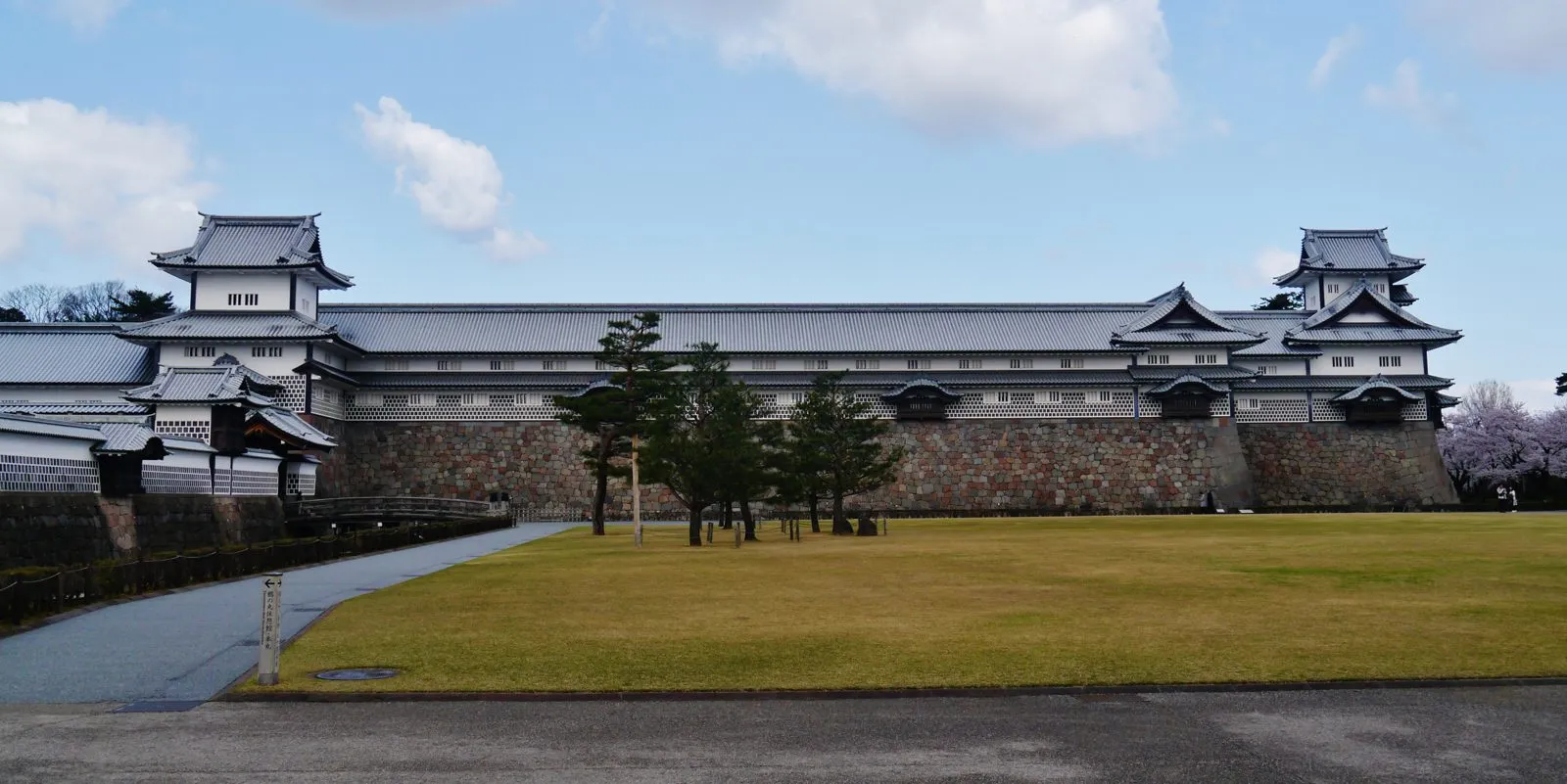
Kanazawa / Guide
Kanazawa Castle: Start With the Stones the Earthquake Brought Down
Kanazawa Castle金沢城
Part of the museum is lying on the ground
Kanazawa Castle is known as a museum of stone walls, and since the earthquake of New Year’s Day 2024, part of that museum has been lying on the ground.
The stones of the walls that fell, and of the walls that had to be taken down because they were no longer safe, have been carried to the Imori moat on the castle’s south-west side. There each one has been washed, checked for cracks, photographed face by face, measured and weighed. They are kept so that they can go back. As a rule, the prefecture says, each stone is returned to the place in the wall it came from.
That rule is what stayed with me. Not any stone of the right size into any gap, but each one home. It means that what looks like rubble is really a wall, taken apart and waiting.
So before you climb into Ishikawa-mon or buy a ticket for the white turrets, go down to the Imori moat and look at the stones. Then go and look at the walls. They read differently afterwards.
At the Imori moat: stones waiting to go home
A visitor route through the stone yard opened in July 2025, along the edge of the moat. The prefecture does not only let you look. Its own words invite you to see and touch the differences between stones from different places and different centuries.
Along the route, panels are named for the damaged walls: the earthen bridge in front of Ishikawa-mon, the south wall of the Honmaru, the south wall of Gyokusen’inmaru, the north-east wall at Osaka-mon. Not all of them came from the castle. One group is from Sazae-yama, the little spiral hill in Kenrokuen next door, and the count of recovered stones includes a stretch of the Tatsumi canal wall as well.
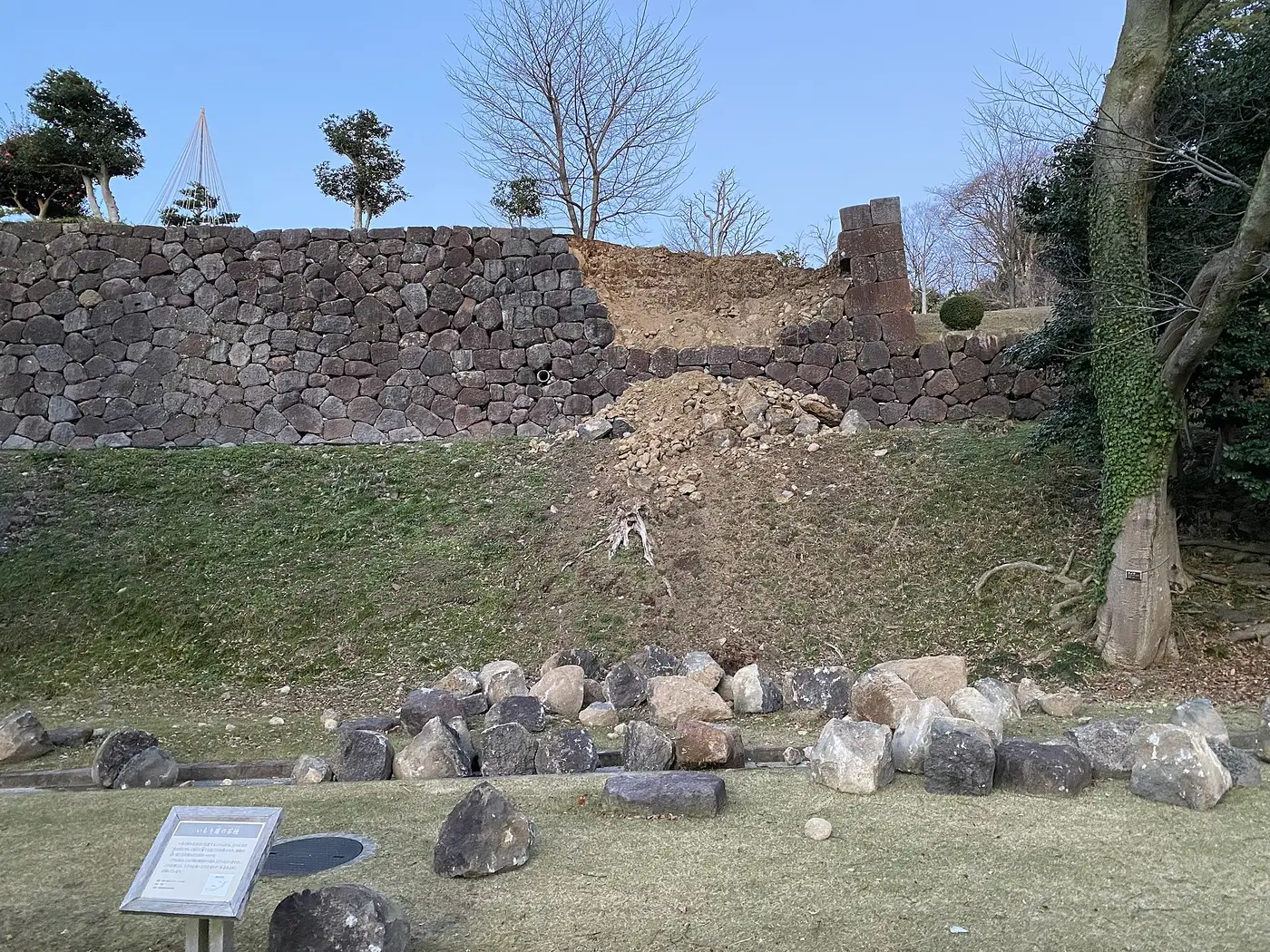
Picture them in rows, large and small, some with crisp, squared faces and some still rough from the quarry. The panels have a code you can scan for an English explanation.
From the route you can also see the restoration work on the south wall of the Honmaru, close up.
In the latest yearly report on the work, the recovered stones numbered 866. The total matters less to me than the work behind it: before a fallen stone was moved at all, someone first worked out where in the wall it had been.
The castle has done this before
At the south-east end of the Imori moat stands the stone base of the Riko turret. It is the orderly kind of wall, roughly squared blocks laid in level courses, and its form, the prefecture says, is mainly that of a repair of 1664. The reason is in the castle’s own timeline: an earthquake had damaged this wall two years earlier.
The moat itself was later filled in by the army and spent the post-war years as tennis courts. The base you see today was rebuilt from about 900 stones, and the restorers used the ones dug out of the ground here first, before turning to new stone from the same prefecture.
The castle’s stone-wall leaflet records another: the base of Osaka-mon, one of the castle’s main gates, collapsed in an earthquake in 1799 and was rebuilt the following year.
This is the detail that gave me the most hope about the walls. They have come down before and gone back up, and the people working on them today share a habit with the restorers of the Riko turret base: reaching for the old stones before the new.
Then read the walls
From the moat, walk up into the castle and look at the stones in place.
Start with the colour. Most of the walls are built of Tomuro stone, quarried on Mount Tomuro about ten kilometres to the south-east, and it comes in two shades: a reddish grey and a bluish grey. The prefecture credits the contrast between the two for the look of the walls; look for both shades as you go.
From the site of the Ushitora turret on the Higashi-no-maru, the prefecture says, you can see Mount Tomuro itself. I like that the quarry is in view of the walls it built.
Then the way the stones are laid. The castle’s walls fall into three methods. The oldest use natural or roughly split stone, stacked as found. Other walls use stones roughly squared before they were laid. The finest use stone cut into neat rectangles and fitted with no gaps, kept for gates and gardens, where people would see them.
One of them is in a garden. Facing Gyokusen’inmaru Garden, the shikishi-tanzaku wall sets square and tall cut stones in a stagger, with a waterfall built into its top, and the prefecture calls walls like it something not seen at other castles.
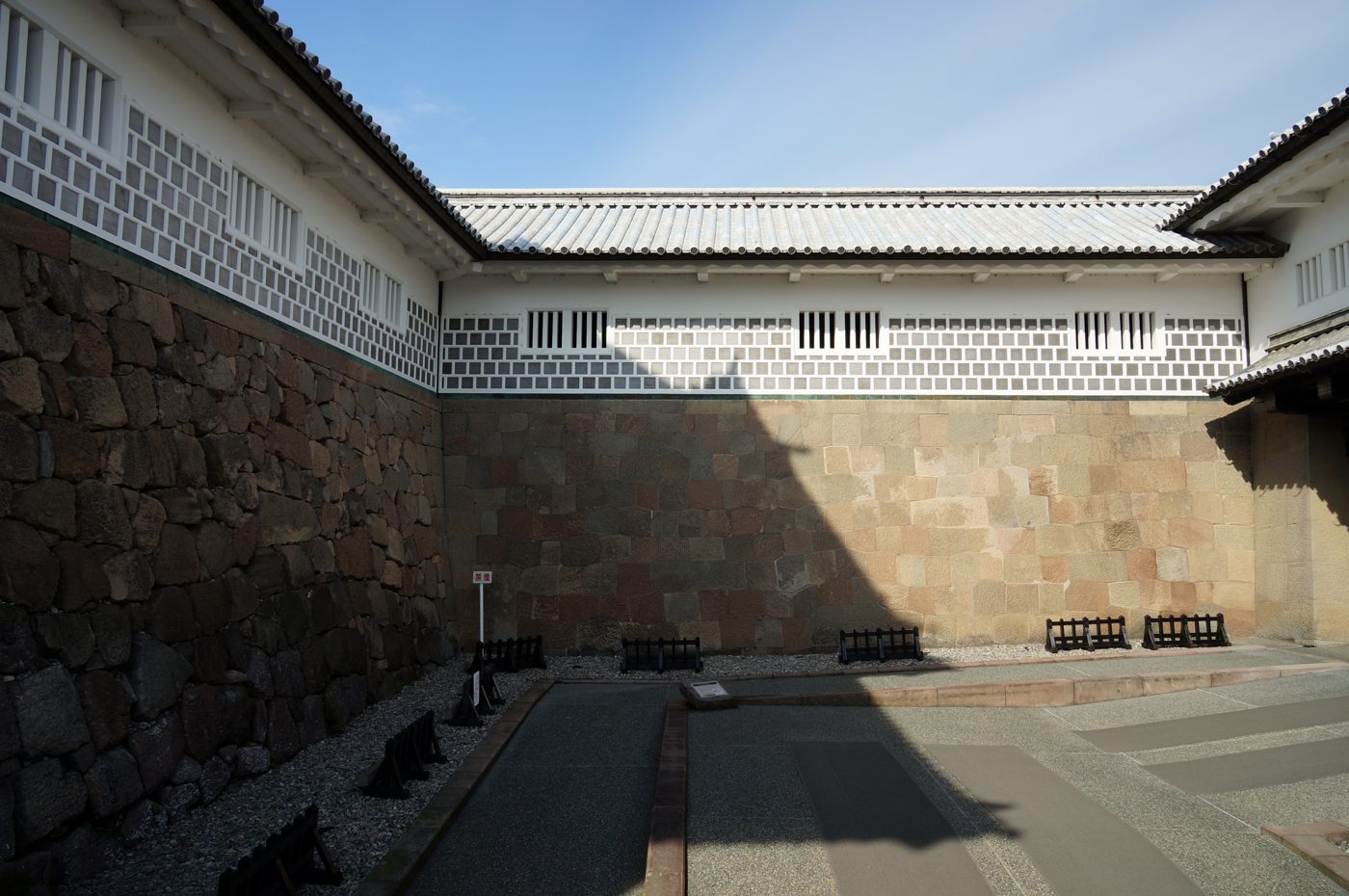
Ishikawa-mon shows two of them side by side. Inside its square courtyard, the masugata, one wall is fine cut stone and the one beside it is roughly squared, a rare case of two methods in one place. Look at the faces of the stones there, too, for large carved marks.
The oldest high wall in the castle is on the east side of the Higashi-no-maru. The leaflet dates it to 1592, when serious wall-building at the castle began, and it is built of natural stone, stacked much as it was found.
If you like the marks, look for more on the walls by the Sukiyashiki, where the leaflet asks you to find a circle with a cross and a square with a cross. They are said to have recorded how the work of cutting the stone was divided. If that is right, the walls still carry the bookkeeping of the people who cut them.
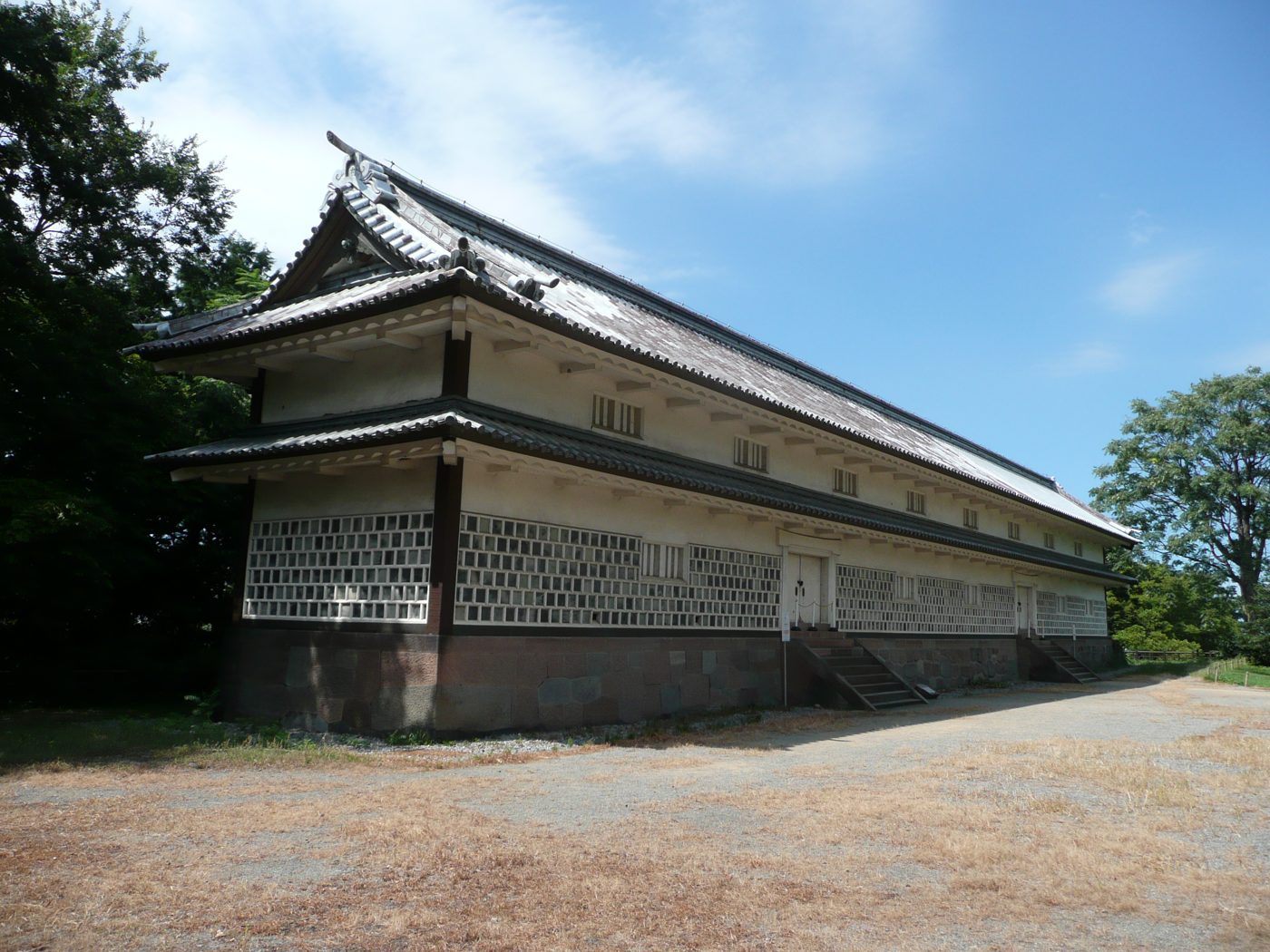
On the Honmaru, look under the west face of Sanjikken Nagaya, the prefecture’s other suggestion, for a regular hexagon among the stones and for stones set on end.
Where the masons started again
The re-laying began in August 2026, at the wall of the earthen bridge in front of Ishikawa-mon, the gate that faces Kenrokuen. The castle’s notes describe stonemasons lifting the stones back one at a time, and packing the fill behind them as they go.
So the gate many visitors arrive by is also where the stones from the Imori moat have started going back into a wall. If you come in this way, look for the work.
If it is a weekend between April and November, go into Ishikawa-mon as well. It is one of three buildings at the castle that survive from the Edo period, and on its opening days you can climb up inside for nothing. The days are in the calendar below.
Where I would start
I would start at the Imori moat, and walk the rows of stones before going anywhere near a gate.
Then I would go up to the walls and look for the reddish and bluish greys, the rough and the cut, the marks the masons left. On the way out I would leave by Ishikawa-mon, where the stones from the moat have begun going back to their places.
Before you go
The Imori moat stone yard
The stone yard and the repairs
| Where | The Imori moat garden, on the castle’s south-west side, inside Kanazawa Castle Park |
| Visitor route | Open since 19 July 2025. Panels for each damaged wall, with a code for an English explanation |
| What you can see | Stones recovered from the damaged walls, and the repair of the Honmaru south wall |
| Hours and fee | The prefecture’s stone-wall pages give none for the route itself (checked 22 October 2026) |
| Re-laying | Began 3 August 2026, starting at the wall of the earthen bridge in front of Ishikawa-mon |
Earthquake damage in Kanazawa Castle Park, per the prefecture: walls collapsed in 5 places and deformed in 23.
Which days the old doors open
The prefecture’s three Edo-period buildings — Ishikawa-mon, Sanjikken Nagaya and the Tsurumaru storehouse — open free on set days:
Special opening of the three surviving buildings, 2026
| When | What is open |
|---|---|
| Saturdays, Sundays and holidays, April to November, plus a few extra days such as the start of April and the Golden Week holidays | All three |
| Other weekdays in August, October and November | Ishikawa-mon and Sanjikken Nagaya |
| Other weekdays in April, May, June, July and September | Usually none; the calendar adds a few extra days |
| December to March | None |
9:30–15:30. Admission free. Steep stairs inside; the prefecture says the buildings cannot be viewed in a wheelchair. The prefecture notes that the schedule may change.
Hours and prices
Hours and prices
| Park grounds | Free. 7:00–18:00 from 1 March to 15 October; 8:00–17:00 from 16 October to the end of February |
| Hishi-yagura, Gojikken Nagaya, Hashizumemon (reconstructions) | ¥320 adult, ¥100 child 6 to under 18. 9:00–16:30, last entry 16:00 |
| Combined ticket with Kenrokuen | ¥500 |
| Kahoku-mon and Nezumitamon interiors | Free, 9:00–16:30 |
The Japanese fee page lists exemptions for over-65s, visitors with a disability certificate and one carer, and some others, all with proof; the English page lists only the over-65 exemption.
Getting there
| Entrance | Nearest stop | Walk |
|---|---|---|
| Ishikawa-mon | Kenrokuen-shita / Kanazawa-jo | 5 min |
| Gyokusen’inmaru | Hirosaka / 21st Century Museum | 5 min |
| Ote-mon | Owaricho | 5 min |
| Kuromon | Musashigatsuji / Omicho Market | 7 min |
| Nezumitamon | Minamicho / Oyama Jinja | 5 min |
To start at the Imori moat, use the Gyokusen’inmaru entrance: the prefecture’s access page puts the accessible parking for Gyokusen’inmaru Garden in the park beside the moat. Imori-zaka, the slope from the Ninomaru plaza down to the garden, is too steep for wheelchairs, the prefecture says.
The Kuromon side is close enough to Omicho Market for the castle and lunch to be one outing.
Free guidance in English is available at the Ishikawa-mon rest house or at Gyokusen-an, in principle daily except over New Year, 9:30–15:30. No booking; you turn up.
Sources and images
We have not visited Kanazawa Castle for this guide. It is written from the official Kanazawa Castle Park site run by Ishikawa Prefecture.
- Ishikawa Prefecture, Kanazawa Castle Park official site — “Restoration of stone walls” (Japanese and English) and its timeline of the work; “Museum of stone walls”; “Imori moat”; the stone-wall walking leaflet (PDF). Checked 22 October 2026.
- Ishikawa Prefecture, materials for the expert meeting on restoring the stone walls of Kanazawa Castle and Kenrokuen: “Work carried out in fiscal 2025” (PDF). Checked 22 October 2026.
- Ishikawa Prefecture, Kanazawa Castle Park official site — the special opening of the Important Cultural Properties and its fiscal 2026 leaflet; opening hours; fees and exemptions (checked 22 October 2026); access (checked 23 September 2026).
- Photographs: the collapsed wall above the Imori moat by SXEL (CC BY 4.0, Wikimedia Commons); Ishikawa-mon’s masugata by 663highland (CC BY-SA 3.0, Wikimedia Commons); Sanjikken Nagaya by 上条城 (public domain, Wikimedia Commons).
More in Kanazawa
- Kenrokuen — For a landscape garden, best early in the day
- Omicho Market — For seafood, local produce and an early meal
- Higashi Chaya District — For old wooden streets, and teahouses you can step inside
- Komatsu Udon near Komatsu Station — For Komatsu's udon, before the counter under the tracks closes at three
- Where to Stay — For choosing where to sleep by your mornings: Korinbo for the free hours in Kenrokuen, the station for early trains, Higashi Chaya for the quiet street
Explore other areas
- Hokkaido — Sapporo
- Kanto — Hakone, Tokyo
- Hokuriku — Kanazawa · You are here
- Koshin-Tokai — Fuji Five Lakes
- Kansai — Nara
- Chugoku — Hiroshima
- Kyushu — Fukuoka
- Okinawa — Naha
