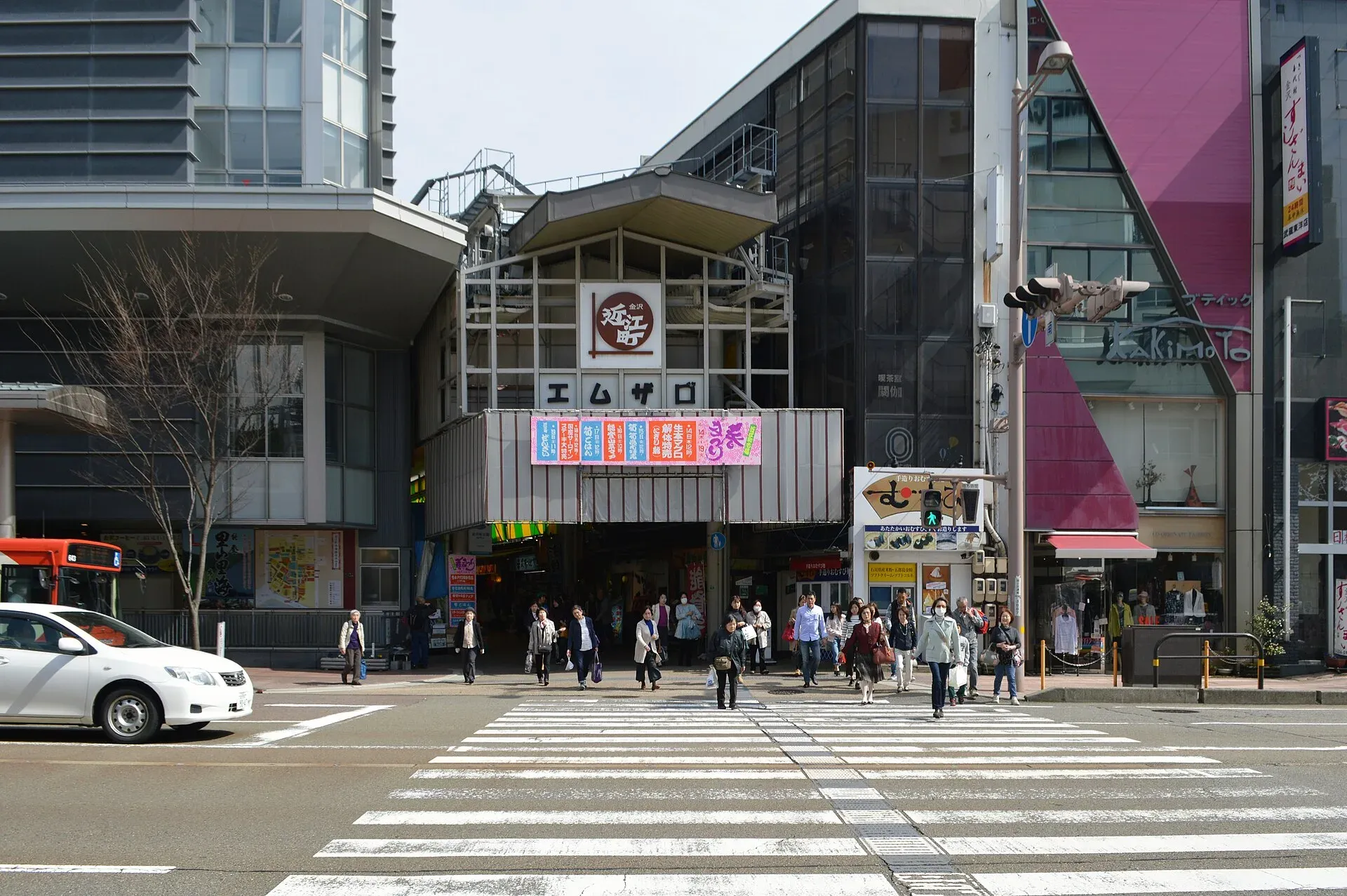
Kanazawa / Guide
Omicho Market, Kanazawa: Go to the Vegetable Crates Before the Fish
Omicho Market近江町市場
The vegetables that belong to this city
Omicho Market is famous for bowls of raw fish. A few steps away from them, the greengrocers’ crates hold something that belongs to this city.
They are Kaga vegetables: old varieties still grown mainly in Kanazawa, which the city says were pushed to the edge of extinction once Japan began growing uniform, easy-to-ship vegetables in bulk. Fifteen of them are now officially recognised, and the best of them are sold with a Kaga vegetable mark stuck on.
So before you sit down for a bowl, walk the vegetable aisle. Look for the mark, and ask the person behind the crates which Kaga vegetable is in today.
A seed shop that would not let them go
In the city’s own booklet on Kaga vegetables, the rescue starts with a seed shop.
The booklet puts the problem in one plain sentence: once a seed line is broken, the variety is gone, and the same vegetable can never be grown again. In 1991, Matsushita Ryo, who ran a seed and seedling shop in Kanazawa, called growers and market people together to keep the old varieties alive. He also gave them the name they are sold under now.
I keep thinking about that sentence. Lose the seeds and the vegetable is gone for good, and someone in a shop in this city decided that was not going to happen to Kanazawa’s.
What to look for in the crates
Some of them are easy to spot once you know what you are looking at.
The heta-murasaki aubergine is small and egg-shaped. Its name means “purple under the cap”: an ordinary aubergine is white beneath its green cap, and this one is purple there. Kinjisō, a leaf vegetable, is green on top and a vivid red-purple underneath, so turning a leaf over changes its colour completely.
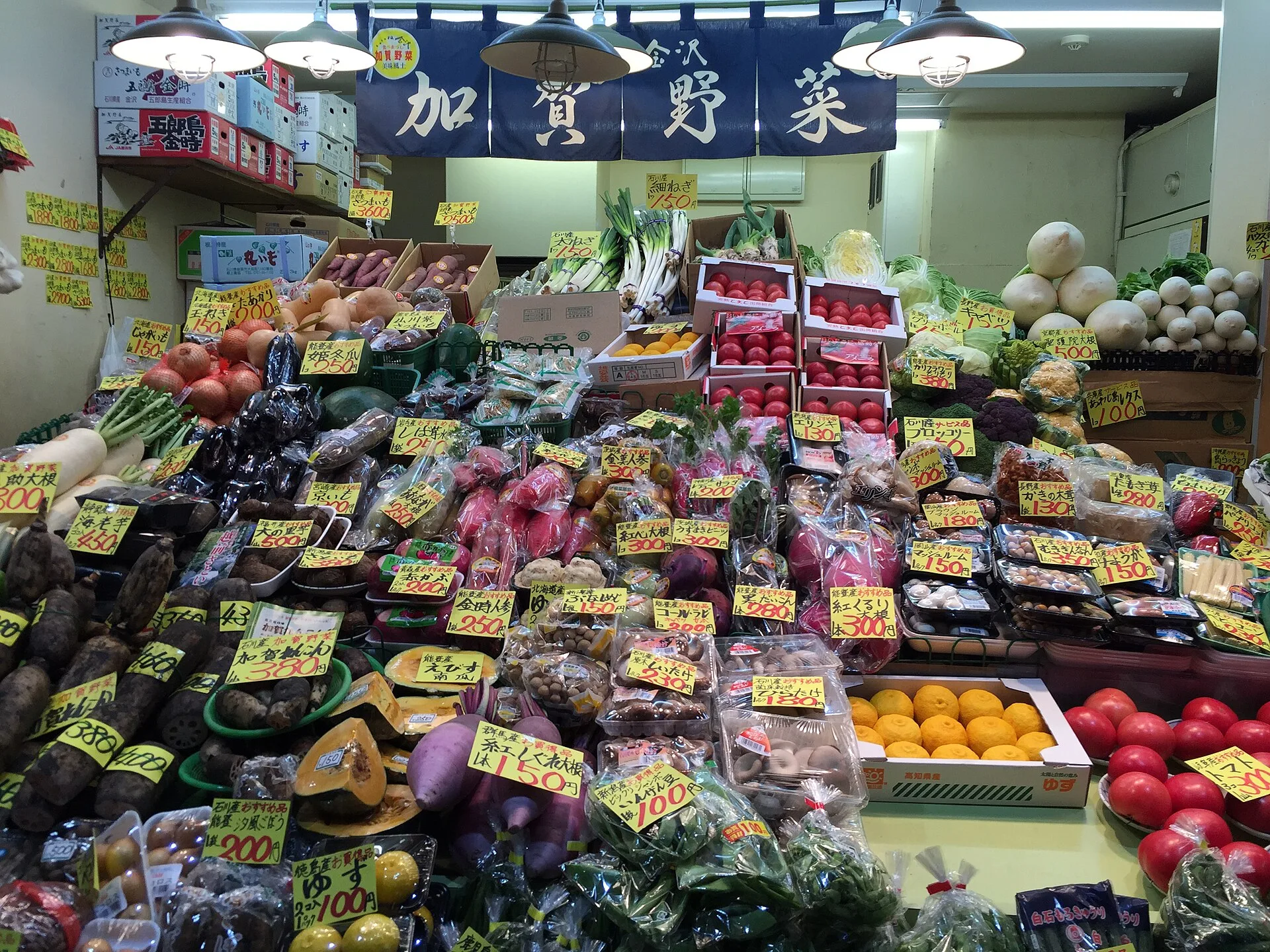
Not every one of them is safe yet. The city’s latest figures count a single farming household still growing heta-murasaki aubergine. I did not expect the number to be one. It is a summer vegetable, and the market’s calendar puts it in May and June; if you see it in a crate then, stop and look.
Others have come back. Gensuke daikon is grown by more farms now than when it was recognised, and the city records about ten times as much of it going to market. The market’s calendar puts it in November and December, so a late-autumn visit is your chance to see a vegetable that came back.
Then ask. The market’s own pamphlet lists the people behind the counters among the reasons to come: they know food, and if you ask, they will tell you how to cook something and how to keep it. A traveller with no kitchen can still ask what a vegetable is and how it is eaten, and come away knowing a little more about how this city cooks.
Come in the morning, and mind the day
The fish and vegetable stalls keep an earlier clock than most of the restaurants, so you have time to walk the aisles before you choose a meal.
Picture the lanes early in the morning: fish laid out on ice under bare lights, vegetables stacked in crates, a shopkeeper calling a price across to a regular. You are watching a city decide what it will eat tonight.
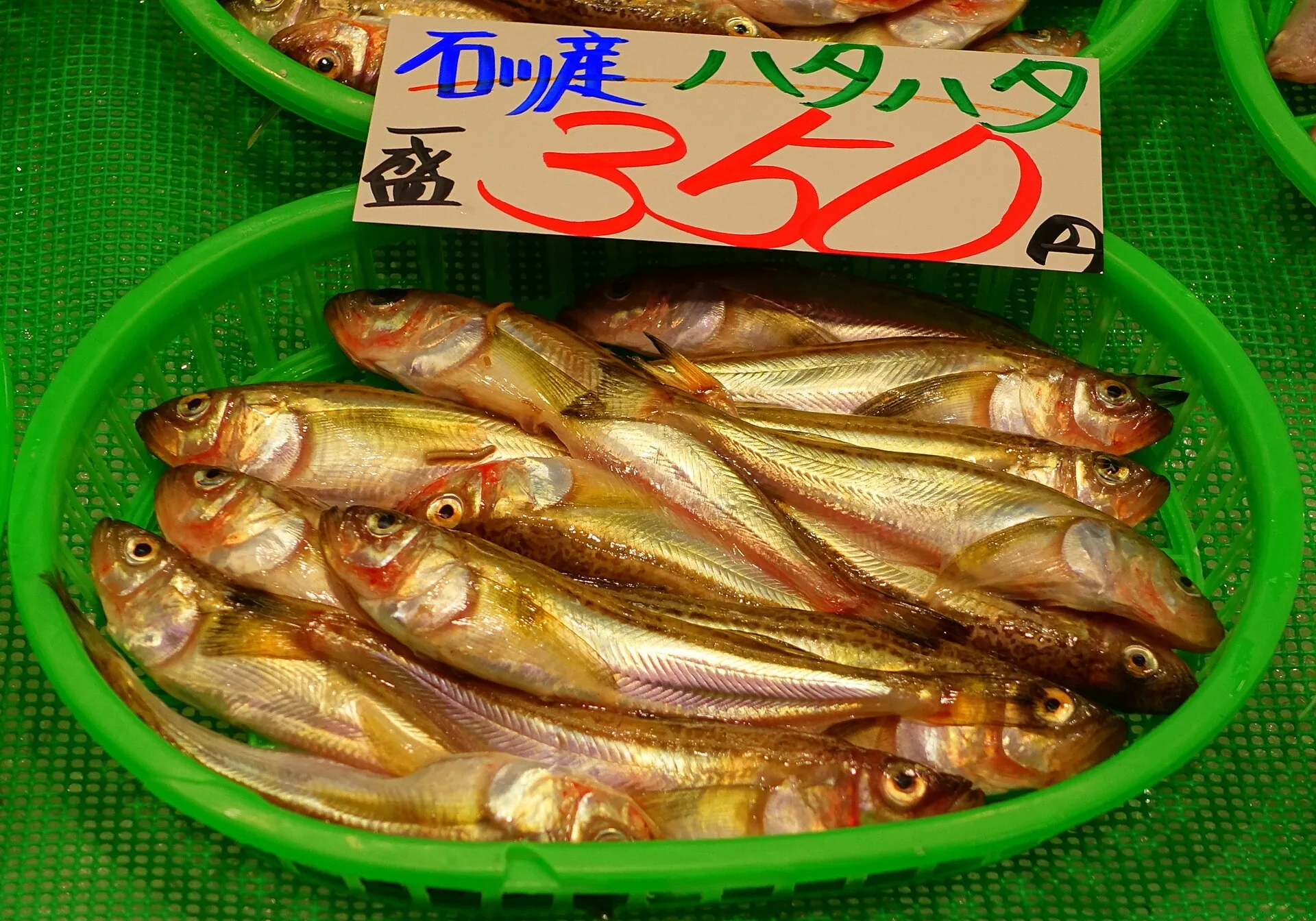
The market calls itself the kitchen of Kanazawa’s residents, and the two halves of that kitchen rest on different days. The prefecture’s tourism site explains why: some shops close on Wednesdays and Sundays, the days the city’s central wholesale market is shut. In the market’s own directory, the fish shops lean towards Wednesday and the greengrocers towards Sunday.
So if the vegetable aisle is what you came for, skip Sunday. If you want both halves open, aim for Monday, Tuesday, Thursday, Friday or Saturday.
You may want to buy something. Eating while walking is banned inside the market; the tourist association asks you to eat in the spaces the shops provide. The pamphlet also points to things the shops make themselves and sell only here, such as pickles, tofu and kamaboko fish cake. If you have nowhere to cook, start with the pickles, and ask how long they keep.
Then eat
When you have walked the aisles, sit down for the bowl. The restaurants and their hours are in the table at the end.
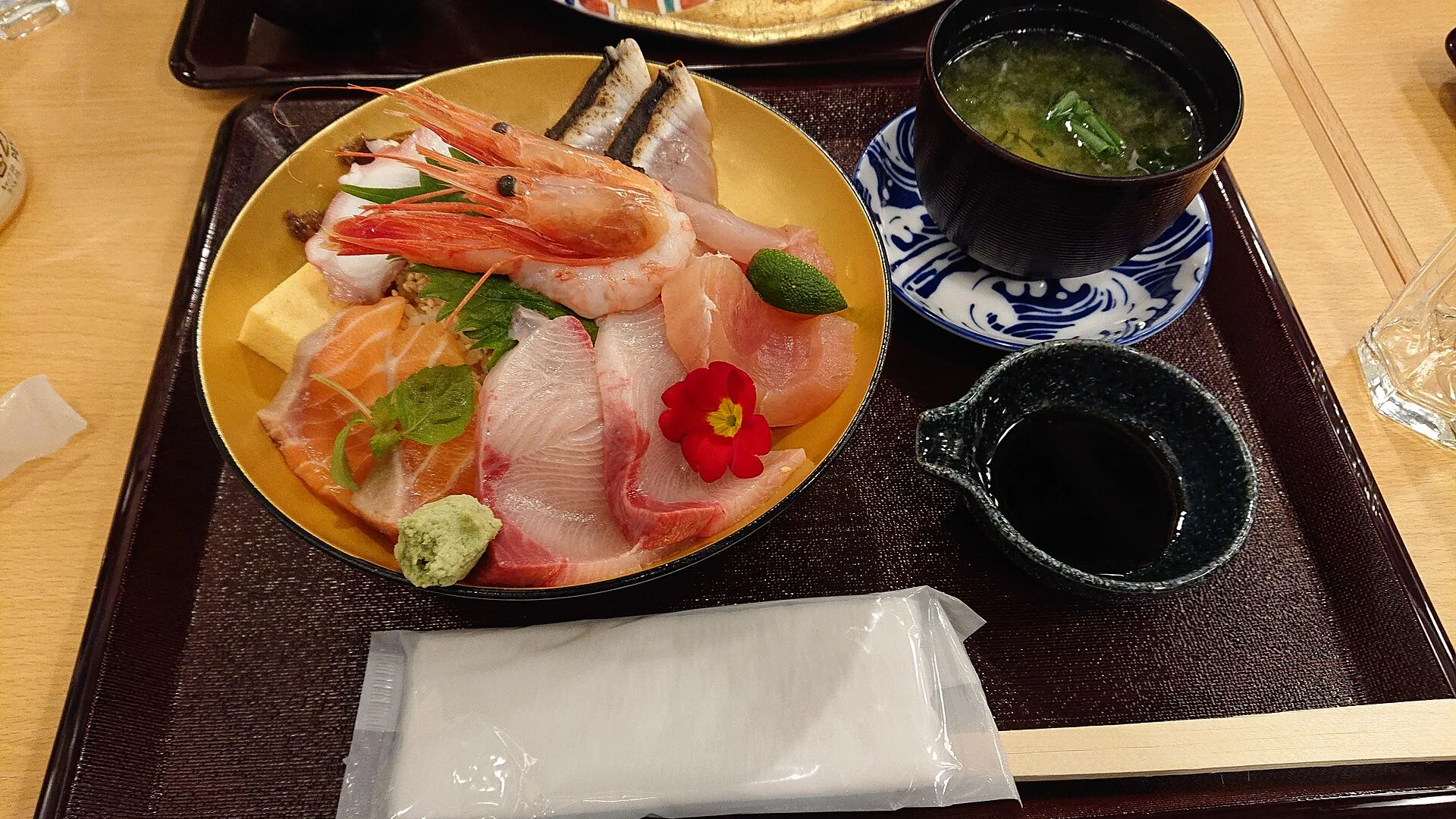
Eat it after the vegetable aisle rather than before. The aubergine you may have seen in the crate, purple under its cap, is down to a single farm.
Where I would start
I would arrive early on a Tuesday or a Thursday and go to the greengrocers before the fish. I would look for the Kaga vegetable mark, turn over a bunch of kinjisō if there was one, and ask which Kaga vegetable had come in that day.
Then I would sit down for a bowl.
Before you go
Kaga vegetables at Omicho
What the market says is in season
| Months | Vegetables and fruit | Seafood |
|---|---|---|
| January–February | Kanazawa ippon futonegi (green onion), Futatsuka karashina (mustard greens) | yellowtail, cod, thread-sail filefish |
| March–April | bamboo shoots, mountain vegetables | rockfish, halfbeak, barracuda, isaza |
| May–June | Kaga futo-kyuri (thick cucumber), heta-murasaki nasu (aubergine), watermelon | whiting, horse mackerel, sea bream |
| July–August | kinjiso, Kaga renkon (lotus root), Utsugi red-skinned pumpkin, tomatoes | neon flying squid, rock oysters |
| September–October | Noto matsutake, Kaga hakusai (napa cabbage), Ruby Roman grapes, Kaga Shizuku pears | sweet shrimp, flounder |
| November–December | Gensuke daikon, Kanazawa shungiku, Gorojima kintoki sweet potatoes, Kaga maruimo (round yam) | crab, sea cucumber |
The pamphlet groups the year into pairs of months; it does not say that every item is on sale on every day of them. Not every vegetable listed is one of the fifteen Kaga vegetables.
The fifteen Kaga vegetables, and how some are faring
| The fifteen | sweet potato, Kaga lotus root, bamboo shoot, Kaga thick cucumber, kinjisō, heta-murasaki aubergine, Gensuke daikon, Kanazawa seri (water dropwort), Utsugi red-skinned pumpkin, Kanazawa ippon futonegi, Kaga tsurumame (hyacinth bean), red zuiki (taro stem), Futatsuka karashina, kuwai (arrowhead), Kanazawa shungiku |
| Who counts | Vegetables grown in Kanazawa since 1945 or earlier and still grown mainly there |
| Heta-murasaki aubergine | 12 farming households when recognised; 1 in 2024 |
| Kinjisō | 30 farming households when recognised; 6 in 2024 |
| Gensuke daikon | 12 farming households when recognised; 20 in 2024, with about ten times the shipments |
Hours, days off and getting there
Getting there, and when the shops rest
| Market hours | about 9:00–16:00, varying by shop; some restaurants open earlier and close later |
| Closed | 1–4 January; otherwise each shop sets its own days |
| Wednesdays and Sundays | some shops close on the days the central wholesale market is shut; 16 of 25 fish shops list Wednesday, 10 of 20 greengrocers list Sunday |
| Listed opening times | 8:30 or earlier: 13 of 25 fish shops, 16 of 20 greengrocers, 10 of 44 places to eat |
| On foot | about 15 minutes from Kanazawa Station |
| By bus | from Kanazawa Station east exit, Hokutetsu buses from stops 6 to 9, or the Machi bus; the nearest stop is Musashigatsuji |
| Car parks | Fureai-kan (24 hours, up to 225 cars); Ichiba-kan (7:30–23:30, up to 94 cars); Omicho Parking (24 hours, up to 228 cars) |
| Eating | no eating while walking; use the shops’ own eating spaces |
Each shop sets its own hours and days off, and several list irregular closures. Counts are from the market's directory of 158 listed shops.
Places to eat
Places to eat, by opening time
| Opens | Restaurant | Closes | Closed |
|---|---|---|---|
| 7:00 | Yutaka Suisan | 15:00 | Wednesdays |
| 7:00 | Noka Bansai To-nari-ya | 15:00 (last orders 14:30) | generally open; New Year closure |
| 7:00 | Ikiiki-tei Omicho | last orders 14:30 | irregular |
| 7:00 | Noka Bansai Ichiba-ya | 15:00 (last orders 14:30) | generally open |
| 8:30 | Hyakumangoku Udon | 15:00 | irregular |
| 8:30 | Mawaru Omicho Ichiba Sushi | 20:00 (last orders 19:30) | generally open |
| 9:00 | Kaisendon Ichiba | 15:00 | irregular |
| 9:00 | Ippuku Yokocho | 17:00 (food 16:30, drinks 16:50) | Wednesdays |
| 10:00 | Kaisendon Hikariya | 16:00 (last orders 15:30) | Mondays, plus irregular |
| 11:00 (10:30 weekends and holidays) | Kaisendon Hirai | 15:00 | Wednesdays |
| 11:00 (9:00 Sundays and holidays) | Jimono-tei | 15:00 | Wednesdays (open if a holiday) |
| 11:00 | Sushi Enome | 15:00 | Thursdays, plus irregular |
| 17:30 | Kushiage & fish bar Hikariya & yajimon | midnight | Mondays |
The market's own shop pages differ from this list on several opening times, closing times and days off — for example, they give Noka Bansai Ichiba-ya an 8:00 start and name Tuesday as Ikiiki-tei's day off. Check the shop's own page before you plan around one restaurant.
The market’s year
- 6 November — the pamphlet marks the opening of the snow crab season, with sales from the 7th.
- 5 January — the pamphlet’s first sale of the year. The tourist association lists the market as closed from 1 to 4 January.
If you are going on to the castle or the garden, each has its own page: Kanazawa Castle and Kenrokuen.
If some of what you buy here is coming home with you, our guide to bringing Japanese food home sets out what six countries let through in a suitcase, and why posting it is harder.
Sources and images
We have not visited Omicho Market for this guide. It is written from the market’s own official pages and pamphlet, Kanazawa City’s booklet on Kaga vegetables, the Kanazawa tourist association and the Ishikawa prefectural tourism federation; where you are asked to picture a scene, that is what it is.
- Kanazawa City, Agriculture and Fisheries Promotion Division, “Minna de manabō! Kaga yasai” (March 2026) — the decline and rescue of the traditional vegetables, the seed shop and the 1991 preservation group, the definition of the fifteen Kaga vegetables, the brand mark, the descriptions of heta-murasaki aubergine and kinjisō, and the farming figures. Checked 22 October 2026.
- Omicho Market official site, top page — the market’s description of itself as a retail market and the kitchen of Kanazawa’s residents, and the walk and buses from Kanazawa Station. Checked 23 September 2026.
- Omicho Market official site, shop directory and each shop’s own page — the categories of the 158 listed shops, and their published opening times and days off where supplied, from which we counted the figures in this piece. Checked 23 September 2026.
- Omicho Market official pamphlet (Japanese and English editions, November 2022) — the people behind the counters, the shops’ own products, the seasonal calendar, the annual calendar, and the car parks. Checked 23 September 2026.
- Kanazawa tourist association, Omicho spot page and feature page — the market’s hours and New Year closure, the ban on eating while walking, and the hours and days off of the restaurants listed. Checked 23 September 2026.
- Ishikawa prefectural tourism federation (Hot Ishikawa), Omicho page — the shops that close with the central wholesale market on Wednesdays and Sundays. Checked 23 September 2026.
- Photographs: the produce by bryan… from Taipei, Taiwan (CC BY-SA 2.0, Wikimedia Commons); the fish counter by Daderot (CC0, Wikimedia Commons); the kaisendon by 経済特区 (CC BY-SA 4.0, Wikimedia Commons).
More in Kanazawa
- Kenrokuen — For a landscape garden, best early in the day
- Kanazawa Castle — For history, and three buildings that survive from the Edo period
- Higashi Chaya District — For old wooden streets, and teahouses you can step inside
- Komatsu Udon near Komatsu Station — For Komatsu's udon, before the counter under the tracks closes at three
- Where to Stay — For choosing where to sleep by your mornings: Korinbo for the free hours in Kenrokuen, the station for early trains, Higashi Chaya for the quiet street
Explore other areas
- Hokkaido — Sapporo
- Kanto — Hakone, Tokyo
- Hokuriku — Kanazawa · You are here
- Koshin-Tokai — Fuji Five Lakes
- Kansai — Nara
- Chugoku — Hiroshima
- Kyushu — Fukuoka
- Okinawa — Naha
