Kanazawa / Guide
The Garden Named for an Impossible Combination — Kenrokuen, Kanazawa
Kenrokuen兼六園
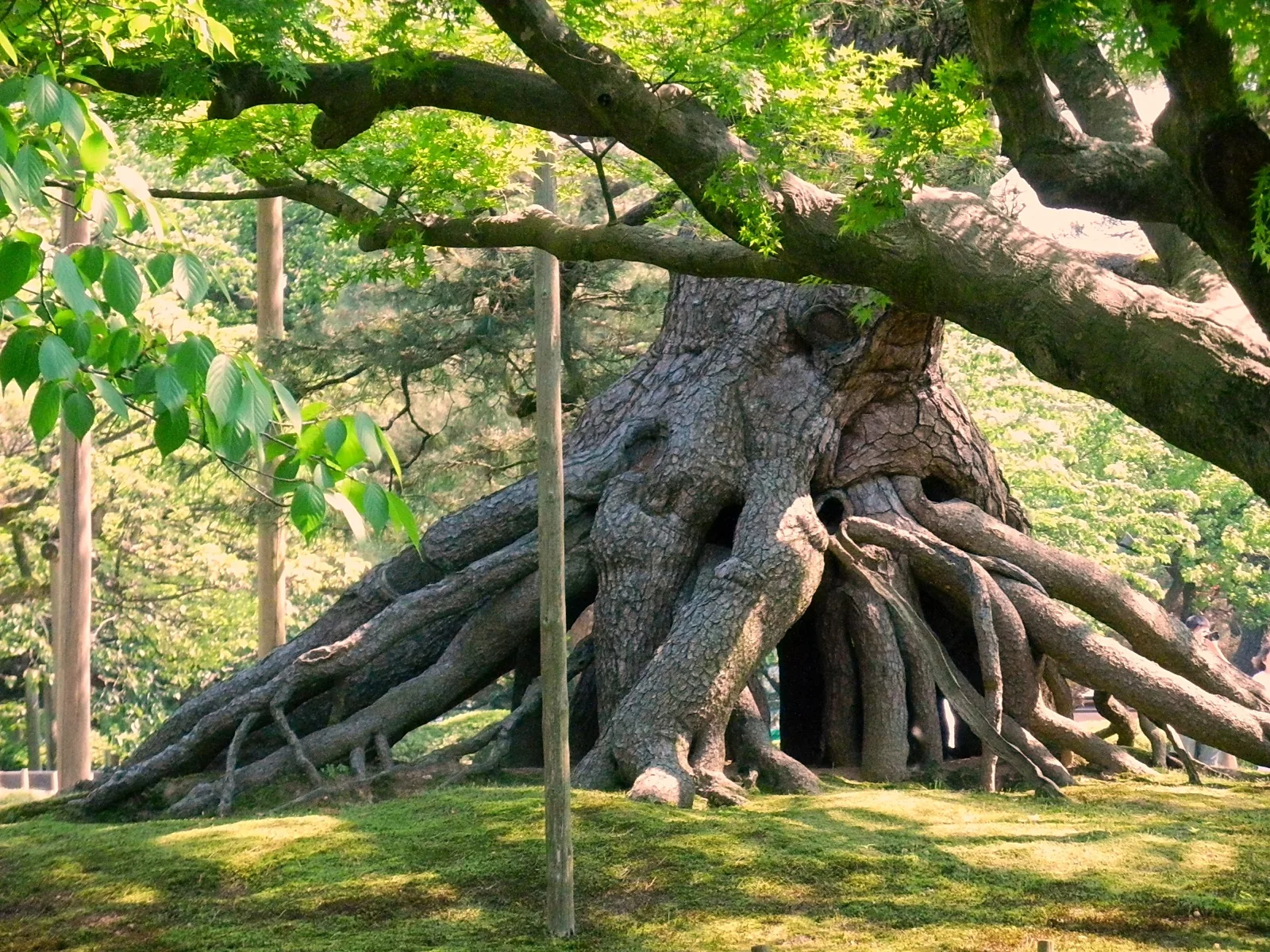
Two metres off the ground. More than forty roots, thick and thin, holding a black pine in the air near the end of the prefecture’s thirty-minute route. It looks like the oldest thing in the garden — a tree that has stood so long the soil has simply gone from beneath it.
It has not. According to Ishikawa Prefecture, the thirteenth lord of Kaga had earth heaped into a mound, a young pine planted on top of it, and the roots kept buried while the tree grew. Later, once it had, the soil was taken away. The old look is real. So is the hand that arranged it.
There is a name for that combination, and the garden was given it. In 1822 Kanazawa borrowed a phrase from a Song-dynasty Chinese book on gardens, the Record of the Celebrated Gardens of Luoyang. The book lists six qualities that the gardens of Luoyang were said never to hold at once: pursue vastness and you lose secluded depth; let the gardener’s hand show and you lose the look of age; fill the place with water and you give up the long view. One garden, Hu Yuan, was said to have had all six. Kenroku-en means combining the six. It is a claim before it is a name.
The pine settles one half of one pair. There are two more pairs, and the prefecture’s own short route does not reach all of them.
That is what kept me reading. Most famous gardens are described; this one argues. Kanazawa did not name the place after a view, a lord or a season — it named it after a claim that a Chinese text had called impossible, and then the garden had to make the claim stand up on the ground. Read that way, Kenrokuen stops being a list of sights and becomes a case with three parts, two of which the short route never reaches.
Made, and made old
Once you have seen it in the pine, it is difficult to stop seeing it.
Sazae-yama, the spiral hill at the edge of the main pond, is nine metres high and about ninety metres around. Ordinary numbers. What is not ordinary is where the hill came from: it is built out of the soil that came up when the same lord had the pond enlarged. The hill and the pond are not two features. They are one act, seen from two sides.
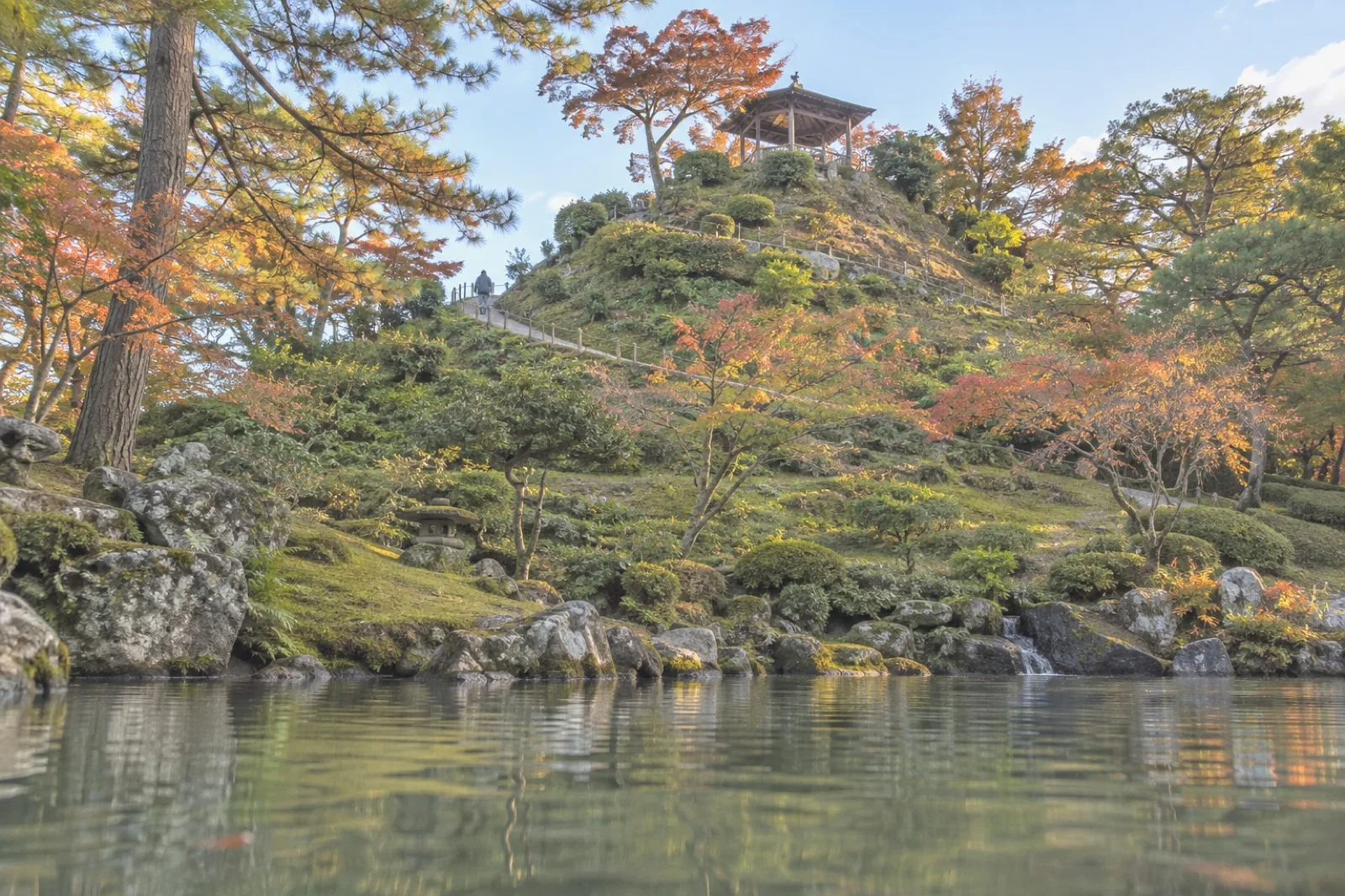
Figure 1
The Karasaki pine, the finest-branched tree here, is not a local survivor either. Nariyasu had the seed brought from the shore of Lake Biwa, in another province, and grown on.
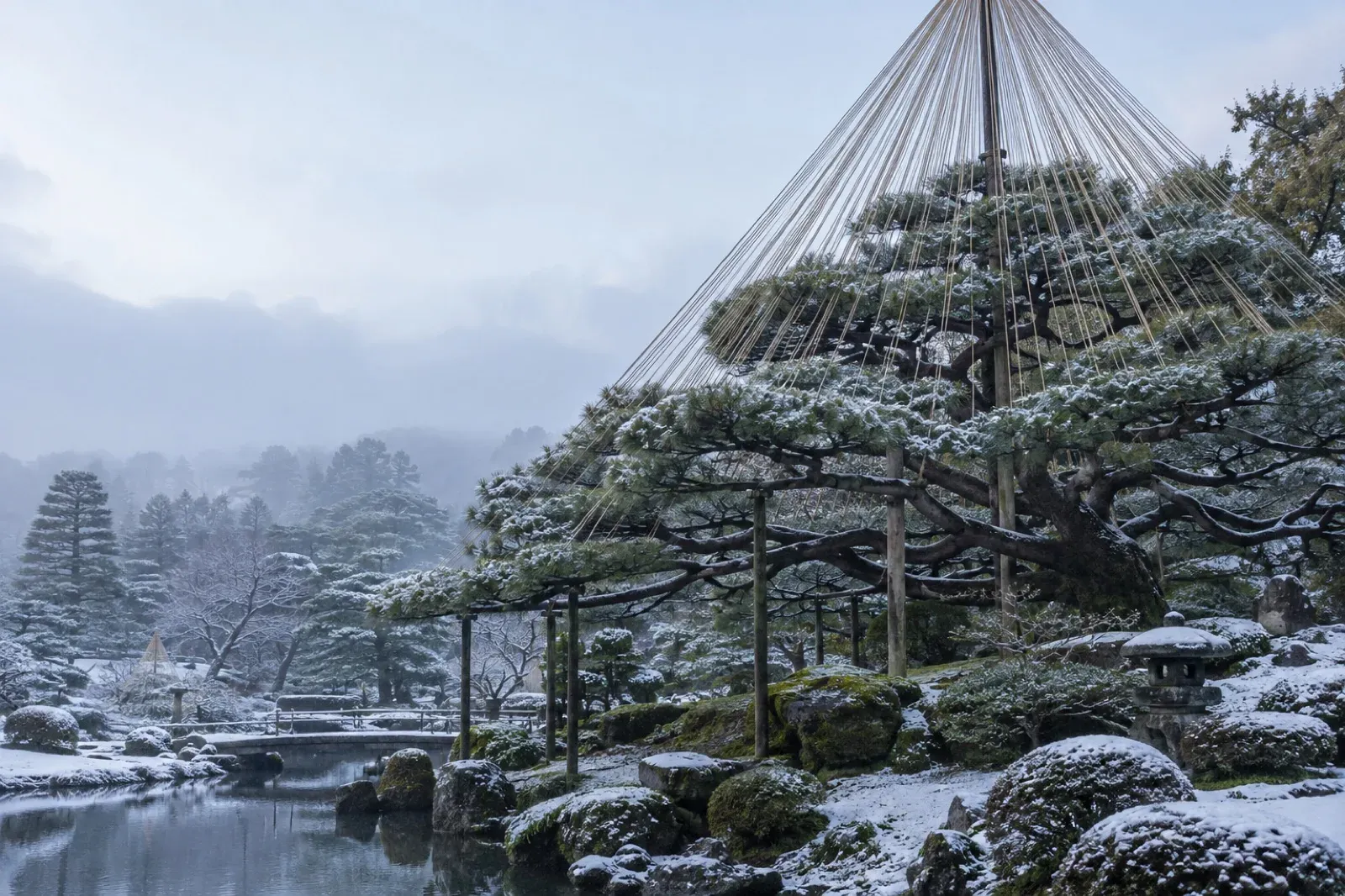
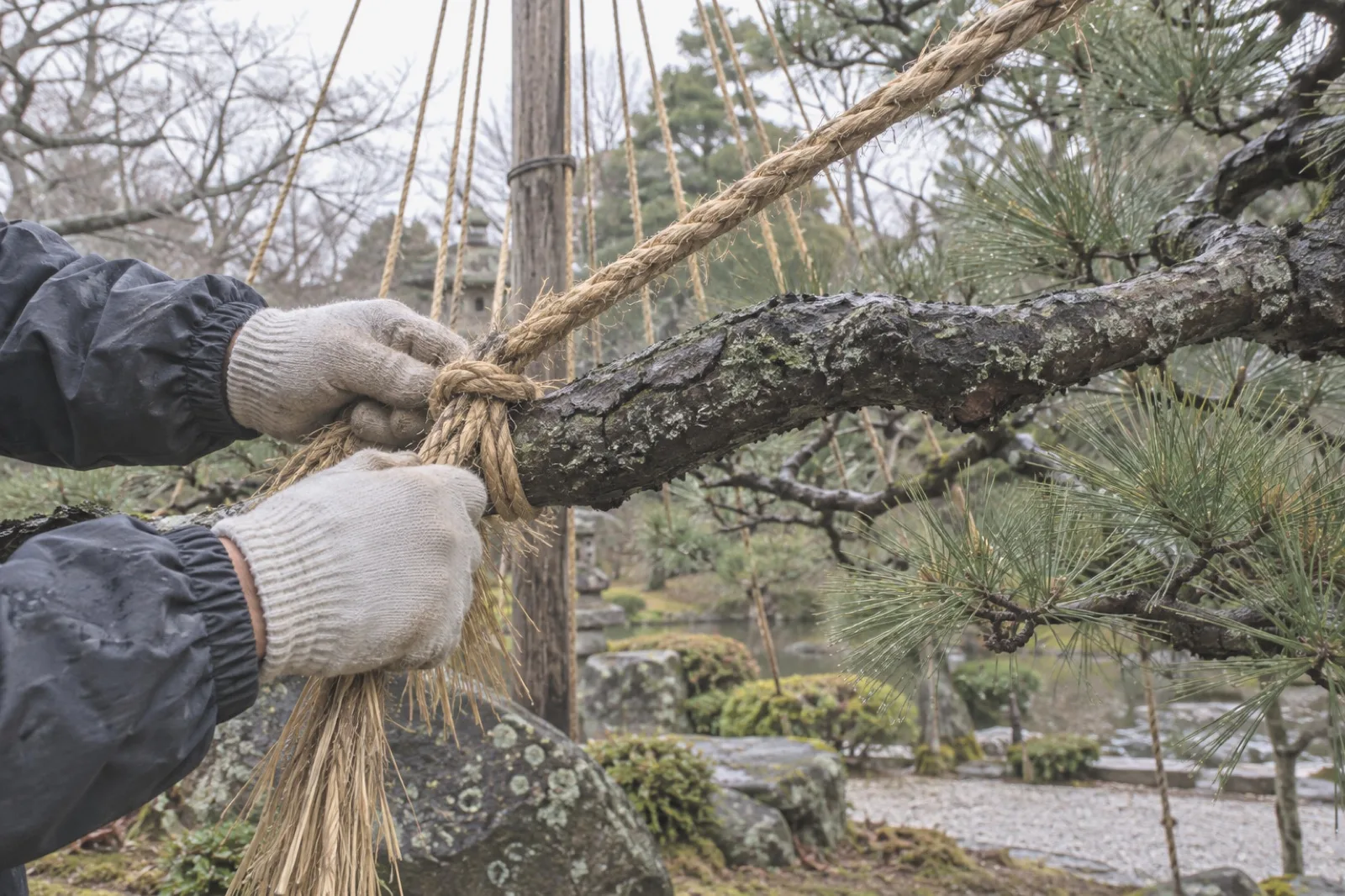
And every winter that tree is rebuilt. Gardeners raise posts beside it and hang ropes from them in a cone, so the branches will not break under the wet snow that comes in off the Sea of Japan. In 2024 the prefecture announced that work would start at nine in the morning on 1 November, and gave the count for that one tree: five posts, and roughly eight hundred ropes. The prefecture calls the result a sight not to be seen in other gardens. It is dismantled and tied again from nothing, every year.
None of which stops the place from feeling old. The Japanese text on the six quotes a period account of a garden so thoroughly worked over that “wherever there is an islet or a shore, there is almost always a bridge” — and, in the same breath, of great trees throwing deep shade, and moss in more places than could be counted.
That is one pair closed. Artifice and antiquity, holding each other up.
Fifteen minutes from the wide part
The second pair asks you to walk.
Kasumiga-ike is the first large thing the short route brings you to: about 5,800 square metres of water, the biggest pond in the garden, and nowhere more than 1.5 metres deep. That shallowness does something. With the Karasaki pine, Sazae-yama and the Uchihashi-tei teahouse set around its rim, the water works as a floor underneath them rather than a depth of its own — everything placed on one plane, legible in a single look. This is the vastness the name promises.
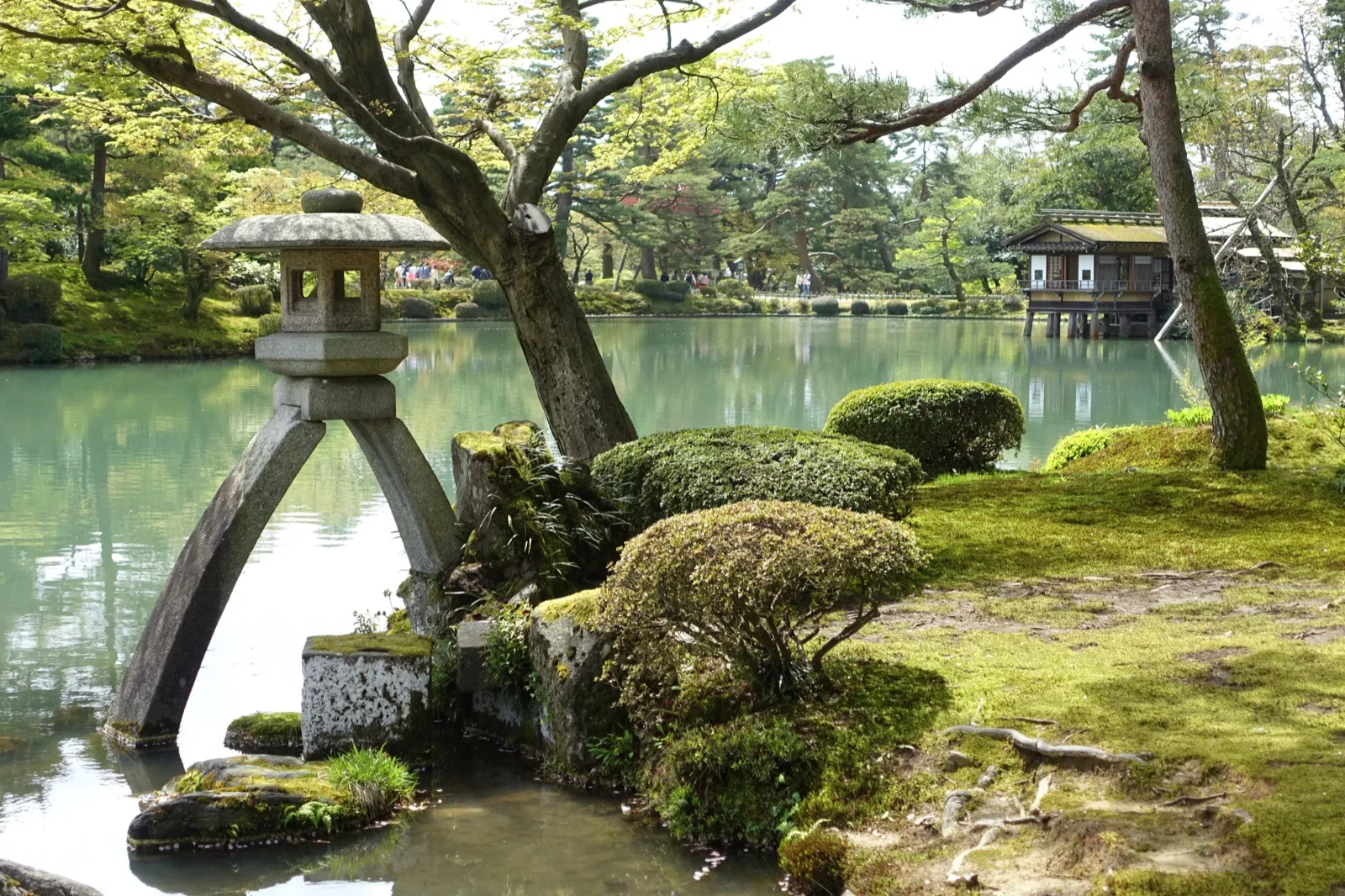
Now walk to Yamazaki-yama, over near the Kodatsuno gate.
It is a built-up hill too, but planted with maples and horse chestnuts instead of pine — deciduous cover that turns and drops, rather than the same dark needle all year. Water comes out of the rocks at its foot and runs 570 metres as a winding stream — and that stream is going to the pond you were standing beside a quarter of an hour ago. There is a five-tiered stone pagoda partway up. In autumn the whole hill turns; people call it the autumn-colour hill.
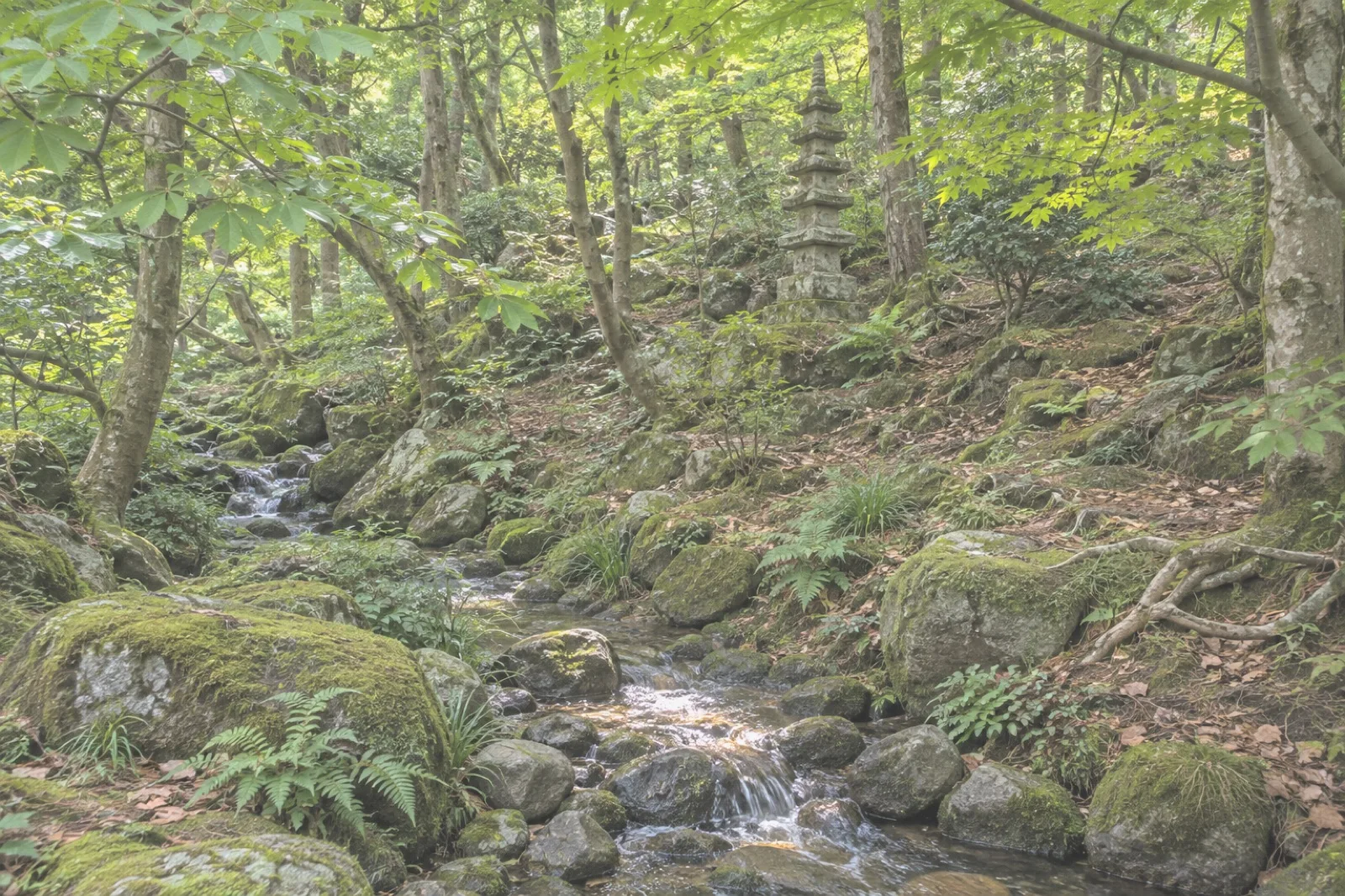
Figure 2
At the far end of the garden, Hisago-ike does the same work with a gourd-shaped pond and two islands modelled on the legendary islands of long life. It is also, the prefecture says, where the making of Kenrokuen is thought to have begun — not at the famous lantern, but here, in the part most visitors never reach.
A retainer who saw the garden in its own century wrote that it was broad and bright and open, and then added the line the prefecture still quotes today: and yet it is exactly as though one were deep in the mountains.
Look for the pump
The third pair is a problem of altitude, and the garden solves it in front of you without saying so.
Between the Yugao-tei teahouse and the Midori-taki waterfall — the full route only — a column of water stands about three and a half metres in the air.
Look for the pump.
The prefecture’s description mentions none. The fountain rises, it says, on the pressure created by Kasumiga-ike sitting higher up the garden than the fountain does; and when the level of the pond changes, the height of the jet changes with it. The pond you walked past earlier is what is holding this water up. The thing is thought to have been built as a trial — could water be made to climb into the castle’s second enclosure? — and it is said to be the oldest fountain in Japan.
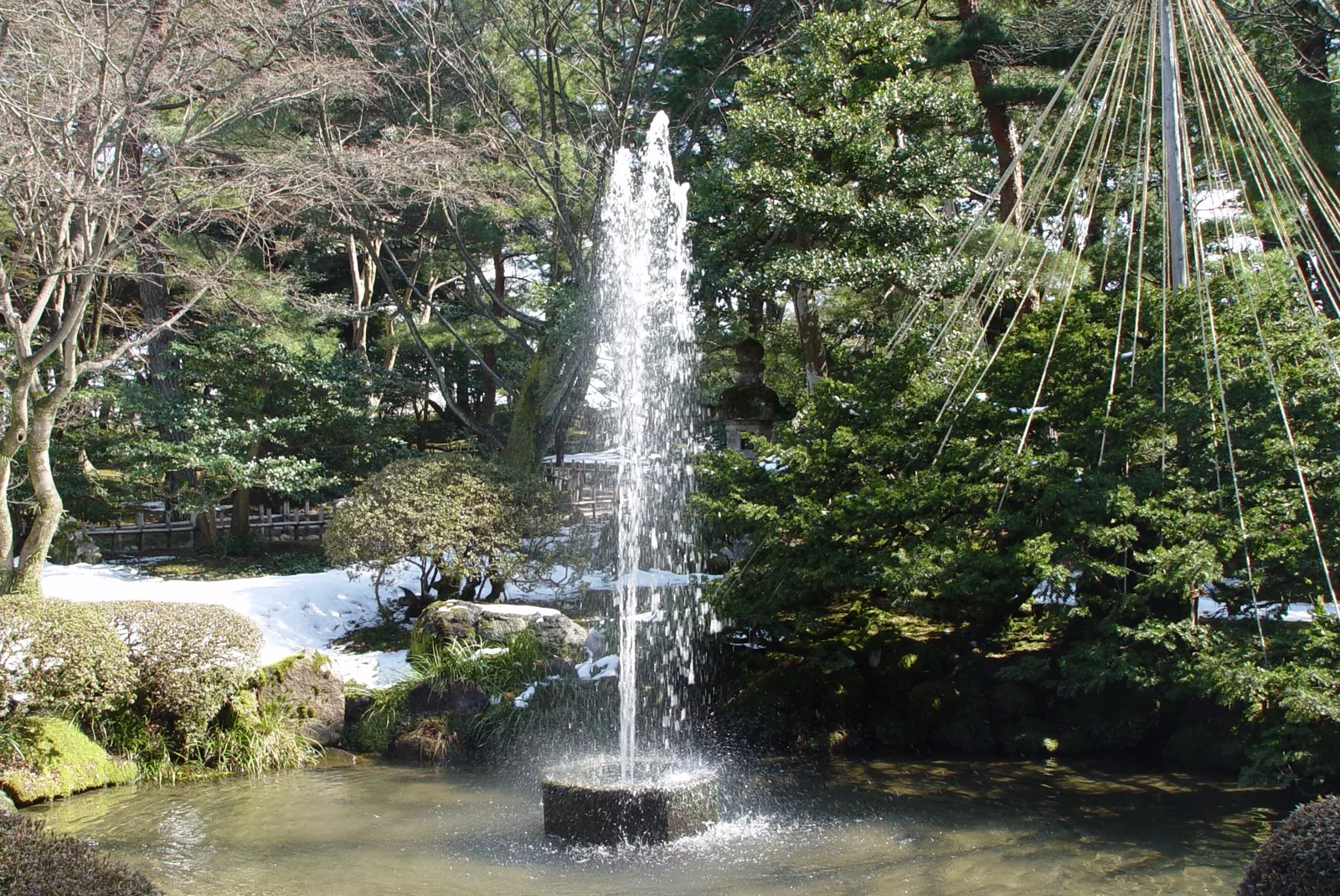
Almost none of that water is originally from here. In 1632 the third lord, Toshitsune, had a channel cut from the upper Saigawa river at Kami-tatsumi, about ten kilometres away, mainly so the castle would have something to fight fires with. The Tatsumi channel was later routed into the garden’s streams. Midori-taki drops 6.6 metres out of the main pond on its way down to Hisago-ike, which is a long way for water that arrived as a fire precaution.
Figure 3
So the garden is full of water, and water lives low. Which should settle the matter.
Then you climb to Chōbō-dai, where the prefecture’s short route begins, and it hands you the distance anyway. Utatsu-yama stands immediately in front, Mt Tomuro and Mt Iozen behind it, part of the Hakusan range beyond that. On a clear day the view keeps going, past the Kaga plain to the Kahoku lagoon, the Uchinada dunes, the Sea of Japan, and the Noto peninsula.
You are standing in a garden of ponds, looking at the sea.
Which route reaches which
Three pairs, then. Here is the part that decides your morning: the prefecture publishes two routes, and they do not reach the same ones.
The flat route is about 500 metres and is given as roughly thirty minutes. It is the one recommended for wheelchair users, and it runs Chōbō-dai → the Karasaki pine → Kasumiga-ike → the Kotoji lantern → Gankō-bashi → Shichifukujin-yama → the Kenrokuen cherry → the Meiji memorial → the raised-root pine → Hanami-bashi → Uchihashi-tei.
Read against the six, that route gives you the whole of artifice and antiquity — the raised-root pine and the Karasaki pine are both on it — plus the open half of the first pair, plus the viewing terrace. What it does not reach: Yamazaki-yama, Hisago-ike, Midori-taki, the fountain. Which is to say, the secluded half, and all of the water.
The full route is about 1,300 metres and is given as roughly ninety minutes. It adds those four, along with Sekirei-jima, the plum grove, Funa-no-ochin, Shigure-tei, Sazae-yama and Yugao-tei. That ninety-minute figure also covers the Traditional Arts and Crafts Museum and Seisonkaku, which charge separately; leave those out and the garden itself takes rather less.
Thirty minutes is not a compressed version of ninety. It is a complete half of the claim.
Figure 4
| The three pairsgold rule = one pair | 30 min flat route |
90 min full route |
|---|---|---|
| Artificeraised-root · Karasaki | ● | ● |
| Antiquitymoss, old trees | ● | ● |
| VastnessKasumiga-ike | ● | ● |
| Secluded depthYamazaki · Hisago | — | ● |
| Waterfountain · Midori-taki | — | ● |
| Long viewChōbō-dai | ● | ● |
| Pairs reached | 4 of 6 | 6 of 6 |
A few things that are easy to get wrong:
- Admission is ¥320 for adults and ¥100 for ages 6–17, and free for visitors aged 65 and over on production of ID. The Japanese-language page lists credit cards and electronic money as accepted; the English page, checked on 11 September 2026, said cash only. Carry cash.
- A ¥500 combination ticket adds the turret complex at Kanazawa Castle Park, immediately next door.
- Gankō-bashi is closed. The eleven stones of the goose-flight bridge have worn too far to walk on. It is still there to look at.
- Shigure-tei costs nothing to enter — 9:00 to 16:30, last entry 16:00, and closed between noon and one for cleaning. Matcha with a sweet is ¥1,000, sencha ¥500.
- There is no official map of toilets inside the garden that we could find (checked 12 September 2026).
The hours before it opens
The wide part of the garden is at its widest when there is no one on the far shore, and for part of every morning the garden is free.
| Period | Free early opening | Last entry |
|---|---|---|
| 1–31 March | 5:00–6:45 | 6:30 |
| 1 April – 31 August | 4:00–6:45 | 6:30 |
| 1 September – 15 October | 5:00–6:45 | 6:30 |
| 16–31 October | 5:00–7:45 | 7:30 |
| 1 November – end of February | 6:00–7:45 | 7:30 |
Two things follow from this table. Only two gates open during those hours — Renchimon and Zuishinzaka — so arriving early settles your route before you do. And the closing and last-entry times above come from the Japanese-language page; on the English page, checked on 11 September 2026, we could find only the opening times. Neither page says whether you are expected to leave when the free period ends, so plan on being asked to.
Regular hours are 7:00 to 18:00 from 1 March to 15 October, and 8:00 to 17:00 from 16 October to the end of February, last entry thirty minutes before closing. The garden does not close for holidays.
Which gate you want depends on what you are pairing the garden with. Katsurazaka is a five-minute walk from the Kenrokuen-shita bus stop, which is about twelve minutes by bus from Kanazawa Station; take it if you are going on to the castle. Mayumizaka is five minutes from the Hirosaka / 21st Century Museum stop, about ten minutes by bus from the station, and puts you next to the museum. Official descriptions do not give gradients for the approaches.
On crowds, the prefecture publishes attendance for its free-admission periods, and the figures repay a careful reading. The cherry-blossom opening in 2024 drew 486,600 people over ten days — about 48,660 a day, the highest since free openings began in 1977. The Hyakumangoku festival opening in 2025 drew 36,888 over three days, about 12,296 a day. The new-year opening, about 12,200 a day. Free entry is not what produces the crowd. Cherry blossom is. There is no published hour-by-hour attendance data.
Where I stand
If the morning is short, take the flat route and don’t feel short-changed. Thirty minutes gets you artifice and antiquity whole — both pines — along with the open half of the first pair and the terrace with the sea behind it. That is one of the three pairs settled in full, and half of another.
If you have ninety minutes, spend the extra hour at the far end. The secluded half and all of the water sit past the point where the short route turns back: the 570-metre stream, Hisago-ike, Midori-taki, and a fountain standing three and a half metres in the air on nothing but the level of the pond above it.
What I would give up to get there is the paid extras. The Traditional Arts and Crafts Museum and Seisonkaku both charge separately, and both are folded into that ninety-minute figure — leave them out and the garden itself takes rather less than the number suggests. I would rather spend the difference on the part of the garden that can only be reached on foot.
Two ways to fit it into a day
Half a day. Katsurazaka gate → Chōbō-dai → the flat route, thirty to forty minutes → out at Katsurazaka → Kanazawa Castle Park next door on the ¥500 ticket. You will have both halves of artifice and antiquity, the wide water, and the sea from the terrace. You will not have the seclusion or the fountain.
A full day. Renchimon or Zuishinzaka in the free early hours → Chōbō-dai and the pond at first light → pay at the gate when regular hours begin, 7:00 from March to mid-October and 8:00 otherwise → the full route, taking in Yamazaki-yama, the fountain and Hisago-ike → breakfast at Omicho Market, where the first counters open at seven → the 21st Century Museum of Contemporary Art, whose public zone runs 9:00 to 22:00, though the exhibition zone closes on Mondays → Higashi Chaya in the afternoon. Seisonkaku, inside the garden’s grounds, closes on Wednesdays.
Either way, leave by the raised-root pine — forty roots in the air, holding up a tree that was made to look older than it is, by a lord who had soil piled around it and then carried away.
Kanazawa named this place after an argument: six qualities that a Song-dynasty book said no garden could hold at once. The short route shows you the garden. The long one is where you find out whether the name was earned.
Sources and images
- Ishikawa Prefecture, official Kenrokuen site — garden history, the six qualities, routes, opening hours, admission, the fountain, the Tatsumi channel, yukitsuri. Checked 11–12 September 2026. English and Japanese pages differ on payment methods and closing times; both readings are given in the text.
- Attendance figures for free-admission periods: Ishikawa Prefecture announcements. Checked 12 September 2026.
- Photographs: the raised-root pine by lienyuan lee (CC BY 3.0, Wikimedia Commons); the Kotoji lantern by Daderot (CC0, Wikimedia Commons); the fountain by Jovandavid (public domain, Wikimedia Commons).
- Some images on this page are AI-generated scenes and are labelled as such. They illustrate the setting; every factual claim rests on the sources above, not on the images.
- Diagrams drawn by us from the figures published by Ishikawa Prefecture.