
What's in this guide11 sections
Quick answer
ZenMarket is not a scam. It is run by ZenGroup Inc., an Osaka company founded in 2014, and holds a solid 4.0 Trustpilot score (9,408 reviews). Among collectors it is the consensus pick for Yahoo! Auctions. Its service fee includes shipping insurance and consolidation, and the 60-day free storage is among the longest in the business. Its weaknesses: the spring 2026 fee increase put Mercari and Yahoo! Auctions purchases at ¥800 per item, and two costs sit outside the fee table (a 4.99% exchange rate spread, measured August 3, 2026, and the prepaid deposit top-up fee, officially 3.5%), which together come to 3.3 times the ¥800 on a ¥30,000 order. First pick for auction hunters; Mercari-focused buyers should compare Buyee first. As of August 2026.
Ask Reddit which proxy service to use for Yahoo! Auctions and the answer barely varies: ZenMarket. Its Trustpilot score, 4.0, sits comfortably above the 3.6 of Buyee, the industry’s biggest name. So far, this looks like a review with no suspense.
Then you open the fee table. In spring 2026, ZenMarket raised its fee for Yahoo! Auctions and Mercari Shops from ¥500 to ¥800 per item, Mercari purchases now sit at ¥800 across the board. Per item, that is among the highest rates of any major proxy. The best-reviewed service is also the most expensive one. How do those two facts fit together?
The answer is in what the fee includes. This review breaks down what the ¥800 actually buys, where the deposit system catches people off guard, and which complaint patterns emerge from 9,400+ reviews, all from official pages and documented user reports. We have no financial relationship with ZenMarket or its competitors.
What is ZenMarket? (30 seconds)
ZenMarket is a proxy shopping service operated by ZenGroup Inc., founded in Osaka in April 2014. It buys items on your behalf from Japanese sites, receives them at its warehouse, and ships them overseas in one consolidated box. It supports Mercari, Yahoo! Auctions, Amazon Japan, Rakuten, Rakuma and (per the official line) any other online marketplace. It also runs a sister marketplace, ZenPlus, which ships overseas directly.
The full fee picture (July 2026, from official pages)
You pay in two rounds: item price plus service fee first, then international shipping once your parcel is weighed. Both payments come out of an account balance you top up in advance (more on that below).
| Fee | Amount | Notes |
|---|---|---|
| Service fee: recommended stores | ¥300 per item | Selected shops: minne, Suruga-ya, BOOTH and others |
| Service fee: standard (Amazon, Rakuten, most sites) | ¥500 per item | |
| Service fee, Mercari & Yahoo! Auctions | ¥800 per item | Yahoo! Auctions and Mercari Shops raised from ¥500 in April–May 2026 |
| Consolidation & initial packing | Free | Included in the service fee |
| Shipping insurance (parcels under ¥5,000,000) | Free | Included in the service fee |
| Storage | Free 60 days, then ¥50/day per item | 90-day hard limit, then disposal without compensation |
| Parcel reinforcement | ¥1,000 per box | Optional |
| Cancellation after arrival | ¥1,000 per item | Only if the seller accepts the return |
| International shipping | At cost | Official calculator, 190+ countries, up to 50kg |
The number to stare at is the ¥800, specifically, what’s inside it. Buyee’s ¥500 is a bare price: inspection and shipping compensation are paid options at ¥300–500 each. ZenMarket’s fee includes consolidation, shipping insurance for parcels under ¥5,000,000, and domestic bank fees from the start. Price the two services with protection switched on, and the gap all but disappears.
The deposit system: ZenMarket’s one quirk
You don’t pay per order with your card. You top up an account balance first: by card (Visa, Mastercard, Amex via Stripe), PayPal, bank transfer, Wise, Alipay, or 45+ cryptocurrencies. Every payment draws from that balance.
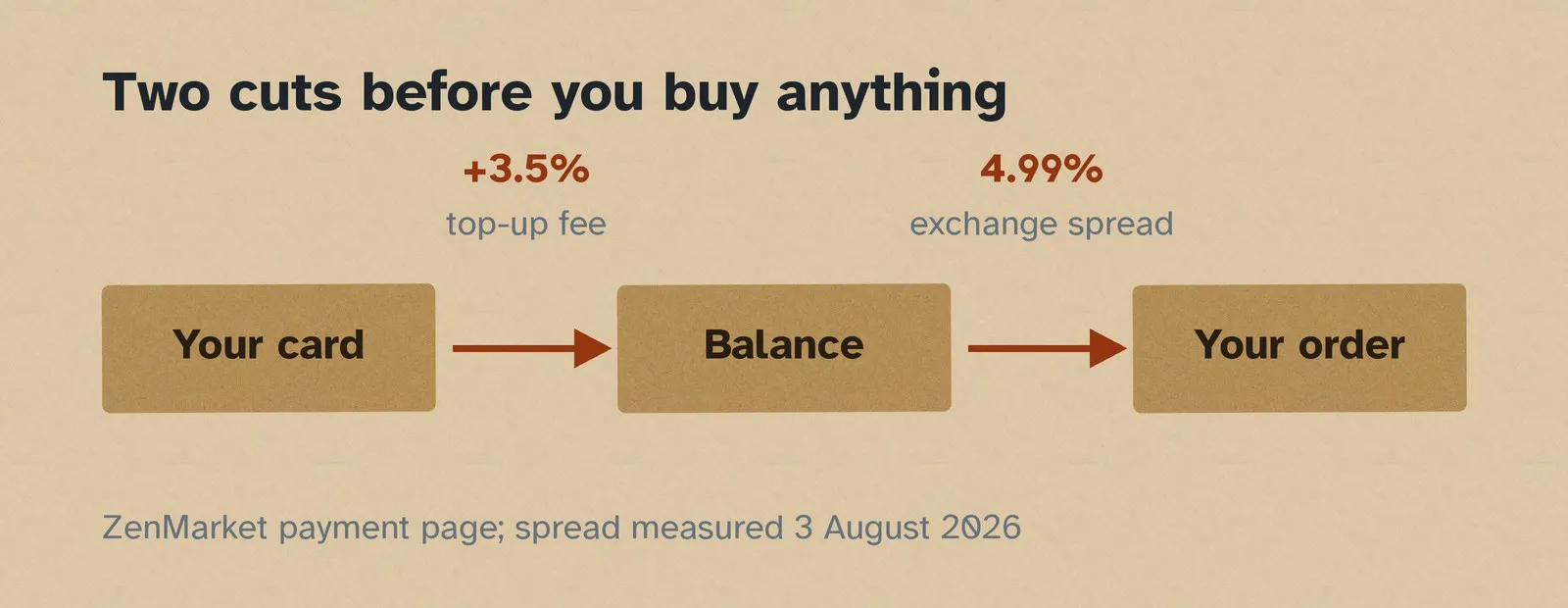
Two things to know. Topping up costs a fee: the official payment page states 3.5%, though another official page says rates start from 1%, so the exact rate may vary by method. We could not pin down a full table. And your balance expires in 180 days, after which withdrawals are restricted. For a service whose banner is “no hidden fees,” the deposit fee is the one cost that never appears on a product quote. Budget for it.
What the insurance actually covers
The fee includes “shipping insurance,” say the official pages. The user agreement, meanwhile, says ZenMarket is not responsible if an item doesn’t match its description or arrives damaged, compensates only when its own staff are proven at fault (capped at the item’s value), and considers its service complete once the parcel is handed to the carrier. How the insurance and the disclaimers mesh is not something we could resolve from the official pages. What is clear: seller-side problems (misdescribed items, scams) are not covered, and there are documented Reddit reports of buyers not being refunded after seller fraud.
A worked example: three ¥2,000 Mercari items
Same basket as in our Buyee review, for comparison.
- Items: ¥6,000
- Service fee: ¥800 × 3 = ¥2,400 (insurance and consolidation included)
- Deposit fee: roughly ¥300 (at 3.5%)
- Fees so far: about ¥2,700: before international shipping adds another ¥2,000–5,000 by weight
Buyee runs ¥1,500 bare, or ¥3,000 with its Standard protection plan on every item. So on fees alone the ranking depends on how you shop: cheapest without protection is Buyee; cheapest with protection included is (narrowly) ZenMarket, even after the price increase. Buying a single item, though, you will feel the ¥800.
Add shipping and that narrow win disappears. We later pulled real quotes from both calculators for an identical 2kg parcel to the US: Buyee came in ¥3,119–6,199 cheaper depending on the carrier, which flips the total regardless of protection. The full numbers are in Buyee vs ZenMarket.
The two fees that aren’t in the fee table
Every number above is in yen. You don’t pay in yen.
ZenMarket is one of three major proxies that convert your money at their own rate (Buyee and FromJapan are the others), and none of the three publish the spread. On August 3, 2026 at 12:27 JST, ZenMarket’s site displayed ¥150.00 to the dollar. The market rate at that moment, taken from the OANDA figure Buyee prints on its own checkout page, was ¥157.48. That is a 4.99% spread, and it applies to the item price, not just to the fee.
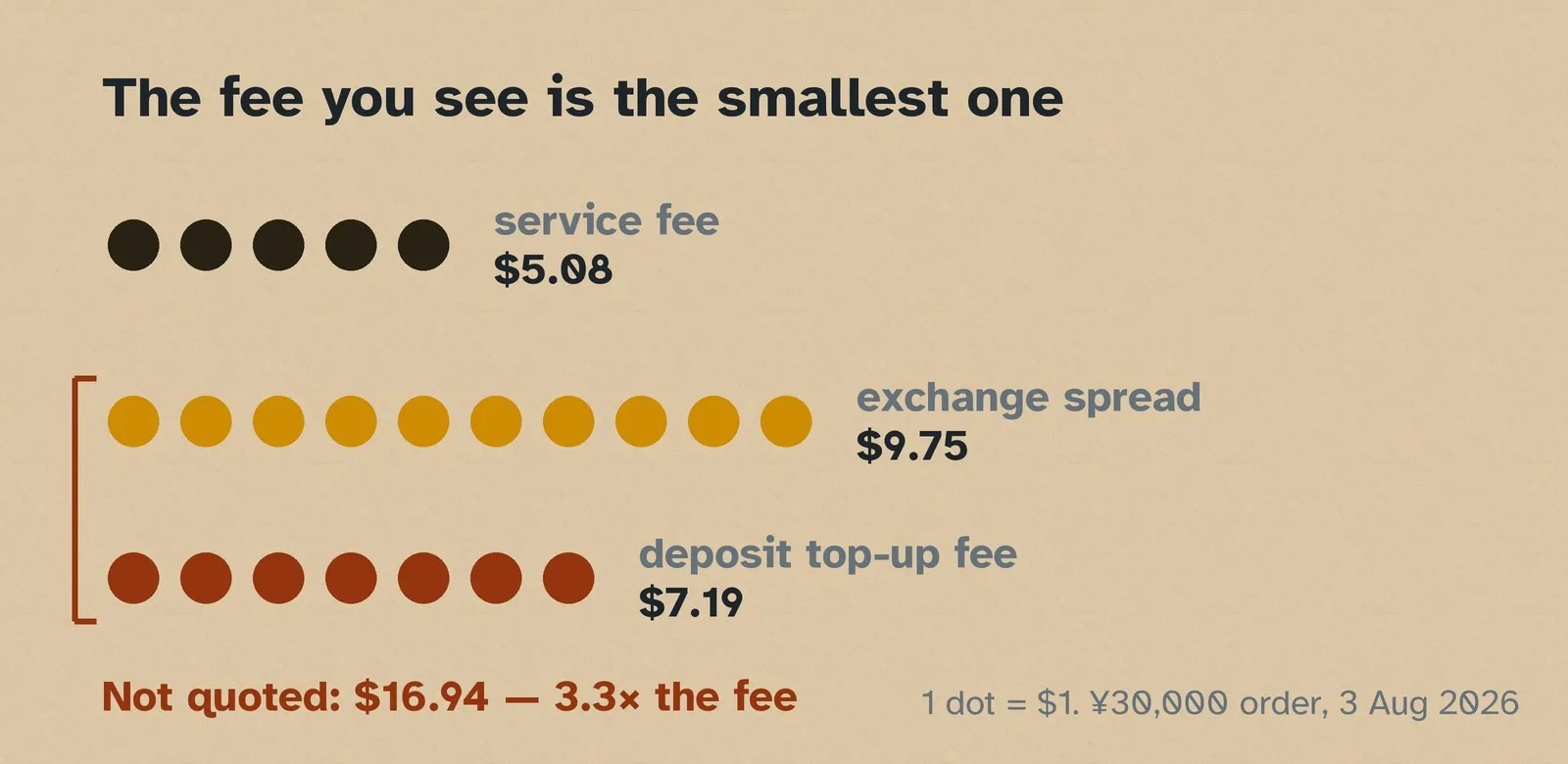
Set that beside the deposit top-up fee and the ¥800 argument changes shape. Here is a ¥30,000 Yahoo! Auctions purchase with every line converted at the market rate, so the numbers add up:
| What you pay | |
|---|---|
| The item | $190.50 |
| Service fee (¥800) | $5.08 |
| Exchange rate spread (4.99%) | $9.75 |
| Deposit top-up fee (3.5%) | $7.19 |
| Charged to you | $212.52 |
The cost ZenMarket quotes you is $5.08. The two it doesn’t quote come to $16.94, 3.3 times the fee that gets all the attention.
This is not a ZenMarket failing in particular. Buyee’s spread the same day was 4.88%: a difference of 0.11 percentage points, or 21 cents on this order. On currency, the two are the same service. The deposit fee is what separates them: Buyee charges your card per order, so there is no balance to fund and nothing to take a cut of.
Which means the “narrowly cheaper with protection” verdict above needs one correction. The same three ¥2,000 Mercari items, with the deposit fee counted:
| Total | |
|---|---|
| Buyee, no protection (¥500 × 3 orders) | $49.95 |
| ZenMarket (¥800 × 3, insurance included) | $56.00 |
| ZenMarket + deposit fee | $57.96 |
| Buyee + Standard protection (¥500 × 3) | $59.94 |
ZenMarket still comes out ahead on a protected basket, by $1.98, down from $3.94 before the deposit fee is counted. So is ZenMarket expensive? On a consolidated haul you’d have insured anyway, no. On a single unprotected purchase, yes, and by more than the fee tables suggest: $8.01 on this basket.
What we could not confirm. The ¥150.00 is what ZenMarket displays, but ZenMarket runs on deposits, so the conversion happens when you fund your balance rather than when you buy. Confirming that the displayed rate is the funding rate would mean completing an order, which we have not done. Read 4.99% as measured, not as stated policy.
One caveat for buyers outside the dollar: Buyee’s spread varies by currency, from 3.71% on the Chinese yuan to 6.37% on the British pound. Whether ZenMarket varies its rate the same way could not be tested, its currency switcher can’t be driven from outside the site. The full seven-service measurement, including the two services that add nothing at all on currency, is in our investigation of proxy exchange rates.

What 9,400+ reviews actually say
ZenMarket’s Trustpilot score is 4.0 from 9,408 reviews (checked July 25, 2026). The complaints collapse into three patterns:
- Cancellation costs: ¥1,000 per item once it reaches the warehouse; on cheap items, the cancellation fee can exceed the item price
- No cover for seller trouble, scams and misdescribed items are outside the compensation policy
- Repacking delays: changing your shipping method triggers a repack, typically costing 2–3 days
The praise clusters just as tightly, around customer support. “Worth paying a bit more for” is a recurring phrase, and for Yahoo! Auctions the community consensus runs ZenMarket first, FromJapan second. This is ZenMarket’s second price rise (¥300 to ¥500 in October 2023, now ¥500 to ¥800 for auctions and Mercari Shops), and each one drew grumbling without moving the consensus.
Who should use ZenMarket, and who shouldn’t
Use ZenMarket if you buy mostly from Yahoo! Auctions (the consensus pick), you collect purchases over weeks before shipping (60 free days, free consolidation), or you’d rather pay one flat fee with insurance built in than manage options.
Consider alternatives if you buy mostly from Mercari (Buyee’s official partnership and bare ¥500 fee win there), you ship fragile or high-value items (Japan Rabbit’s packaging reputation is unmatched), or you want minimum fees (Neokyo charges ¥350, Doorzo less, though we priced both services end to end and Doorzo’s lower fee is not the number that decides it).
For the full seven-service breakdown, see our comparison of Japan proxy shopping services.
How ZenMarket works, step by step
- Register (free) and add items to your cart
- Top up your balance and pay for the items, first payment
- Wait a few days while ZenMarket buys the items and they reach the warehouse
- Choose your shipping method and address
- Once the parcel is weighed and measured, pay international shipping, second payment
- Receive your box
- Mind the two clocks: 60 free storage days, and the 180-day balance expiry
FAQ
Is ZenMarket legit? Yes. ZenMarket is operated by ZenGroup Inc., founded in Osaka in 2014 with ¥80 million in capital, and holds a 4.0 Trustpilot score from 9,408 reviews as of July 2026. For Yahoo! Auctions it is the community’s consensus first pick.
How much are ZenMarket’s fees? ¥300 per item at recommended stores, ¥500 at Amazon, Rakuten and most sites, and ¥800 for Mercari and Yahoo! Auctions after the spring 2026 increase. Consolidation and shipping insurance for parcels under ¥5,000,000 are included. A deposit fee (officially stated at 3.5%) applies when you top up your balance.
ZenMarket or Buyee, which is better? The community rule of thumb: Buyee for Mercari (official partner), ZenMarket for Yahoo! Auctions. On total cost, Buyee is cheaper used bare; ZenMarket is narrowly cheaper once you add protection, since its fee includes insurance.
Does ZenMarket refund problem items? Only when ZenMarket itself is proven at fault, capped at the item’s value. Seller-side problems (items not matching the description, scams) are not covered, and there are documented reports of refunds being refused. Check seller ratings carefully on expensive purchases.
Is ZenMarket expensive? It depends on the basket. On three ¥2,000 Mercari items with protection, ZenMarket totals $57.96 against Buyee’s $59.94, cheaper, because insurance is included in the ¥800 fee. Without protection Buyee comes to $49.95, which puts ZenMarket $8.01 higher. Two costs outside the fee table drive the gap: a 4.99% exchange rate spread, measured on August 3, 2026, and a deposit top-up fee officially stated at 3.5%.
Does ZenMarket charge a deposit fee? Yes. ZenMarket runs on a prepaid balance, and topping it up costs 3.5% according to the official payment page, though another official page says rates start from 1%, so it may vary by method. On a ¥30,000 order at 3.5% that is roughly $7.19, more than the ¥800 service fee itself. It is the one cost that never appears on a product quote, and your balance expires after 180 days.
Does ZenMarket mark up the exchange rate? Measured on August 3, 2026 at 12:27 JST, ZenMarket displayed ¥150.00 per US dollar against a market rate of ¥157.48, a 4.99% spread, applied to the item price rather than the fee. Buyee’s was 4.88% the same day, so the two are effectively identical on currency. We could not confirm whether the displayed rate is the one applied when you fund your balance.
The bottom line
The riddle from the top (best reviews, highest fee) comes down to where each service hangs its price tag. Buyee posts a low sticker with an options shelf beside it; ZenMarket folds the shelf into the sticker. That’s why ¥800 stings on a single impulse buy and looks reasonable on a consolidated haul with insurance you’d have paid for anyway. If your habit is stalking Yahoo! Auctions for weeks and shipping one box a month, the community’s verdict has survived two price rises for a reason. Just add the deposit fee to your budget, it’s the one number the quote won’t show you.