
What's in this guide11 sections
Quick answer
Comparing the two fee tables decides almost nothing. On an identical basket (three ¥2,000 Mercari items, 2kg, ECMS to the United States) Doorzo comes to ¥10,978–11,178 and ZenMarket to ¥15,327. Most of that gap is shipping, not fees: ECMS costs ¥4,278 through Doorzo and ¥6,409 through ZenMarket. But a third number sits outside both tables. Doorzo bills Japan domestic postage, sometimes as a cash-on-delivery adjustment after your parcel reaches the warehouse, and on two Book Off listings at the same ¥8,800 price we saw ¥600 and ¥1,000. Three store items is ¥1,800–3,000, most of the gap, gone. So the answer changes with what you buy: Mercari and small, Doorzo wins clearly; store purchases, the comparison stops being decidable; over $800, Doorzo unlocks ¥3,300 sea mail and wins outright; high-value or insured, ZenMarket, whose ¥800 includes shipping cover to ¥5,000,000. As of August 2026.
Put the fee tables side by side and the contest looks settled. Doorzo asks ¥200–300 per item. ZenMarket asks ¥800 for a Mercari purchase, about 2.7 to 4 times Doorzo’s fee.
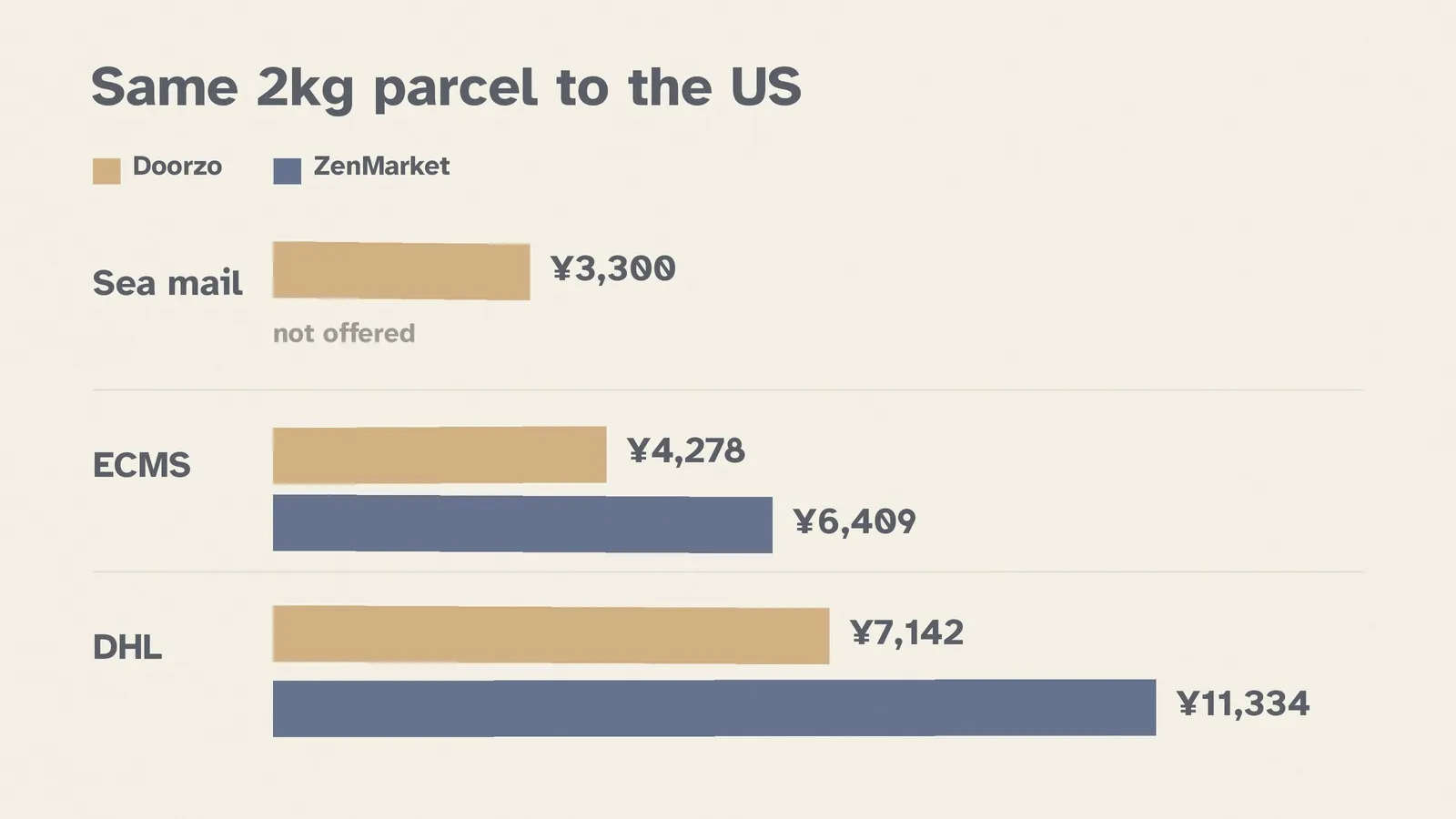
Then price the shipping, and a bigger number moves in the other direction. ECMS, 2kg, to the United States: ¥4,278 on Doorzo, ¥6,409 on ZenMarket. That single line is ¥2,131, more than the entire fee difference on a three-item order (¥1,500–1,800).
And then there is the line that appears on neither table.
The fee tables, and what is inside them
Doorzo’s proxy purchase fee is 3% of the item price, with a ¥200 minimum and a ¥300 cap per item (up to ¥500 on Surugaya items), shown once the item is in your cart (official); our Doorzo review goes through the rest of its pricing. ZenMarket runs three tiers: ¥300 at recommended stores, ¥500 at most shops, and ¥800 for Mercari and for auction bidding (official), and our ZenMarket review covers what that buys you.
Read only that, and Doorzo wins by a distance. The tables are not measuring the same thing, though.
| Doorzo | ZenMarket | |
|---|---|---|
| Fee per item | ¥200–300 (3% of the item price) | ¥300 / ¥500 / ¥800 (Mercari, auction bids) |
| Included in the fee | Consolidation, up to 10 orders | Consolidation, protective packing, shipping insurance to ¥5,000,000, domestic bank fees |
| Protective packing | ¥100–300 by weight, plus ¥200 outer wrap | Included |
| Free storage | 60 days single / 15 days after consolidation | 60 days, then ¥50/kg/day |
| Prepayment fee | None, you pay in two stages | 3.5% on deposits (see below) |
| Exchange rate | Not published | Displayed rate, roughly 5% off market |
| Trustpilot | 4.6 from 1,144 reviews (29 Jul 2026) | 4.0 from 9,408 reviews (25 Jul 2026) |
ZenMarket’s ¥800 carries insurance and packing inside it. Doorzo’s ¥200–300 is bare, and packing is billed on top. The gap is real, but it is narrower than the headline.
We priced the shipping on both
Neither company publishes a fixed rate card; quotes only exist inside their calculators. We ran identical inputs through both official tools (2kg, destination United States, July 2026) and recorded what came back.
| Method | Doorzo | ZenMarket |
|---|---|---|
| Sea mail (2–4 months) | ¥3,300, orders over $800 only | Not offered |
| ECMS (5–13 days) | ¥4,278 | ¥6,409 |
| EMS | Orders over $800 only | ¥7,900 |
| FedEx | Not found | ¥8,612 |
| DHL | ¥7,142 | ¥11,334 (GREEN+) |
Doorzo is cheaper on every route we could compare: ¥2,131 on ECMS, ¥4,192 on DHL. Whatever you conclude from the fee tables, more money moves here.
One condition governs the top row. On US-bound parcels, Doorzo can only use Japan Post (EMS, EPL, air mail, sea mail) when the parcel’s total value exceeds $800. The ¥3,300 sea mail rate, the lowest figure we have found from any proxy service, is therefore unavailable on precisely the small orders that would benefit most from it: the same threshold decided our Doorzo-versus-Neokyo comparison.
The number neither table shows
Doorzo splits payment in two: item price, proxy fee and Japan domestic shipping at order time, then international shipping after the parcel reaches its Tokyo warehouse. Its fee page also lists a “Japan Domestic Shipping COD” line in that second stage: domestic postage has an official route to reach you after you have already paid (official).

How much? Open Doorzo’s product pages and the answer is not a rule but a spread. Two Book Off listings, both at ¥8,800, from the same retailer, showed ¥600 and ¥1,000 of domestic postage. Same price, same shop, different number, and nothing published explains the difference.
Three items from stores like that is ¥1,800–3,000. Set that against the ¥4,149–4,349 gap we are about to calculate, and most of it disappears.
ZenMarket’s fee page has no domestic shipping line at all. Its ¥800 is stated to include domestic bank fees, which is a different thing. We could not establish what ZenMarket charges to move an item from the seller to its warehouse, which means the honest position is that neither total can be fully assembled in advance.
The worked example
Three ¥2,000 Mercari items (¥6,000) consolidated into a 2kg box and sent by ECMS to the United States. Duty is excluded from both columns because it depends on the goods.
| Doorzo | ZenMarket | |
|---|---|---|
| Items | ¥6,000 | ¥6,000 |
| Service fee | ¥600 | ¥2,400 |
| Protective packing | ¥100–300 | Included |
| Shipping (ECMS, 2kg) | ¥4,278 | ¥6,409 |
| Deposit fee (3.5%) | — | ¥518 |
| Total | ¥10,978–11,178 | ¥15,327 |
Doorzo is ¥4,149–4,349 cheaper. On Mercari, where domestic postage is usually carried inside the listing price, that figure is close to what you will actually pay.
Buy the same value from stores instead, add ¥600–1,000 of domestic postage per item, and the same comparison lands somewhere between ¥1,149 and ¥2,549. The ranking has not flipped, but it has stopped being a fact and become a range.
Two reasons Doorzo’s total will not hold still
The fee itself has a published rule. Doorzo’s fee page sets it at 3% of the item price, with a ¥200 minimum and a ¥300 cap per item; the number settles when the item is in your cart. The two lines below are where the total moves.
International shipping is recalculated on arrival. Doorzo’s calculator states its output is a reference figure and that the charge is computed from actual weight and dimensions once the parcel is at the warehouse.
The exchange rate is not published anywhere. This is the one we spent the most time on. In July we looked through the quote screen, the underlying data requests and the help centre. In August we tried four more routes: the site’s currency switcher, the help pages, FAQ and terms of service, the shipping calculator’s currency display, and the app listing. We could not find a currency switcher on the site at all. Doorzo’s site assembles its pages entirely in the browser, and no exchange figure appears anywhere in what it renders.
We are not saying the rate is hidden. We are saying we could not find it. What follows from that is narrow and practical: if you budget in a currency other than yen, you will not know what Doorzo’s invoice becomes in your own money until it is charged.
ZenMarket shows every number, with two asterisks
The other side of this comparison is a company that prints its prices. Storage is 60 days free, then ¥50 per kilo per day. Photographs before shipping are ¥500 per item. Repacking after your box is sealed is ¥1,000–4,000. Disposal of unwanted items is ¥300 per kilo. You can add these up.
Asterisk one: the prepayment fee contradicts itself. ZenMarket’s payment page states the deposit fee is 3.5% of the transaction, with a worked example: send ¥1,035 to deposit ¥1,000. Its fee summary lists the same item as “from 1%”. We found this in July; it was still there when we checked in August. We used 3.5% above, the figure that produces the larger total.
Asterisk two: the exchange rate you see is not the one you are charged. On 3 August we measured ZenMarket’s displayed conversion at ¥150.00 to the dollar against a market rate of ¥157.48 at the same moment, about 5% adrift, in the direction that makes yen prices look more expensive in your currency. But ZenMarket’s payment page states that conversion at checkout is performed by PayPal or the card processor at their rates. So “ZenMarket takes 5%” is the wrong conclusion. The right one is narrower: the foreign-currency figure you read on the site is not the amount you will be billed.
Four ways to buy, four answers
Mercari, small orders. Doorzo, by ¥4,149–4,349 on the basket above. Domestic postage usually sits inside a Mercari listing price, so this is the case where the unknowns bite least.
Store purchases, Book Off, amiami and similar. Not decidable in advance. Domestic postage of ¥600–1,000 per item is unpublished and irregular, and store coverage differs between the two services, so the same item is often not available on both. Doorzo’s reach into used and hobby retailers is the widest of the services we have compared; whether ZenMarket carries any particular one of them we have not verified.
Orders above $800. Doorzo, decisively. Japan Post unlocks and ¥3,300 sea mail beats ZenMarket’s cheapest route by ¥3,109 in the shipping line alone. The cost is time: two to four months.
High-value items. ZenMarket. Shipping insurance to ¥5,000,000 is inside the ¥800 fee. On a ¥100,000 purchase, cover matters more than ¥4,000 of total. We found no equivalent insurance statement for Doorzo.
Do not ignore the third service
For US-bound shipping specifically, neither of these is the cheapest we have measured. Buyee’s ECMS came to ¥3,290 for the same 2kg parcel, below Doorzo’s ¥4,278. Buyee’s fee is ¥500 per order rather than per item, so Doorzo pulls ahead as the item count rises, but on shipping alone the ranking runs Buyee, then Doorzo, then ZenMarket.
If shipping cost is the thing you are optimising, the Doorzo-versus-ZenMarket question may be the wrong one.
FAQ
Which is cheaper, Doorzo or ZenMarket?
On visible costs, Doorzo: ¥10,978–11,178 against ¥15,327 for three ¥2,000 Mercari items shipped 2kg to the US by ECMS. Most of the difference is shipping, not fees. Buying from stores instead adds ¥600–1,000 per item of Japan domestic postage on Doorzo, which narrows the gap to roughly ¥1,149–2,549.
Why can the totals not be compared exactly?
Two things on Doorzo are not knowable at order time: the final international shipping charge, and the exchange rate, which is not published. On ZenMarket, domestic shipping is not itemised on the fee page and the deposit fee is stated as both 3.5% and “from 1%”.
Is ZenMarket’s ¥800 fee expensive?
It is high per item, but it includes consolidation, protective packing, domestic bank fees and shipping insurance to ¥5,000,000. Doorzo’s ¥200–300 excludes packing, which is ¥100–300 plus ¥200 for an outer wrap.
What is ZenMarket’s prepayment fee?
Its payment page says 3.5% of the transaction; its fee summary says “from 1%”. The two have contradicted each other since at least July 2026 and still did in August. Budget for 3.5%.
What is the $800 rule on Doorzo?
For US-bound parcels, Japan Post services (EMS, EPL, air mail and sea mail) are only available when the parcel’s total value exceeds $800. Below that line the ¥3,300 sea mail rate cannot be selected and ECMS at ¥4,278 is the practical floor.
Which has the better exchange rate?
That comparison cannot be made. ZenMarket publishes a display rate, which on 3 August 2026 sat about 5% below market, though the actual conversion is performed by PayPal or your card issuer. Doorzo publishes no exchange rate that we could find.
The bottom line
Doorzo is cheaper, and the reason is shipping rather than the fee everyone quotes. Across every route we could price, it undercut ZenMarket, by ¥2,131 on the cheapest one.
What the fee tables cannot tell you is how much of that survives contact with your actual basket. Three items from a used-goods retailer can carry ¥1,800–3,000 of Japan domestic postage that appears on no comparison page: including, until now, ours. Cross $800 and Doorzo’s advantage roughly doubles. Buy something worth insuring and ZenMarket’s ¥800 stops looking expensive.
The two companies are not really competing on price. One of them sells a lower number; the other sells a number you can rely on before you order. Which of those you need depends on whether you are optimising a purchase or a budget.
The $800 condition is Doorzo’s own policy rather than a rule of the route, which is why it disappears the moment you order through somebody else. That is not true of every wall in this market: some of them stand at the same height whichever service you pick.
What we could not verify
Doorzo’s exchange markup, after seven separate approaches across two months. Whether Doorzo provides shipping insurance, and to what ceiling. What ZenMarket charges for domestic shipping from seller to warehouse. Which of ZenMarket’s two stated deposit fees is correct. Whether ZenMarket carries the used and hobby retailers Doorzo reaches. Doorzo’s FedEx availability.
ZenMarket’s live site refused our requests throughout early August, so its fee figures here were confirmed against a 25 July 2026 copy of the same pages and cross-checked against our own July measurements. Doorzo’s figures were taken from its live pages on 7 August 2026. Shipping quotes for both are from July 2026 and will move.