What's in this guide12 sections
Quick answer
Doorzo is a real company (SIG Service Inc., registered in Kita-ku, Tokyo, and trading since December 2013), and it holds the highest Trustpilot score of any major proxy service at 4.6 from 1,144 reviews. Its ¥200–300 service fee is the cheapest of the seven big players, it reaches stores no one else does (amiami, Lashinbang, Book Off), consolidates ten orders free, and stores single items for 60 days. Its weakness is all in one place: you cannot see your total. Payment splits in two, the second half isn't priced until your parcel reaches the Tokyo warehouse, Japan domestic shipping can arrive later as a COD adjustment, and US-bound parcels can only use Japan Post (the cheapest option) if the parcel's value exceeds $800. Good for heavy, cheap, unhurried shipping. Bad if you need the number up front. As of July 2026.
Line up seven proxy services and read only the fee column: Doorzo wins. ¥200 an item at the bottom, ¥300 at the ceiling, under Neokyo’s flat ¥350, less than half of ZenMarket’s ¥800 for Mercari. And its Trustpilot score, 4.6, is the highest of the group. Cheapest and best-reviewed. That should be the whole review.
Then you open the user communities and almost nobody is talking about fees. They are talking about shipping. One r/doorzo thread is titled “Doorzo shipping prices are absurd,” and describes $1,486 of goods that cost $2,107 to ship, 142%. Somewhere between saving ¥250 on fees and paying more for postage than for the items, something changes.
Where that gap comes from is written on Doorzo’s official fee page.
What follows is every cost we could put a number to, assembled from Doorzo’s own pages and from a shipping calculator that requires an account to open. We have no financial relationship with Doorzo or its competitors.
What is Doorzo? (30 seconds)
Doorzo buys items from Japanese shopping and flea-market sites on your behalf, receives them at a Tokyo warehouse, and ships them overseas in one box. It is operated by SIG Service Inc., founded 4 December 2013 and registered at Akabanekita, Kita-ku, Tokyo, with cross-border e-commerce development and operation listed as its business.
It covers Mercari, Rakuma, Yahoo! Auctions, PayPay Flea Market, Amazon Japan, Suruga-ya and Rakuten: plus amiami, Lashinbang and Book Off, which the others don’t reach. For figures, anime goods and second-hand hobby stock, that last group sometimes makes Doorzo the only option.
The site runs in 18 languages. Its Discord has roughly 4,200 members. Support is weekdays 10:30–18:30 JST with a stated one-business-day reply target; order processing and the warehouse run 10:00–19:00 daily, and anything ordered outside those hours waits for the next operating day.
The full fee picture (July 2026, from official pages)
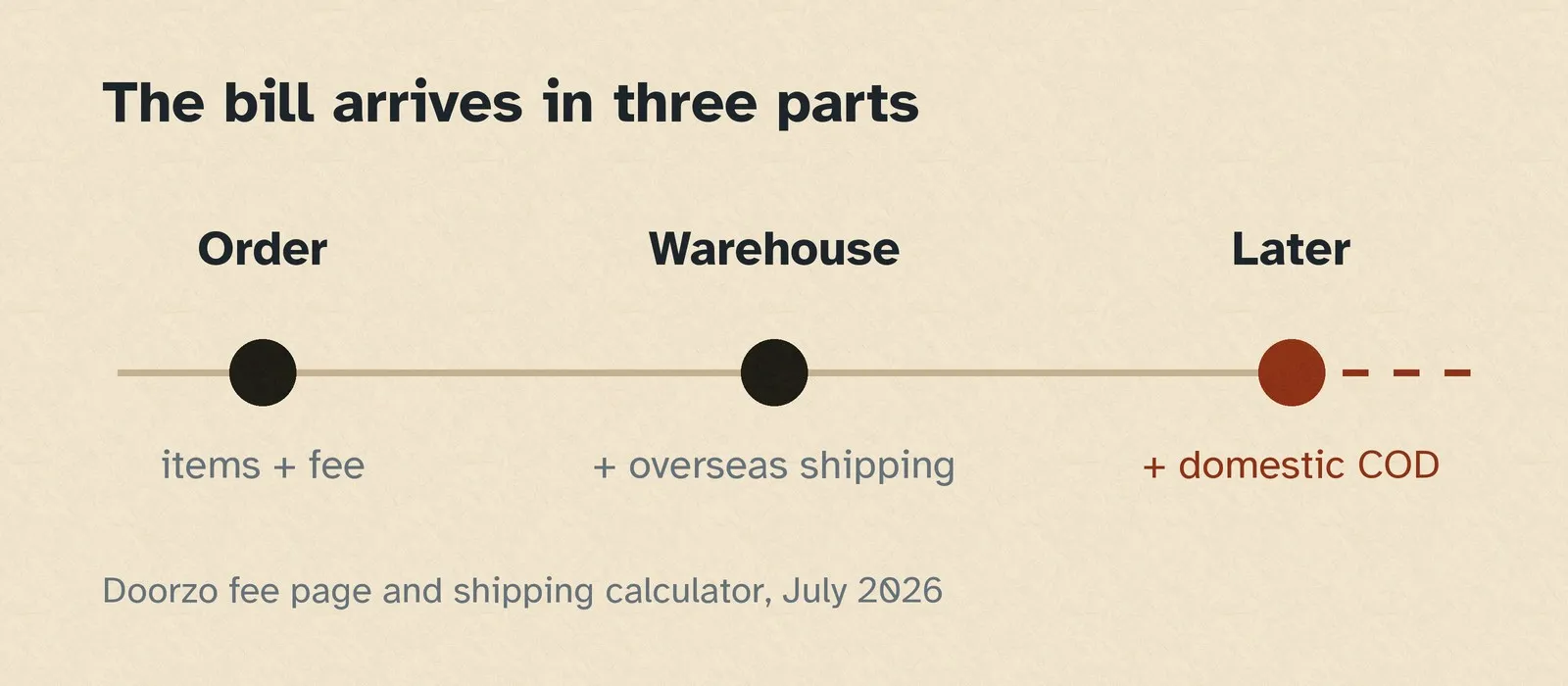
Doorzo splits payment in two. That structure is the whole story.
| Payment | When | What’s in it |
|---|---|---|
| First | At order | Item price + proxy purchase fee + Japan domestic shipping (if applicable) + optional services |
| Second | After arrival at the warehouse | International shipping + optional services + related fees (usually free) + Japan domestic shipping COD (if applicable) |
Two-stage payment is normal. Buyee does it, ZenMarket does it, nobody can price international shipping before a parcel is weighed. What separates them is how much else stays unpriced, which is the whole of our Doorzo versus ZenMarket comparison.
What is unusual is the last item in that second row. Doorzo’s fee page states that the “Japan Domestic Shipping COD” fee is listed as a shipping adjustment on arrival at the warehouse, payable together with international shipping. Domestic postage inside Japan has an official route to reach you after you have already paid for your order.
Here is everything with a number on it.
| Item | Amount | Notes |
|---|---|---|
| Proxy purchase fee | 3% of the item price, with a ¥200 minimum and a ¥300 cap per item (up to ¥500 on Surugaya items) | Official wording: the fee “will be shown in your shopping cart” |
| Fee-free coupon | One per week | Site banner: zero purchase fee, all sites, 1 coupon/week |
| Japan domestic shipping | Varies by item | Added at checkout, or billed later as a COD adjustment |
| Consolidation | Free up to 10 orders, then ¥100 per order | No cap on item count; carrier weight and size limits still apply |
| Free storage | 60 days single items / 15 days after consolidation | Extension up to +30 days at ¥50 per kg per day |
| Protective inner packing | ¥100 under 2kg / ¥200 for 2–5kg / ¥300 for 5–10kg | The figure above 10kg is unreadable in the page image. Glass and ceramics are excluded from postal compensation |
| Outer packing | ¥200 | |
| International shipping | At cost plus handling | No handling fee on EMS; DHL adds ¥150–2,200 by weight |
| Doorzo points | 1 point = ¥1 | Usable against Japan Post international shipping and some extra fees |
The fee really is the lowest in the business, and it follows a published rule: an item under ¥6,667 pays the ¥200 minimum, one above ¥10,000 pays the ¥300 cap, and in between the fee is 3% of the price. It appears when the item is in your cart.
The “zero purchase fee” campaign, unresolved in our Doorzo vs Neokyo comparison because its conditions were set in an image, turns out to be readable on the site banner: one coupon per week. Not a standing discount. One item per order, free.
The rule that isn’t on the fee page
On international shipping, the official fee page says the cost is calculated from the actual weight of your parcel and the method you pick.
Open the shipping calculator and a different note appears: under FedEx, DHL and ECMS rules, when volumetric weight exceeds actual weight, volumetric weight is used. Large, light parcels get billed by the space they take up. Figure boxes, cushioned packaging, shoes, all of them can price well above what the scale says.
The same note adds that the system estimates weight and volume automatically before a consolidated shipment goes out, re-weighs after dispatch, and refunds any overcharge, but does not require topping up an undercharge.
That r/doorzo complaint ($1,486 of goods, $2,107 of shipping) describes 28 items consolidated into five boxes, in packaging the buyer says was larger than the contents needed, with a repack request refused. Whether that was the rule working or the rule failing isn’t something one buyer’s account can settle. What is documented is that volumetric billing is official policy, and that it lives in a calculator note rather than on the page that explains the fees.
The $800 rule on US-bound parcels
The calculator carries one more restriction, in Doorzo’s own words (translated from the Japanese interface):
If the destination is the United States, Japan Post (EMS, EPL, airmail, surface mail) is only available when the total value of the parcel exceeds 800 USD. For parcels of 800 USD or less, Japan Post cannot be used, so please select another shipping method.
Set that against the real quotes for a 2kg parcel to the US, taken from the logged-in calculator (fees included):
| Method | 2kg to US | Available under $800? |
|---|---|---|
| Surface mail | ¥3,300 | ✕ (Japan Post) |
| ECMS air | ¥4,278 | ○ |
| Japan Post AIR Packet | ¥5,070 | ✕ |
| Doorzo Priority | ¥5,148 | ○ |
| Doorzo Air | ¥5,610 | ○ |
| Airmail | ¥6,700 | ✕ |
| FedEx | ¥6,839 | ○ |
| DHL | ¥7,142 | ○ |
| Japan Post EMS | ¥7,900 | ✕ |
The cheapest option is unavailable on cheap orders. Under $800, your floor is ECMS at ¥4,278. The threshold matches the US de minimis exemption; Doorzo gives no reason of its own.
So the smaller your purchase, the higher your shipping floor. Sending one ¥10,000 figure to the US, Doorzo’s ¥3,300 headline is not for you.
A worked example: three ¥2,000 Mercari items
Same basket as our Buyee and ZenMarket reviews.
- Items: ¥6,000
- Proxy purchase fee: ¥200 × 3 = ¥600
- Consolidation: free (within ten orders)
- Fees so far: ¥600
Doorzo wins this outright. Buyee charges ¥500 an item, so ¥1,500. ZenMarket charges ¥800 for Mercari, so ¥2,400 plus its deposit fee. On fees alone Doorzo runs between a quarter and two-fifths of its rivals.
Since June 2026 there is a fourth column for this basket: Mercari’s own overseas route, which publishes no fee. We measured it at a flat $4.65 per item (roughly ¥700, above every proxy here), but it carries no separate Japan domestic shipping, which is the cost none of these tables can predict.
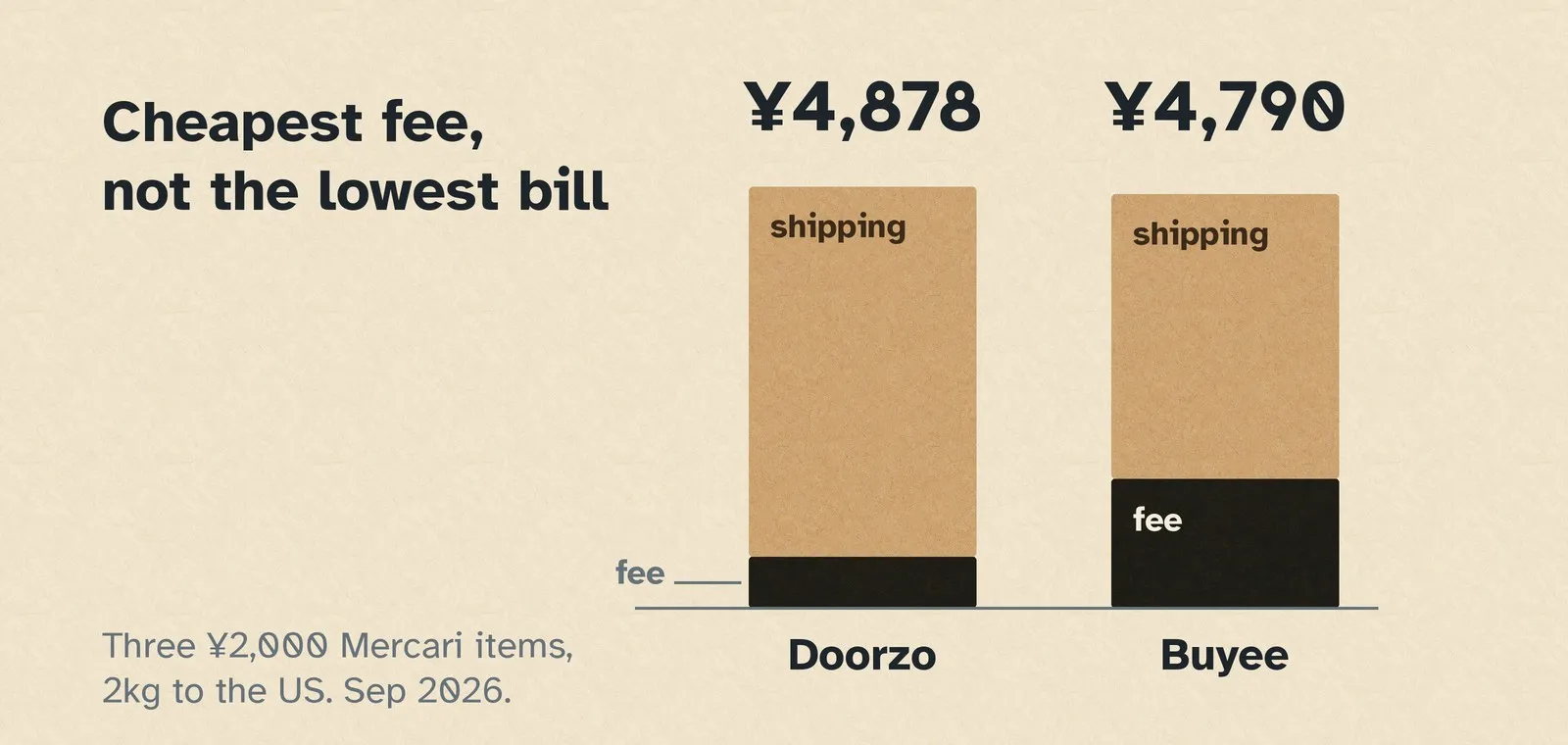
Add shipping and the picture inverts. ¥6,000 is about $37, far below the $800 line, so surface mail and EMS are both out. The cheapest available method for 2kg to the US is ECMS at ¥4,278.
- Doorzo total, fees plus shipping: ¥4,878
- Buyee, same basket: ¥1,500 in fees plus ECMS at ¥3,290 = ¥4,790
The fee advantage is more than spent on postage: Doorzo comes out ¥88 more expensive than Buyee.
And Japan domestic shipping is still to come. Open a Doorzo product page and Book Off listings show ¥600 and ¥1,000 of domestic postage: on two items at the same ¥8,800 price, from the same retailer. Three of those and the gap to Buyee only widens.
Whether Doorzo is cheaper depends on how you shop, which is true of every service here. What’s specific to Doorzo is that you find out which one it was after you’ve bought.
What 1,144 reviews actually say
Doorzo’s Trustpilot score is 4.6 out of 5 from 1,144 reviews (checked 29 July 2026), the highest of any major proxy, above ZenMarket’s 4.0 and Buyee’s 3.6. The distribution:
| Stars | Reviews |
|---|---|
| 5 | 982 |
| 4 | 73 |
| 3 | 18 |
| 2 | 14 |
| 1 | 57 |
Note the shape. Only 18 reviews sit at three stars, while 71 sit at one or two, 6.2% of the total. Opinion is bunched at both ends rather than spread.
The negative reports we could actually read are both about shipping: the 142% case above, and a second thread describing a parcel returned to Japan on a refused-delivery status.
One caveat on reading any of it. Doorzo staff participate actively in r/doorzohaul, the company runs an official Reddit presence and a Discord, and the reviews displayed on its own product pages are selected by Doorzo. Neokyo does the same thing through u/NeokyoProxy. Neither service’s community is a neutral sample.
What recurs in the praise is dispatch speed and packing care: the on-site reviews we read were from buyers in Malaysia, Indonesia and Taiwan, and “shipped very fast, carefully packed” is the pattern.
Authentication: Doorzo doesn’t do it, but you can buy it
The official FAQ is unambiguous: Doorzo does not authenticate any items, and recommends you assess the listing, the photos and the seller’s rating yourself.
Its footer, meanwhile, offers Doorzo Authenticate, JDirectItems Auth. and Mercari Authenticate. The contradiction resolves on reading: Doorzo itself doesn’t authenticate, but you can add a third-party authentication service at checkout.
For Yahoo! Auctions items, the work is done by SUKRDUNK, the institution officially appointed by the marketplace.
| Category | Authentication fee |
|---|---|
| Trading cards | ¥1,600 |
| Apparel | ¥2,500 |
| Accessories & watches | ¥2,500 |
Only items tagged 【JDirectItems Authenticate】 qualify, and authentication takes about two business days. The 99.97% accuracy figure on the page is cited from Yahoo! Auctions’ own site, calculated from transaction and error counts between 1 January and 30 June 2025. Eligible cards include Pokémon, Yu-Gi-Oh!, One Piece, Dragon Ball Fusion World and Magic: The Gathering; eligible brands include Hermès, Chanel, Louis Vuitton, Rolex, Cartier, Omega and Supreme.
One condition is easy to miss. If an item fails authentication it goes back to the seller, the marketplace cancels the transaction, and Doorzo refunds you minus the proxy purchase service fee. The item was fake and the fee still stands. Domestic shipping to the authentication centre may also fall to you. Shipping from the centre to Doorzo’s warehouse, if the item passes, does not.
What Doorzo won’t ship
The prohibited list holds few surprises: sprays, perfume, sunscreen, nail polish, hair tonic, alcohol above 24%, e-cigarettes, power banks, fireworks, flammables, chilled and frozen food. Diamonds, raw or cut, are prohibited, worth knowing if you buy jewellery.
Two entries bear on how Doorzo positions itself.
The first is the scope of its liability. Doorzo states it is not responsible for reviewing or verifying the category of items you buy; risks, losses and legal liability from breaching import rules are borne solely by you. If it identifies prohibited items in an order it reserves the right to cancel unilaterally, with third-party costs of the refund (card processing fees, for instance) plus any confiscation or destruction falling to you.
The second is more awkward. Among the restricted entries: glue, and products containing glue, “such as figures, dolls, hobby items, toys, fake eyelash sets, etc.,” which may incur additional disposal fees when disposed of.
Doorzo’s edge is amiami, Lashinbang and Book Off. Which is to say: figures and hobby goods. Its own restricted list names them. How often disposal fees actually land isn’t stated anywhere we could find, and the wording reads as applying when an item can’t be shipped rather than as a routine charge, but anyone buying figures in volume should know the clause exists.
Returned parcels go back to the Tokyo warehouse and get 30 days of free storage. Miss that window without arranging reshipment and the parcel is treated as abandoned, to be disposed of without further notice.
Who should use Doorzo, and who shouldn’t
Use Doorzo if you want something only amiami, Lashinbang or Book Off carries; you keep a batch inside ten orders (the free consolidation window); you care more about price than speed and your order clears $800, where surface mail at ¥3,300 opens up; or you accumulate purchases over months, since 60 free days on single items is among the longest available.
Consider alternatives if you need your total before you commit; you ship large, light items that volumetric billing will punish; you’re sending one cheap item, where the shipping floor is ¥4,278; you’re buying high-value goods, since Doorzo authenticates nothing itself and keeps its fee even when an item fails authentication; or you may need support at a weekend.
The seven-service breakdown is in our comparison of Japan proxy shopping services, and the head-to-head against the most transparent service in the group is in Doorzo vs Neokyo.
How Doorzo works, step by step
- Register free
- Paste an item link or search inside Doorzo. The fee appears once the item is in your cart
- First payment: items, fee, domestic shipping, options. There is no cancellation after payment
- The seller ships and your parcel reaches the Tokyo warehouse, where arrival weight is set
- Choose to consolidate or ship as-is (ten orders free)
- Pick a method in the calculator and make the second payment: international shipping, any domestic COD adjustment, options. Address details cannot be changed after this
- Dispatch: 1–3 business days for EMS, 3–5 for everything else, with an email when it ships
- Receive. Damage must be reported within five days, with photos or an unboxing video, the original packaging kept intact, and proof from the carrier
Two storage clocks run at once: 60 days on single items, 15 after consolidation.
FAQ
Is Doorzo legit? Yes. Doorzo is operated by SIG Service Inc., founded 4 December 2013 and registered in Kita-ku, Tokyo, and holds a 4.6 Trustpilot score from 1,144 reviews as of July 2026, the highest of the major proxy services. Note that Doorzo states plainly that it does not authenticate items and takes no responsibility for verifying whether what you buy complies with your country’s import rules.
How much are Doorzo’s fees? The proxy purchase fee is 3% of the item price, with a ¥200 minimum and a ¥300 cap per item (up to ¥500 on Surugaya items), shown once the item is in your cart. Consolidation is free up to ten orders, then ¥100 per order, with no cap on the number of items. Protective inner packing runs ¥100–300 by weight and outer packing ¥200. A fee-free coupon is issued once a week.
Is Doorzo’s shipping expensive? It depends entirely on the method: a 2kg parcel to the US ranges from ¥3,300 by surface mail to ¥7,142 by DHL. But US-bound parcels can only use Japan Post (EMS, EPL, airmail, surface) when the parcel’s value exceeds $800, which puts the practical floor for small orders at ECMS, ¥4,278. On FedEx, DHL and ECMS, volumetric weight is used whenever it exceeds actual weight.
Doorzo or Neokyo? Doorzo’s fee is lower (¥200–300 against a flat ¥350), but Neokyo lets anyone check real shipping costs without an account. On couriers, Neokyo’s DHL at ¥4,998 is the cheapest of the four major services for 2kg to the US. Neokyo for speed and certainty; Doorzo for heavy, cheap, unhurried shipping.
What if something I buy through Doorzo is fake? Doorzo does not authenticate items, so the risk is yours by default. Yahoo! Auctions items tagged 【JDirectItems Authenticate】 can be authenticated at checkout (¥1,600 for trading cards, ¥2,500 for apparel and watches). If the item fails, it returns to the seller and the transaction is cancelled, but the proxy purchase fee is deducted from your refund.
The bottom line
The gap we started with (cheapest fees, complaints all about shipping) comes down to where Doorzo hangs its price tags. The fee is visible before you order. Shipping is set after your parcel reaches Tokyo. Domestic postage can arrive behind that. The cheap number comes first and the unsettled ones follow.
Which tells you what Doorzo is good at: purchases where the part decided later is small. Heavy, compact, over $800. Ten items collected over months and sent as one box. Fit that shape and the low fee is real money.
Send a single figure to the US and ¥50 of savings disappears into ¥4,278 of postage, at which point the fee was never the number to compare.
Every figure here had to be lifted out one at a time. If you have kept a record of how your own parcel’s volumetric weight was actually calculated, that is the part of this review we still can’t write.