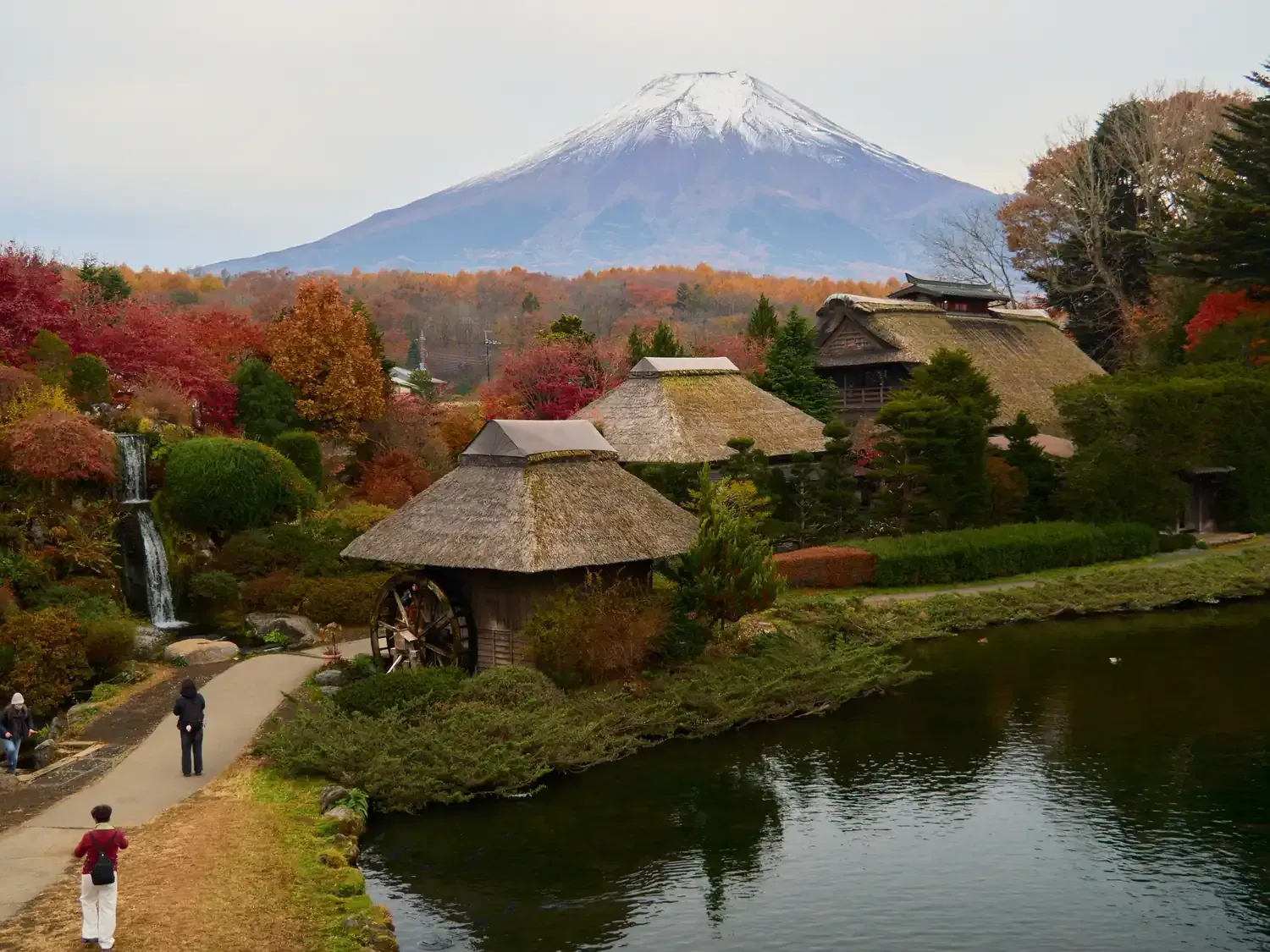
Fuji Five Lakes / Guide
Oshino Hakkai: Keep Your Coin and Find the Pond Where the Sand Moves
Oshino Hakkai忍野八海
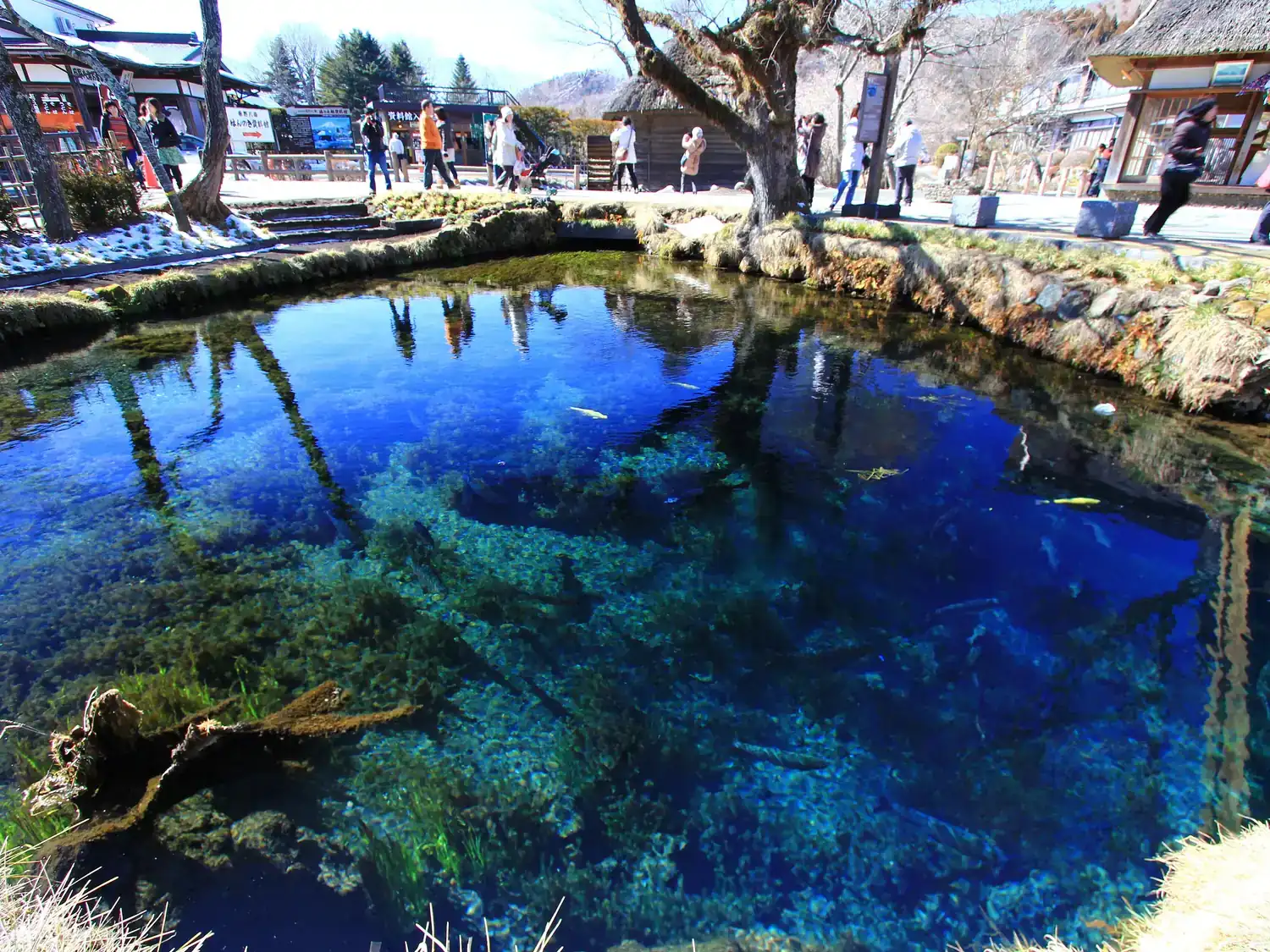
The detail about Oshino Hakkai that I cannot shake is a small one. On the bottom of its clear blue ponds, the village says, the round things shining white are coins, so many that it cannot keep up with collecting them. The water they lie in fell as rain and snow on Mount Fuji and spent more than 20 years seeping through the ground before it welled up here, the local tourist association says.
So keep your coin in your pocket. Instead of tossing one in, walk past the busy centre to Choshi-ike, a small pond tucked into the grass beside the river, where you can watch the spring push sand up from the bottom.
Eight ponds where pilgrims washed before the climb
In the Edo period, the village says, pilgrims preparing to climb Mount Fuji purified themselves in this water before they set off up the mountain. A Fuji pilgrimage group revived the ponds as places of ritual purification in 1843, and today they are part of the Mount Fuji World Heritage Site.
The whole village was once a large lake. When it dried up, the springs that had fed it from underground kept flowing, and they now fill eight small ponds, their water clear all the way down and surprisingly blue where you look into the depths.
Wakuike, on the busiest street
Wakuike faces the busiest street, lined with souvenir shops, with a thatched water mill across the way. Stop for a few minutes even if the street is crowded: it brings up more spring water than any of the other seven, and if you look down past the moving surface, you can see water plants swaying deep in the blue.
Choshi-ike, where the sand moves
Leave the street after that. Follow the Ahara River from Wakuike and look for Choshi-ike, a pond associated with matchmaking, sitting quietly in a patch of grass.
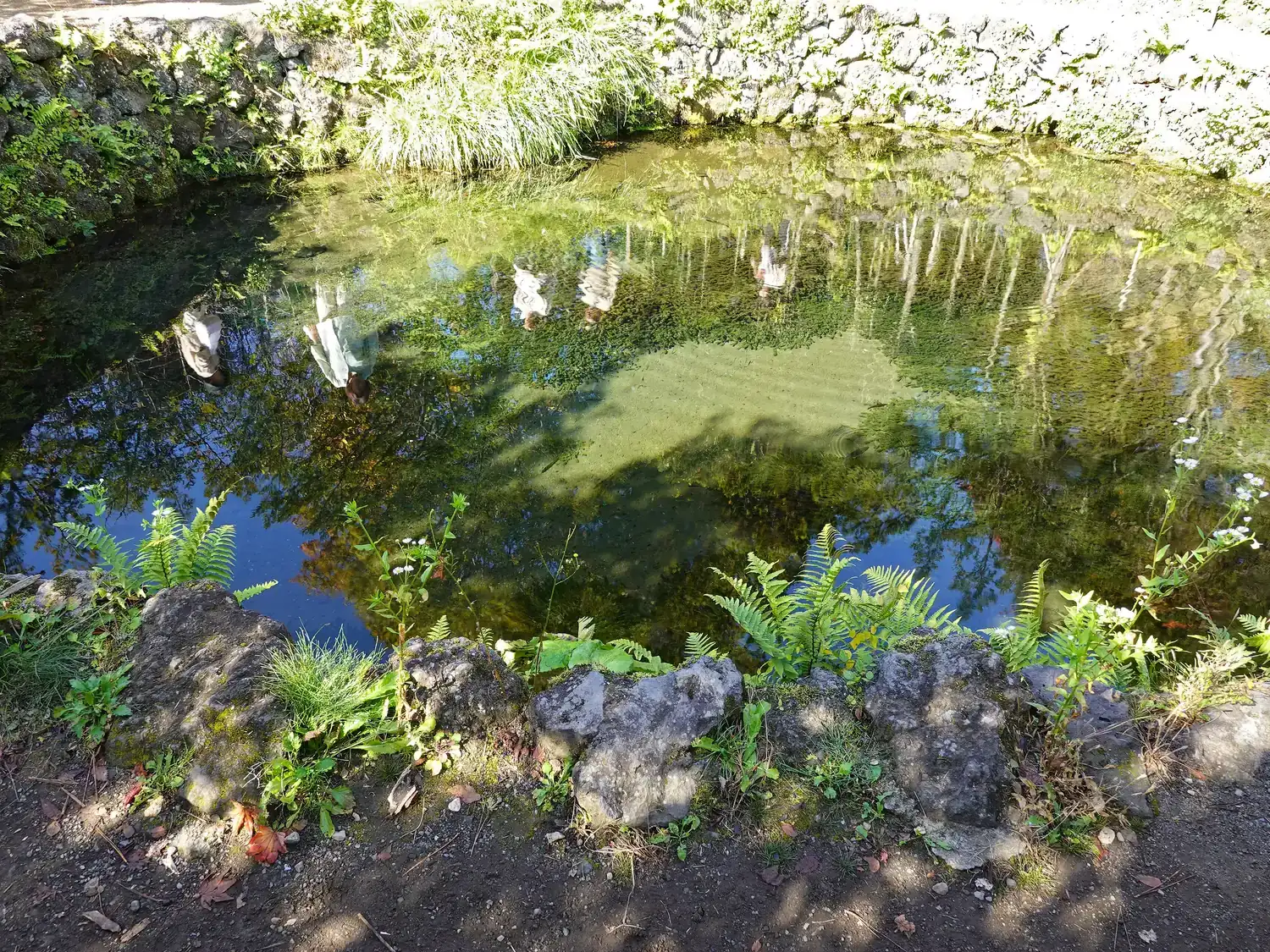
Of the eight, this is the pond I most want to see, because here the water’s long trip underground ends in something you can actually watch: water pushing up through the sandy bottom and lifting the sand.
Kagami-ike, the mirror
An old legend says Kagami-ike, the mirror pond, can tell good from evil. Go there, on the north side of the busy street, if you want Fuji in the water. Very little spring water rises in it, and on the right day the mountain appears clearly upside down on its surface.
The quiet ones at the edges
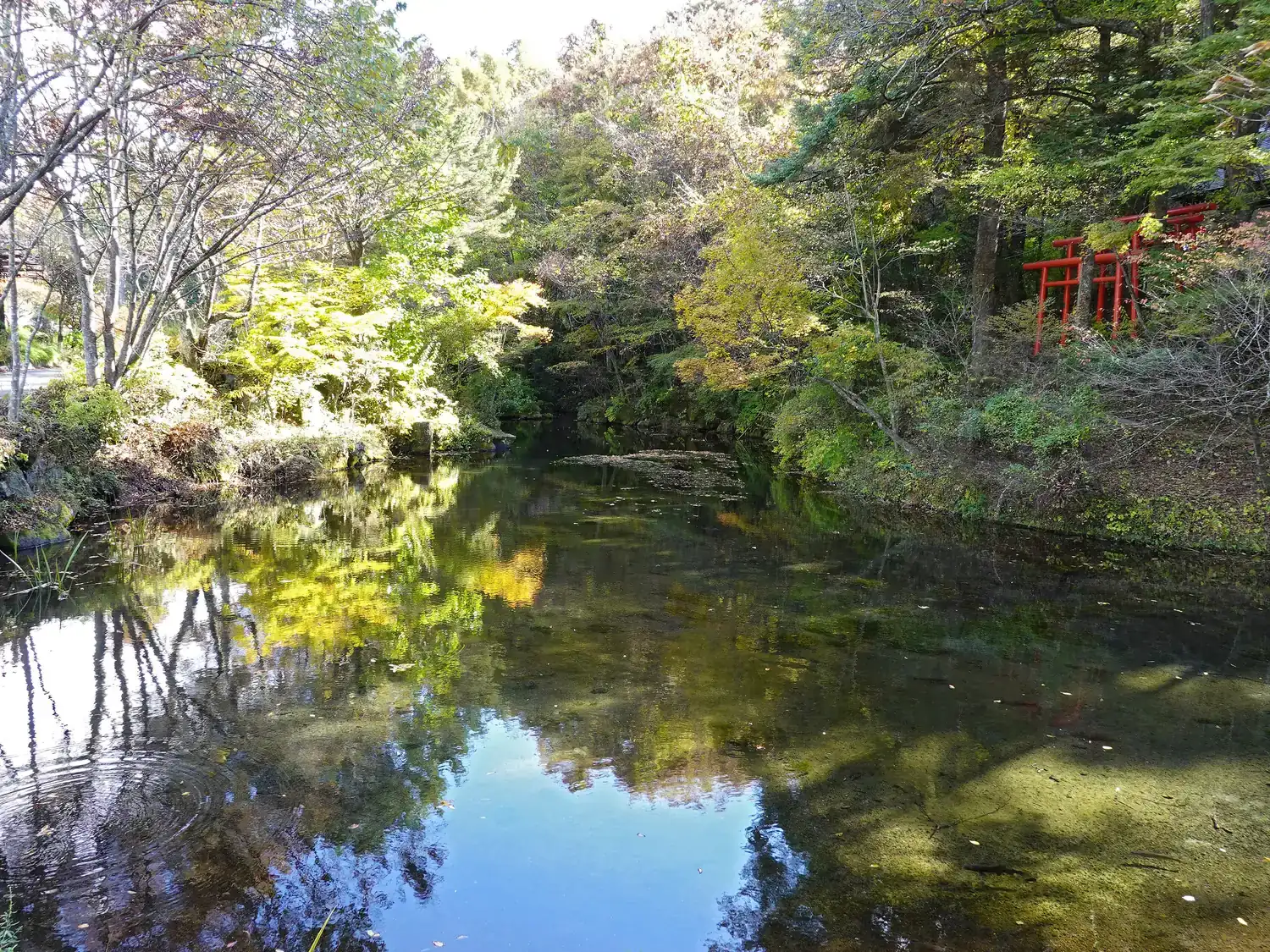
If you want a pond with fewer visitors, walk out to Deguchi-ike. It stands apart from the others and is the largest of them all, with a hill rising straight behind it and a shrine in the woods above. You will find no shops around it and far fewer people, and it shows a pond closest to its natural state.
Legend says that anything dropped into Sokonashi-ike vanishes. It lies at the far end of the grounds of the Hannoki Bayashi Shiryokan, a museum of old household tools, in a quiet stand of large horse chestnut and other trees. Check that the museum is open before you set out for it; when it is closed, you cannot see the pond at all.
Before you go
| Opening hours | There is no entrance and no opening hours, so you can visit at any time (Sokonashi-ike is the exception). There are few street lights, so the tourist association advises against walking around after dark |
| Sokonashi-ike | Inside the Hannoki Bayashi Shiryokan. Admission 300 yen. 9:00–17:00, says the prefecture’s tourism site. When the museum is closed, you cannot see the pond |
| Coins | The village asks you not to throw coins, or anything else, into any of the eight ponds |
| Crowds | Near the centre it gets very busy at weekends and in long holidays. There is no public car park; the tourist association suggests parking a little further out and walking in |
| Parking | Private car parks only. Osada car park, for example, charges 300 yen for a car |
| By bus | From Fujisan Station, take the local bus bound for Uchino to Oshino Hakkai Iriguchi, or the Fujikko loop bus to Oshino Hakkai (Ohashi). The Fujikko starts at Kawaguchiko Station and runs 11 times a day; single rides from 100 yen, or 1,800 yen for a day pass. From Shinjuku, the Chuo highway bus to Oshino Hakkai takes about 140 minutes |
| Winter | Snow usually falls from late November to March, and shaded paths can be icy even without snow |
Checked 7 October 2026.
What I would do
If I had only a few minutes here, I would spend them at Choshi-ike, watching the water lift the sand off the bottom.
We have not visited Oshino Hakkai. The facts here come from the official sources below, checked on 7 October 2026.
- Oshino Village — the coins, the pilgrims and the 1843 revival, the old lake, the World Heritage listing, and bus routes: vill.oshino.lg.jp
- Oshino Tourist Association — the water and how long it takes to rise, each pond, Sokonashi-ike’s admission, opening hours, street lights, crowds, parking and winter roads: oshino-navi.com
- Yamanashi Tourism Organization — Sokonashi-ike’s hours: yamanashi-kankou.jp
- Fujikyu Bus — the Fujikko loop bus: bus.fujikyu.co.jp
- Photographs: the thatched roofs and Mount Fuji (lead image) by lumoplank (CC0); Wakuike by くろふね (CC BY 3.0); Choshi-ike and Deguchi-ike by 663highland (CC BY-SA 4.0). All from Wikimedia Commons.
More in Fuji Five Lakes
- Chureito Pagoda (Arakurayama Sengen Park) — For the view of Mount Fuji, and for what the pagoda in front of it is
- Lake Kawaguchi (Oishi Park) — For Mount Fuji across the water, and the boat back
- Yoshida Udon — For a lunch of the town's hard noodles after a morning at the pagoda
- Where to Stay — For choosing where to sleep by which way the room faces: Kawaguchiko Station, across Lake Kawaguchi, Fujiyoshida or Lake Yamanaka
Explore other areas
- Hokkaido — Sapporo
- Kanto — Hakone
- Hokuriku — Kanazawa
- Koshin-Tokai — Fuji Five Lakes · You are here
- Kansai — Nara
- Chugoku — Hiroshima
- Kyushu — Fukuoka
- Okinawa — Naha
