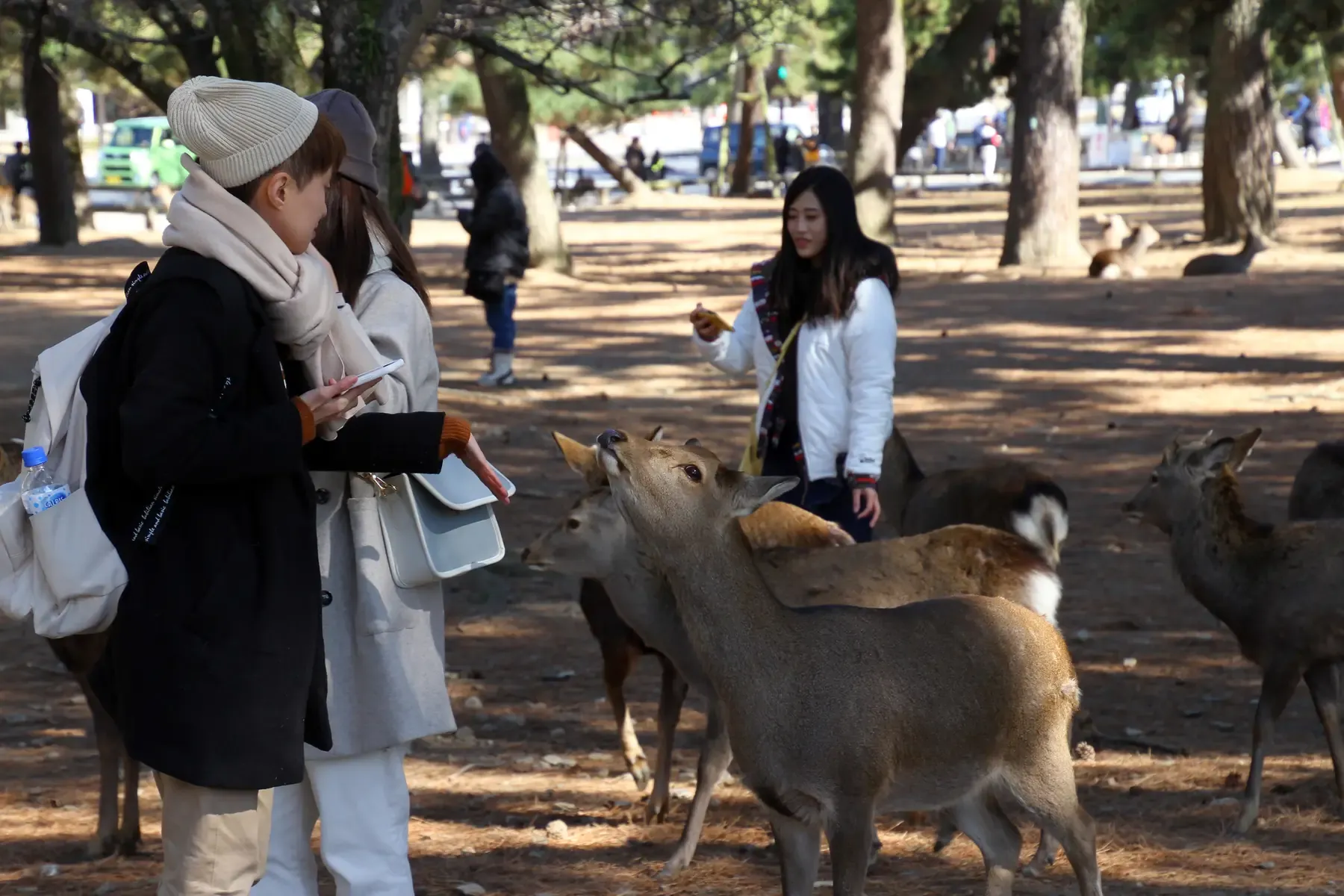
Nara / Guide
Nara Park Deer: Why Feeding Is Prohibited, and What the One Exception Is
Nara Park奈良公園
Nobody owns them
Nobody owns the deer in Nara Park.
That is not a figure of speech. It is a term out of Japanese civil law — mushubutsu, a thing with no owner — and Nara Prefecture uses it on the page where it explains the animals. They are wild. They are not kept. Catching one or hurting one breaks the law, and still nobody owns them.
Which left a question I could not put down. If they belong to no one, who counts them?
Somebody does. On the prefectural page about the deer, the number is 1,687. Two clicks away, on the page about the park, it is about 1,300. Both are official. Only one of them says when it was counted.
Four official pages. Three numbers.
Every figure below is published by the prefecture or by the foundation that looks after the deer.
| Where it is published | The number | When it was counted |
|---|---|---|
| Nara Prefecture — the deer page | 1,687 | July 2026 |
| Nara Deer Preservation Foundation — the count | 1,687 | 15–16 July 2026 |
| The foundation — the injury page | 1,465 | July 2025 |
| Nara Prefecture — the park overview | about 1,300 | not stated |
Five of the twelve English guides give a number at all. They run from "over 1,000" to 1,465 — the 2025 figure. The 2026 count has not reached English yet.
A park with no hours
A place that does not own its animals cannot put them on a timetable.
Nara Park publishes no opening time. It publishes no closing time. It publishes no admission fee — not “free”, nothing at all, on any of the pages that describe the park to a visitor. Of the twelve English guides to this place I read, not one gives an hour or a price either. I took that for an oversight at first. It isn’t. There is nothing to give.
So the hours here belong to the deer, and the deer begin at sunrise.
Two mornings in July
The count that produced 1,687 was taken on the fifteenth and sixteenth of July, between half past five and eight in the morning.
Not by the prefecture alone. Who turned up is on the record: the Nara Deer Preservation Foundation, Kasuga Taisha shrine, the prefectural office, three universities in the city, and a club of volunteers. A shrine and three universities, walking a park at first light, for two mornings in a year.
They start at half past five because that is when the animals can be found. The deer get up at sunrise, spend the day in the grass, and move to wooded ground toward evening. Each group keeps its own sleeping ground, its own feeding ground, its own place to rest. Nobody assigned them.
Why anyone counts an animal nobody owns is a longer answer. It comes at the end.
The park keeps no hours. This is the order the deer keep.
No opening time, no closing time and no admission fee appear on any of the prefecture's visitor pages.
- At sunriseThe deer get up and begin moving.
- Through the dayIn the feeding grounds — the places with grass.
- Toward eveningAway to the sleeping grounds, which are often wooded.
The one hour with a number on it: the annual count runs from 5:30 to 8:00, on two mornings in July. It starts then because that is the hour the animals can be found.
Each group keeps its own sleeping ground, its own feeding ground and its own place to rest. Nobody assigned them.
What eating does to a wood
Grass, leaves, acorns. A diet that leaves two marks, and one of them is the size of a forest.
Deer eat as high as they can reach. The result has a name — the deer line — and once you know it you cannot stop seeing it: below about two metres there are no branches at all. The woods stand open at the height of a person and close above it. The animal did that, one mouthful at a time, for longer than anyone has been counting.
The second mark is underground and belongs to beetles. They take the droppings into the soil; the soil feeds the grass; the grass feeds the deer. The tidiness of this park is not a service someone provides. It is a circle that happens to pass through a lawn people walk on.
The deer line
Deer eat as high as they can reach. Below roughly two metres, the branches are gone.
The woods stand open at the height of a person and close above it. The animal did that, one mouthful at a time, for longer than anyone has been counting.
The one thing you are allowed to give them
Feeding the deer in Nara Park is prohibited.
That sentence surprised me, and I had to go a long way to find it. In English the rule reaches you the other way round — don’t feed them anything except the crackers — which sounds like advice about diet. In Japanese it is a prohibition with a single hole cut in it, and the hole has reasons.
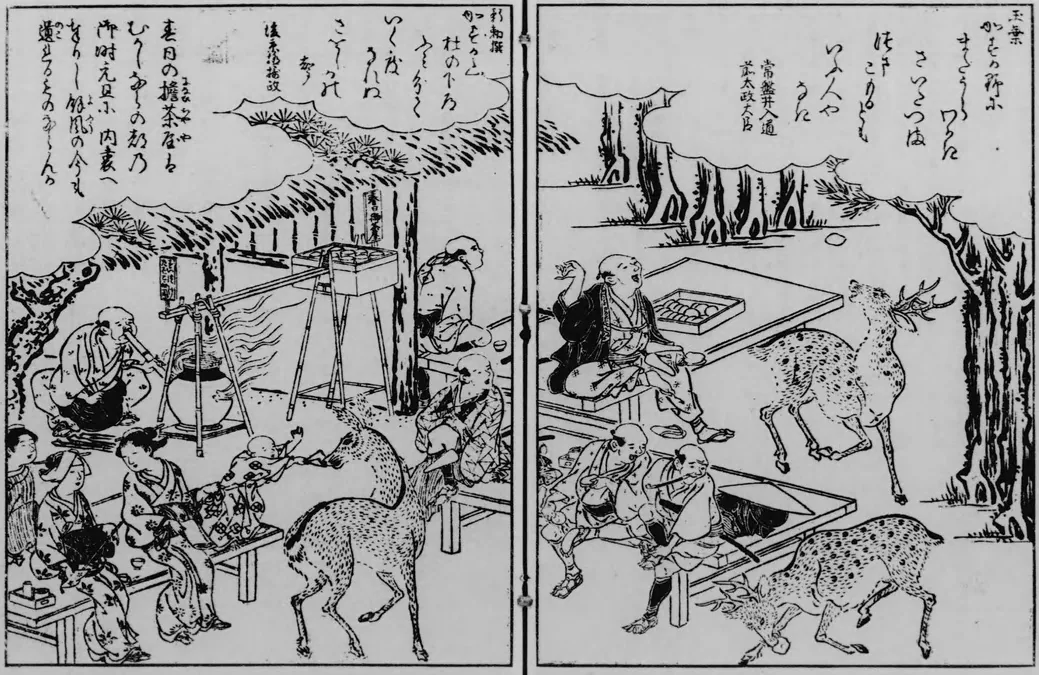
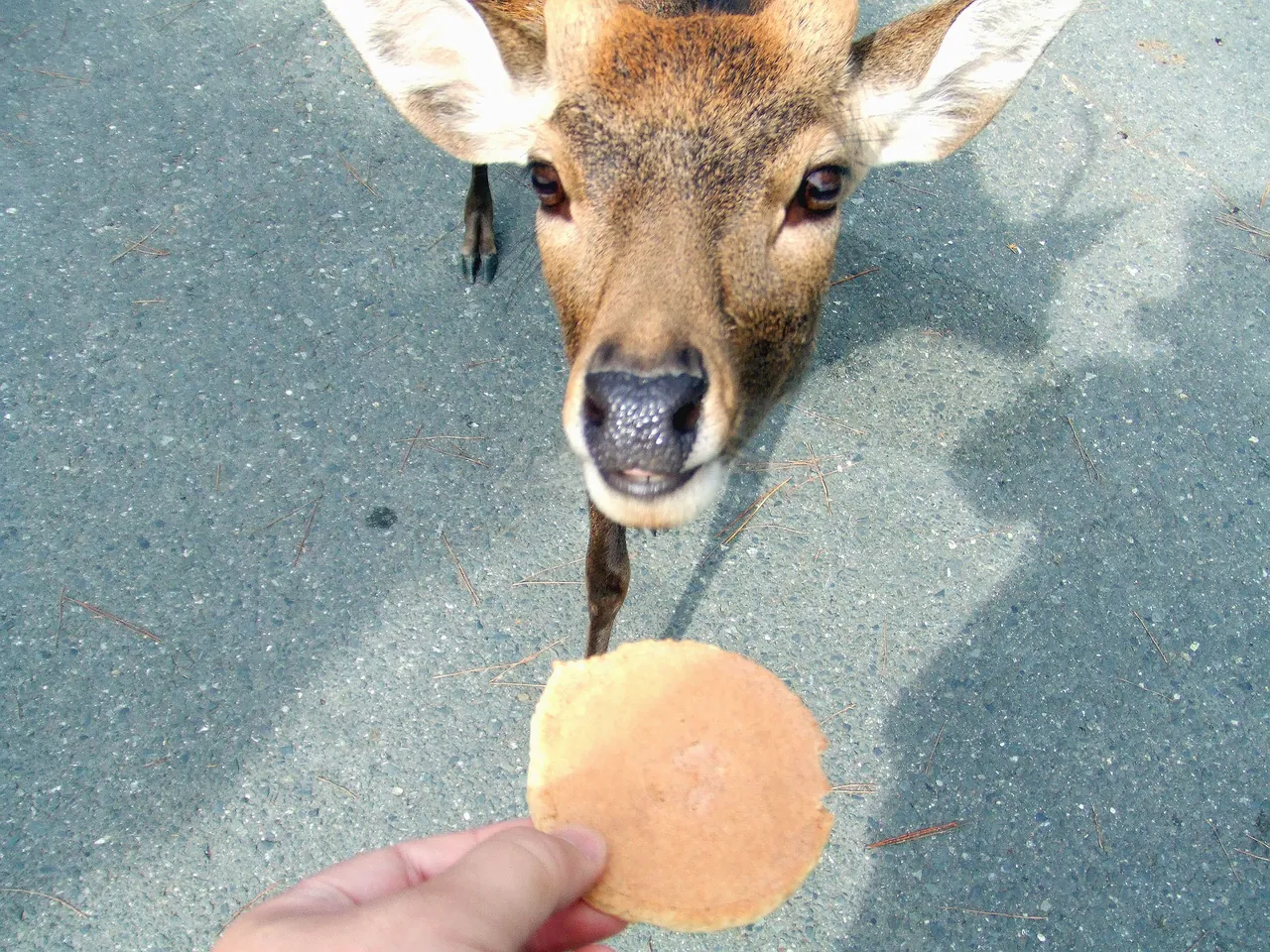
The crackers began in the Edo period, and the prefecture treats that history as the point: they are not a snack sold to tourists but the form the contact between people and these deer has taken for two centuries. They are made to be harmless — rice bran and wheat flour, no sugar, no salt. And part of what you pay goes to the cost of keeping the animals alive.
On those grounds, and only those, one food is legal where every other food is not.
I wanted to know what “prohibited” rests on. The park office names an ordinance — the Nara Prefectural Urban Parks Ordinance — but names it about something else entirely: filming here can require a permit under it. Whether the feeding rule sits inside that ordinance or is the prefecture asking nicely, I could not find out from anything published. So I will put it the way the prefecture puts it, and no further. Nara Prefecture says feeding is prohibited. Until I can read the clause, I am not going to call it illegal.
What I will say is that the cracker in your hand is the only food in this park with permission, and that the permission was written by people who had to justify it.
Holding it wrong
Among the pages I read for this, exactly one was written for you first.
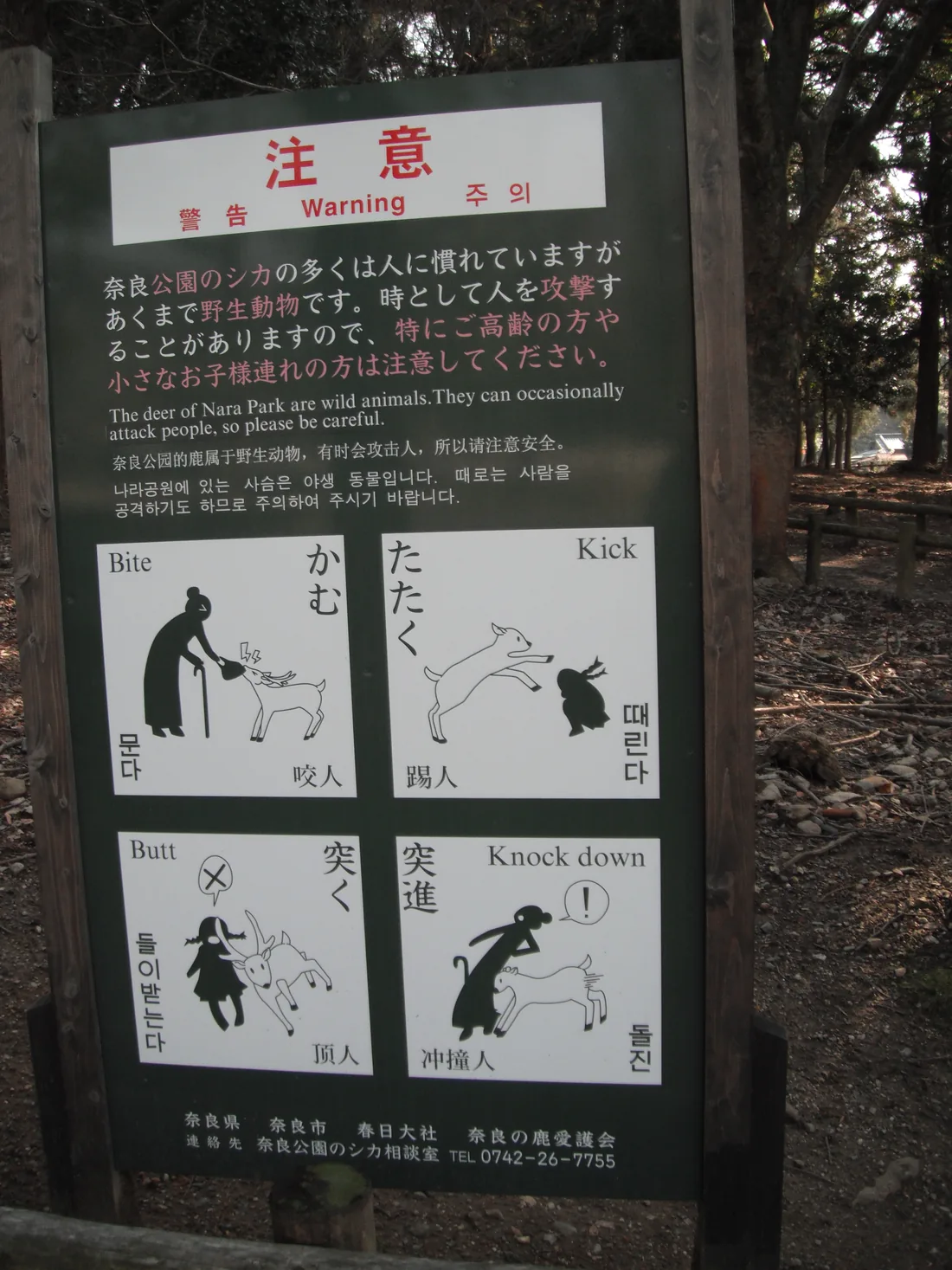
The Foundation’s page on injuries is in English, and the Japanese underneath is labelled as the translation. The rest of it runs the other way round. It is also the bluntest writing either organisation puts out.
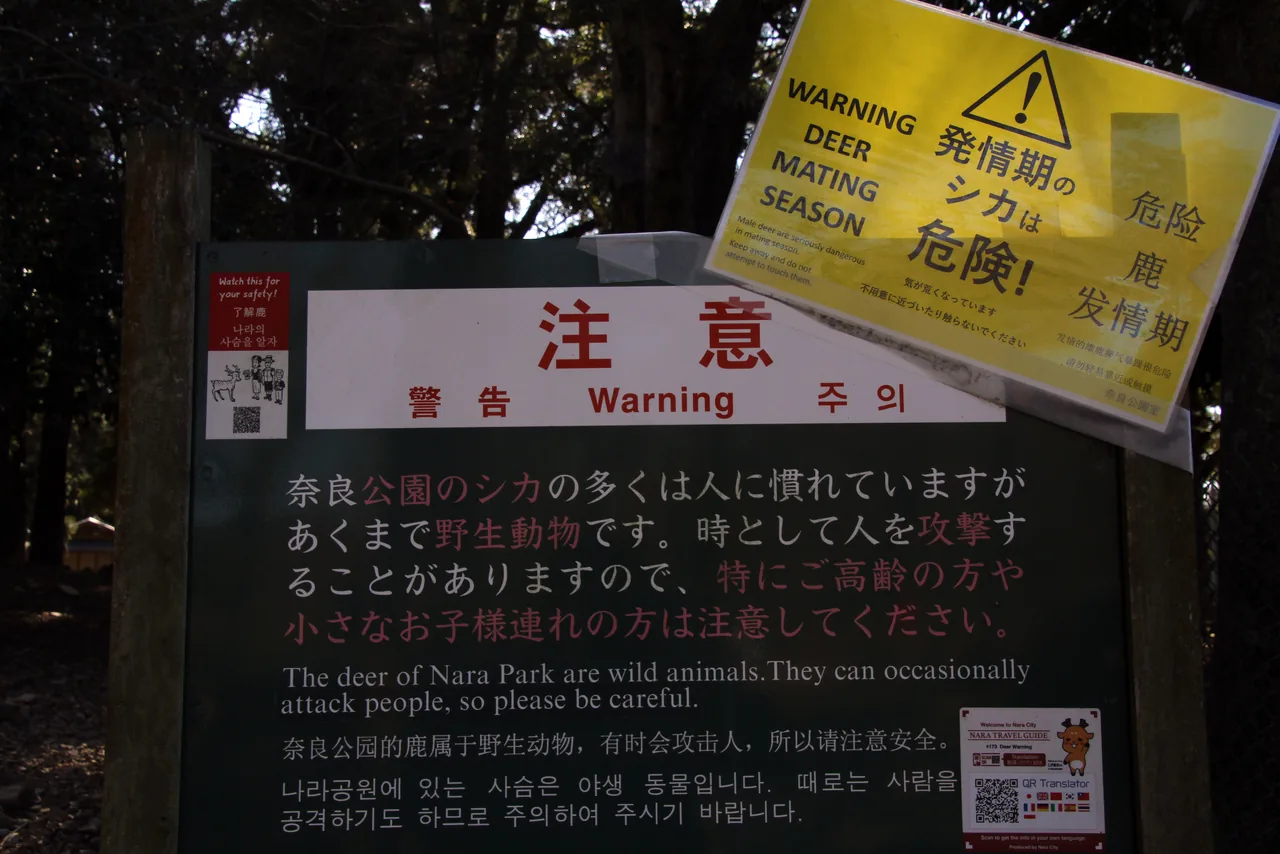
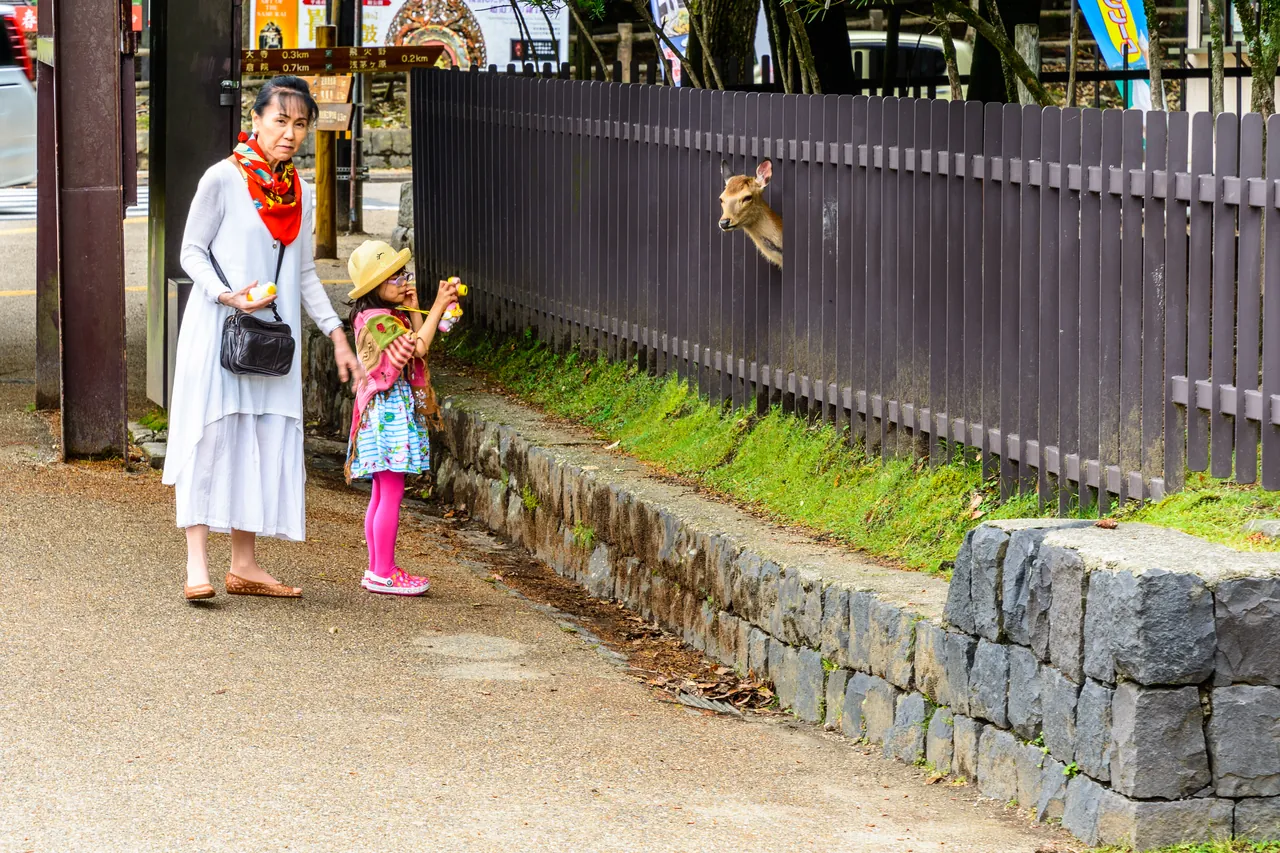
Visitors read the deer as tame, it says, and are gored, charged, knocked down. Wash your hands if you touch one. Holding a cracker back — or pretending to hold one you don’t have — stresses the animal and turns it. Children are in the most danger, for a reason that stays with you once you have read it: their eyes are at the height of the antlers.
Two seasons carry their own warning. In spring the does have fawns to defend. In autumn the stags are in rut.
What I would do with one morning
I would not come here to feed them.
I would come to watch an animal nobody owns spend a day, and I would still buy the crackers, because buying them is the only feeding this park allows and part of the price goes back into the herd.
The hour I would take is the one the counters take. From around sunrise, in the open grass rather than under the trees, because that is where the deer will be and they were not consulted about anyone’s schedule. I would put the map and the paper in a bag first — bags, maps and pamphlets are on the list of things a deer will take out of your hand.
What I would give up is the bowing. Seven of the twelve English guides explain it, several of them well. It is the most photographed second of a visit to Nara and the least surprising fact about the place, and an hour spent waiting for it is an hour not spent watching what the animal does when nobody is offering it anything.
What the park does not have
No bins. The prefecture asks you to carry your rubbish out and gives the reason plainly: deer eat what is dropped, and it kills them.
No car park of its own. No cycling outside the marked places.
| What is published | Checked | |
|---|---|---|
| Opening hours | None published | 14 Sep 2026 |
| Admission | None published | 14 Sep 2026 |
| Bins | None in the park; carry rubbish out | 14 Sep 2026 |
| Car park | None belonging to the park | 14 Sep 2026 |
| Feeding | Prohibited; shika senbei the stated exception | 14 Sep 2026 |
| Deer, general | Nara Deer Preservation Foundation, 0742-22-2388 | 14 Sep 2026 |
| Injured by a deer | Nara Park Deer Consultation Room, 0742-26-7755 | 14 Sep 2026 |
Two numbers, because they are two different problems. One of them is about the deer. One of them is about you.
The column that reads zero
The Foundation counts the dead as well as the living.
A hundred and forty deer died in the last full year. Thirty-six on the roads. Half of the hundred and forty were fawns.
The largest group is not a cause at all. It is called other, and it holds seventy-four animals — more than half the total. The one story about dead deer that has travelled into English, the plastic bags found in a stomach, has no line of its own anywhere in this table. It is in there somewhere, inside the half that nobody could classify.
And there is one more column. It is headed poaching. It has appeared every year the table has been published. Twice in eighteen years it has recorded a single animal, and in every other year it reads zero.
A column that reads zero for sixteen years is still a column somebody decided to keep printing.
140 deer died in the last full year. This is how they were recorded.
Sixty-nine of the 140 were fawns.
The largest group is not a cause at all. Other holds more than half the total, and the best-known story about dead deer in English — plastic bags in a stomach — has no line of its own here. Poaching is printed every year: twice in eighteen years it has recorded a single animal.
Why they count
The purpose is stated in one line, next to the dates and the names of the universities: to make clear how the deer population is moving, and to produce the statistics that protection work is built on.
That is the rest of the answer. Nobody owns these animals, so nobody inherits the job of knowing about them, and the job gets done anyway — by a shrine, three universities, a prefectural office and a volunteers’ club, on two mornings in July, starting at half past five because that is when a deer is where you can see it.
People have been looking at them a long time. A list of the eight sights of the old southern capital, set down in 1465, includes one called simply the deer of Kasugano. Five and a half centuries of being worth looking at, and still no owner.
Set your alarm for the hour the counters use. You will be in the park for the part of the day the deer decided on, which is the only part of it anyone here has ever decided.
Sources and images
- Nara Prefecture, Nara Park Quick Guide, “Deer of Nara Park” — the designation as a national natural monument, the civil-law term mushubutsu for an animal with no owner, the July 2026 figure of 1,687, the ingredients of the crackers, the deer line at roughly two metres, and the dung beetles. Page updated 11 September 2026. Checked 14 September 2026.
- Nara Prefecture, Nara Park Quick Guide, “Outline of Nara Park” — the figure of about 1,300 deer, carried on a page with no update date. The eight sights of the southern capital recorded in a document of 1465, one of which is the deer of Kasugano. Checked 14 September 2026.
- Nara Prefecture, Nara Park Quick Guide, “How to treat the deer in Nara Park” — the statement that feeding is prohibited with shika senbei as the exception, the three grounds given for that exception, the absence of bins, and the spring and autumn warnings. Checked 14 September 2026.
- Nara Prefecture, Nara Park Quick Guide, visitor Q&A — the deer beginning to move at sunrise, the feeding grounds by day and the move to sleeping grounds toward evening, the absence of a car park, the cycling rule, and the two telephone numbers. Checked 14 September 2026.
- Nara Deer Preservation Foundation, annual population survey — the count of 1,687 taken on 15 and 16 July 2026 between 5:30 and 8:00, the list of partner organisations, the stated purpose of the survey, and the mortality table including the columns for stray dogs and poaching. Checked 14 September 2026.
- Nara Deer Preservation Foundation, deer injury page — the description of visitors being gored, charged and knocked down, the advice to wash hands, the warning about withholding a cracker, and the note about children and antler height. This page is written in English with a Japanese translation beneath it. Checked 14 September 2026.
- Nara Prefecture, Nara Park Administration Office — the Nara Prefectural Urban Parks Ordinance, named in the context of permits for filming in the park. Checked 14 September 2026.
- Twelve English-language guides to Nara Park, read for this article. Five give a deer count; none states the park’s opening hours or admission; none sets out the prohibition and its exception. Read 14 September 2026.
- Photographs: the deer walking up to visitors, and the bilingual notice, by Hyppolyte de Saint-Rambert (CC BY-SA 4.0, Wikimedia Commons); the cracker held out by Hirojin taja (public domain, Wikimedia Commons); the pictogram sign by Cesar I. Martins (CC BY 2.0, Wikimedia Commons); the adult and child with a deer by dconvertini (CC BY-SA 2.0, Wikimedia Commons). Illustration of the teahouse by Takehara Shunchōsai, 1791 (public domain, Wikimedia Commons).
- Tables and diagrams drawn by us from the figures published by the sources above.