What's in this guide15 sections
Quick answer
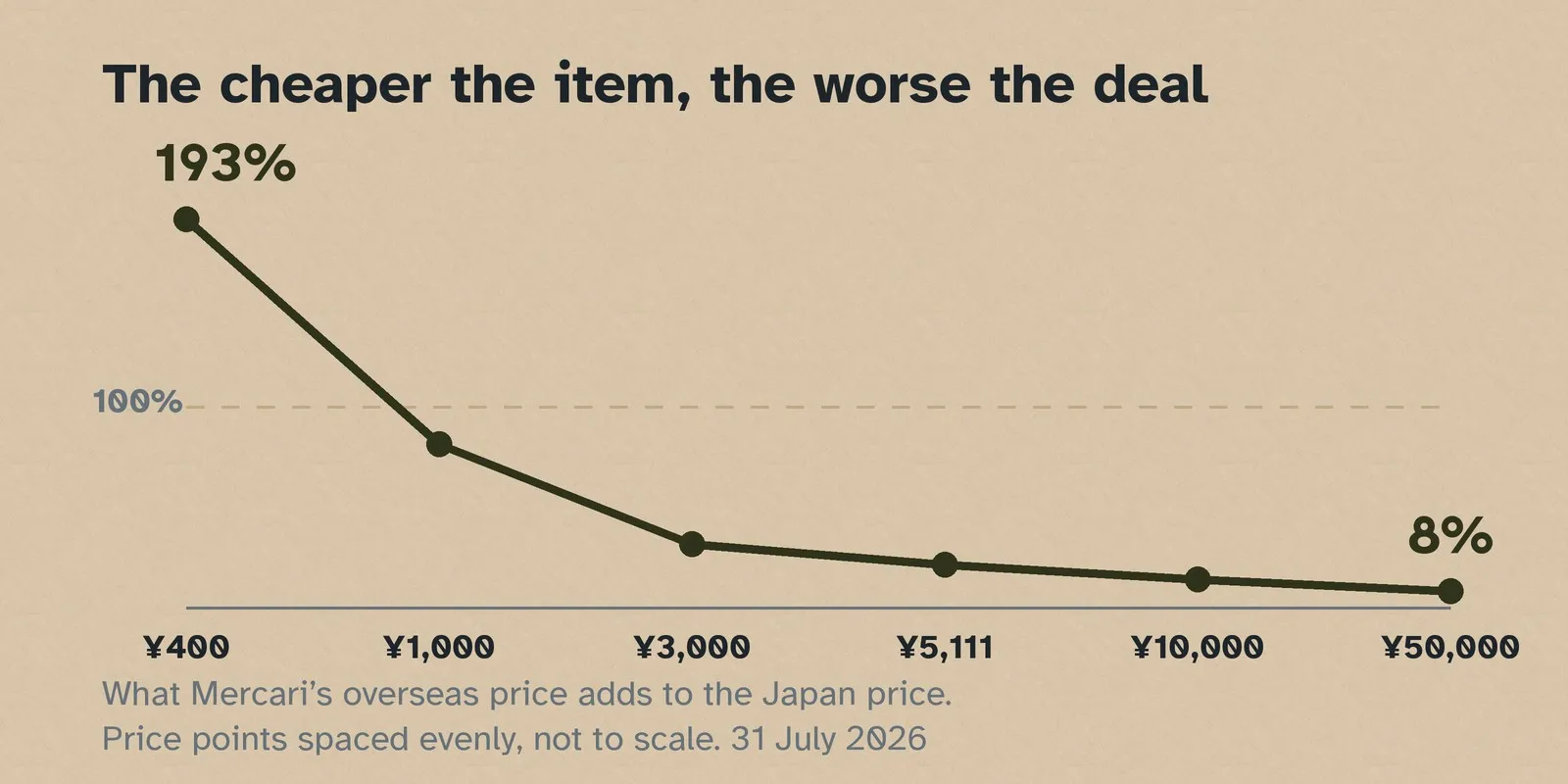
There are now three ways to buy from Mercari Japan, and only some of them tell you what they charge. Mercari's own route launched in the US on 17 June 2026 and publishes no fee at all: its product pages say only that "fee varies by category." We matched 26 items across Mercari Japan and its US site and solved the arithmetic: US price = yen price ÷ 150.57 + $4.65. That is a flat $4.65 per item, plus an exchange rate 6.2% worse than the market. Because $4.65 is flat, it falls hardest on cheap items: 193% on a ¥400 jacket, 31% at ¥3,000, 8% at ¥50,000. Buyee, Mercari's only official partner, charges a published ¥500 per order but adds ¥150–1,500 domestic shipping you cannot see in advance. And Buyee's flat-per-order pricing does not help on Mercari the way it helps on Yahoo! Auctions, because five items means five sellers means five orders. Shipping and duties are on top of every number here. As of July 2026.
A ¥400 jacket was listed on Mercari Japan.
The same jacket, on Mercari’s US site, was $7.31. The market rate that day was ¥160.57 to the dollar, which makes ¥400 worth $2.49. Somewhere in between, $4.82 had been added, 193% of what the item costs.
Mercari does not explain that $4.82. The product page says the “fee varies by category and the final fee will be shown at checkout.” No amount, no percentage, nowhere on the site.
So we matched 26 items across both versions of Mercari. The formula that came out was simpler than it had any right to be.
We have no financial relationship with Mercari, Buyee, or any service named here.
What changed in 2026
Until last year this was a short story. Mercari Japan sellers ship domestically only, so overseas buyers used a proxy service. That was the whole method.
On 17 June 2026 Mercari launched the Mercari Global App in the United States, its third market after Taiwan and Hong Kong. US users can now browse and buy from Mercari Japan and Mercari Shops directly. At the same time the older “Mercari x Japan” feature inside Mercari US was retired, and the traffic moved to japan.us.mercari.com.
Mercari is serious about this. Its cross-border strategy announcement names Stripe for payments and Sagawa Express for shipping, with a target of 50-plus countries and regions by 2028 and over 100 markets after that.
So there are three routes now:
- Mercari’s own route, japan.us.mercari.com, live since June 2026
- Buyee, Mercari’s only official partner
- Every other proxy: Doorzo, Neokyo, ZenMarket, FROM JAPAN
Only the second one publishes a fee.
One detail is worth putting down before the numbers. Every internationally shipped item in the retired Mercari x Japan programme was listed by BEENOS, the company that operates Buyee. Mercari’s official overseas shipping was a proxy service wearing Mercari’s clothes. Whether the new Global App works the same way is not stated anywhere public.
Solving the Mercari Japan proxy fee
Mercari’s US site keeps the Japanese item number in the product image filename. That is enough to match an item on one site to the same item on the other.
We matched 14 trading cards, 6 jackets and 6 cameras and lenses (26 items) and read the yen price from Mercari Japan’s own price metadata rather than the rendered page.
US price ($) = yen price ÷ 150.57 + $4.65
Maximum error across all 26: six cents. Below ¥10,000 it lands exactly.
| Mercari Japan | US site (measured) | Formula predicts | Error |
|---|---|---|---|
| ¥2,233 | $19.48 | $19.48 | +0.004 |
| ¥2,300 | $19.92 | $19.92 | −0.001 |
| ¥3,000 | $24.57 | $24.57 | 0.000 |
| ¥3,800 | $29.88 | $29.88 | −0.003 |
| ¥5,111 | $38.59 | $38.59 | 0.000 |
| ¥8,500 | $61.09 | $61.10 | −0.008 |
| ¥13,200 | $92.30 | $92.31 | −0.012 |
| ¥49,999 | $336.65 | $336.71 | −0.059 |
Three separate ¥3,000 items all priced at $24.57. Two ¥7,000 items both at $51.13. The calculation does not hesitate.
There are only two numbers in it: a flat $4.65 and a rate of ¥150.57.
Mercari’s page said the fee varies by category. It should have produced different numbers for cards, clothing and camera gear. It did not. All three categories returned $4.65, and the six jackets matched to the cent. Cameras came in at $4.57–4.66, drifting only on a ¥58,500 lens where the exchange rate itself moves the last digits.
We stopped short of completing a checkout, so a further fee could appear at payment. But across the listing grid and the product page, no category difference exists.
The other number: ¥150.57
The divisor turns out to be more interesting than the fee.
The rate implied by 26 items is ¥150.57 to the dollar. The market rate the same day was ¥160.57 (00:02 UTC, 31 July 2026). Mercari’s rate sits 6.2% against the buyer.
Buyee can be measured the same way, because it prints yen and dollars side by side: a ¥2,400 item showed as $15.56, implying ¥154.20, 4.0% off market.
| Applied rate | vs market | |
|---|---|---|
| Market | ¥160.57/$ | — |
| Mercari official | ¥150.57/$ | 6.2% against you |
| Buyee | ¥154.20/$ | 4.0% against you |
Currency conversion always carries a spread. Banks charge one, cards charge one. What is notable is that neither company presents this one as a fee. It is inside the price.
And unlike the flat $4.65, the 6.2% scales with the item. On a ¥50,000 purchase the currency spread alone is about $19.
Mercari is not unusual in this. Three of the seven proxy services do the same thing, at 4.88% to 5.04%, and two of them charge nothing on currency at all.
Why cheap items lose
A flat fee means the percentage climbs as the price falls.
| Mercari Japan price | At market rate | US site shows | Added | Added % |
|---|---|---|---|---|
| ¥400 | $2.49 | $7.31 | $4.82 | 193.3% |
| ¥1,000 | $6.23 | $11.29 | $5.06 | 81.3% |
| ¥3,000 | $18.68 | $24.57 | $5.89 | 31.5% |
| ¥5,111 | $31.83 | $38.59 | $6.76 | 21.3% |
| ¥10,000 | $62.28 | $71.06 | $8.79 | 14.1% |
| ¥50,000 | $311.38 | $336.72 | $25.34 | 8.1% |
On a ¥50,000 item, 8.1% is competitive, cheaper than most proxies once their per-item fees and domestic shipping are counted.
The problem is what Mercari actually sells. One card, one keychain, one used shirt, mostly between a few hundred and a few thousand yen. Buy a single ¥1,000 item and the markup is 81%.
None of the figures above include international shipping or duties. The product page states that the “total price will be calculated at checkout.” That $7.31 is the entry number, not the exit.
Buyee: the only published fee
Buyee is Mercari’s official partner, and it publishes a fee table.
| Item | Amount |
|---|---|
| Purchase fee | Flat ¥500 per order |
| Plan | Standard ¥500 / Insured Delivery ¥500 / Inspection ¥300 / Lite ¥0 |
| Japan domestic shipping | ¥150–1,500 |
| Customs clearance commission | ¥2,800 on parcels over ¥200,000 by EMS, Air, SAL or Seamail |
¥500 is $3.11 at market rate, under Mercari’s $4.65.
But Buyee adds domestic shipping from the seller to its warehouse, ¥150 to ¥1,500. On Mercari’s own route that leg is inside the displayed price, because Japanese Mercari sellers conventionally absorb domestic postage.
So for a single item the ranking can flip. Take a ¥3,000 purchase:
- Mercari official: $24.57, plus international shipping and duties
- Buyee: ¥3,000 + ¥500 fee + ¥0–500 plan + ¥150–1,500 domestic = ¥3,650–5,500 = $22.73–34.25, plus international shipping and duties
Choose the Lite plan and get ¥150 domestic shipping and Buyee saves you $1.84. Get ¥1,500 domestic shipping and it costs you $9.68 more. Which of those you get is not knowable before you order.
Three more lines from that fee page are worth reading before you commit:
- An item marked “free shipping” can still incur domestic shipping, because Buyee asks sellers to use trackable methods and a change of method costs money
- Multiple orders from the same seller are processed separately, so domestic shipping is charged per order
- On Ship Directly, shipping is Buyee’s estimate, and if the real cost differs, there is no refund. The page states Buyee bears “no responsibility for explaining expense details”
That last one is the published policy, not an inference.
Flat-per-order does not help on Mercari
Buyee’s flat ¥500 per order is usually cited as the reason it wins on volume. Win five auctions, pay ¥500. Buy six things from one shop, pay ¥500. On Yahoo! Auctions or Rakuten, that is real money saved.
On Mercari it does almost nothing.
Mercari is a flea market of individuals listing one item each. One seller rarely holds five of the same thing. Five items means five sellers, which means five orders:
- Purchase fee: ¥500 × 5 = ¥2,500
- Domestic shipping: ¥150–1,500 × 5 = ¥750–7,500
“Flat ¥500” is per order, not per haul. The structural difference between an auction site and a flea market is doing the work here, and no fee table shows it.
ZenMarket’s pricing hints at the same thing from the other side. Its fee is ¥500 an item on most marketplaces, but ¥800 on Mercari and auctions. The proxies treat Mercari as its own category. Why is not published.
All three routes, side by side
| Route | Fee per item | Currency spread | Domestic shipping | Total is final at |
|---|---|---|---|---|
| Mercari official | $4.65 (unpublished, measured) | 6.2% | Included in listed price | Checkout |
| Buyee | ¥500 per order (published) | 4.0% | Extra ¥150–1,500 | Warehouse arrival |
| Doorzo | ¥200–300, 3% of the item price (published) | Not measured | Extra | Never fully, before you pay |
| Neokyo | ¥350 (published) | Not measured | Extra + ¥500 packing | Warehouse arrival |
| ZenMarket | ¥800 on Mercari (published) | Not measured | Extra | Warehouse arrival |
Read the fee column alone and Doorzo wins at ¥200–300: 3% of the item price, with a ¥200 minimum and a ¥300 cap per item (up to ¥500 on Surugaya items) (official). But Doorzo splits payment in two and Japan domestic shipping can arrive later as a cash-on-delivery adjustment, so the total stays open until the parcel is already in Tokyo.
Mercari’s route is the mirror image. It won’t tell you the fee, but it settles duties at purchase, its help pages state the charged amount is final. On every proxy route, duties arrive after the parcel crosses the border.
The disclosure runs in opposite directions. The services that itemise their fees leave the total open; the service that closes the total hides the fee.
Which route for what
One or two items under ¥1,000
Every route is bad. Mercari’s own adds 81% at ¥1,000; Buyee’s fee plus domestic shipping can exceed the item. Consolidate into fewer orders, or buy from a shop where several items ship as one order, Suruga-ya, Yahoo! Auctions, a Rakuten store.
A single item, ¥3,000–10,000
Mercari’s own route is usually ahead. With no separate domestic shipping leg it competes with Buyee’s Lite plan at best-case postage, and duties settled at purchase are easier to plan for on a first order from Japan.
Several items from several sellers
Every route charges per order. Buyee and Neokyo will consolidate into one box at the warehouse (Neokyo charges ¥500 and up for packing); whether Mercari’s own route consolidates is not documented publicly. International shipping is priced per parcel, so at higher item counts consolidation matters more than the per-item fee.
One item over ¥50,000
Percentages fall to single digits everywhere. Decide on compensation cover and how duties are collected instead. Note Buyee’s ¥2,800 clearance commission above ¥200,000.
You cannot haggle
One constraint that is not about money.
On internationally shipped Mercari items, price negotiation is disabled. The Offer feature and chat-based haggling are both unavailable.
Anyone who has used Mercari inside Japan knows what that removes. Listings are often priced with negotiation expected; domestic buyers ask for a discount as a matter of routine. That entire convention is unavailable to overseas buyers.
Going through a proxy does not restore it. Proxies buy at the listed price. The number on the listing is not a ceiling. It is the price.
FAQ
How do I buy from Mercari Japan from overseas? Three ways as of July 2026. Mercari’s own route at japan.us.mercari.com, live in the US since 17 June 2026, lets you buy Mercari Japan listings directly. Buyee is Mercari’s only official proxy partner. Or use a general proxy (Doorzo, Neokyo, ZenMarket, FROM JAPAN), which buys the item, receives it at a Japanese warehouse and forwards it to you. Mercari Japan sellers ship domestically only, so one of these three is required.
What does Mercari’s own service charge? It does not publish a figure: the product page says only that the fee “varies by category.” Matching 26 items across Mercari Japan and its US site gives a flat $4.65 per item, plus an exchange rate of ¥150.57 to the dollar against a market rate of ¥160.57, a spread of 6.2%. Because $4.65 is flat, it lands as 193% on a ¥400 item, 31% at ¥3,000 and 8% at ¥50,000. International shipping and duties are added at checkout.
Which Mercari Japan proxy is cheapest? It depends on the item’s price and how many sellers you are buying from. Doorzo has the lowest published fee at ¥200–300, Neokyo charges ¥350, Buyee ¥500 per order, and ZenMarket ¥800 on Mercari specifically. But every proxy adds domestic shipping of roughly ¥150–1,500 per order, which Mercari’s own route does not, so on a single mid-priced item Mercari’s route often wins despite the higher fee.
Is Buyee cheaper than buying through Mercari directly? On fees alone, yes: ¥500 per order against $4.65. In practice it depends on domestic shipping, which Buyee charges separately at ¥150–1,500 and cannot be known before you order. On a ¥3,000 item, Buyee with the Lite plan and cheap postage costs about $1.84 less; with expensive postage it costs about $9.68 more.
Can I negotiate the price on Mercari from overseas? No. The Offer feature and chat-based price negotiation are disabled on internationally shipped items, and proxy services buy at the listed price. Discount requests are a routine part of Mercari inside Japan, and that convention is unavailable to overseas buyers.
What we could not determine
Every figure here comes from what is visible before payment is authorised.
We did not complete a checkout, so a further fee at the payment step cannot be ruled out. The measurement covers three categories and 26 items, not the whole catalogue. Some Mercari Japan items do not appear on the US site at all, the first one we tried returned a 404. And Mercari’s help pages describe the exchange rate only as updating automatically in real time, so we cannot say what moment ¥150.57 belonged to.
What holds is the agreement across 26 items: $4.65, and 6.2%. A fee that is published nowhere can still be calculated.
Whether a ¥400 jacket is worth $7.31 is a different question. At least now it is being asked with the number in hand.