What's in this guide14 sections
Quick answer
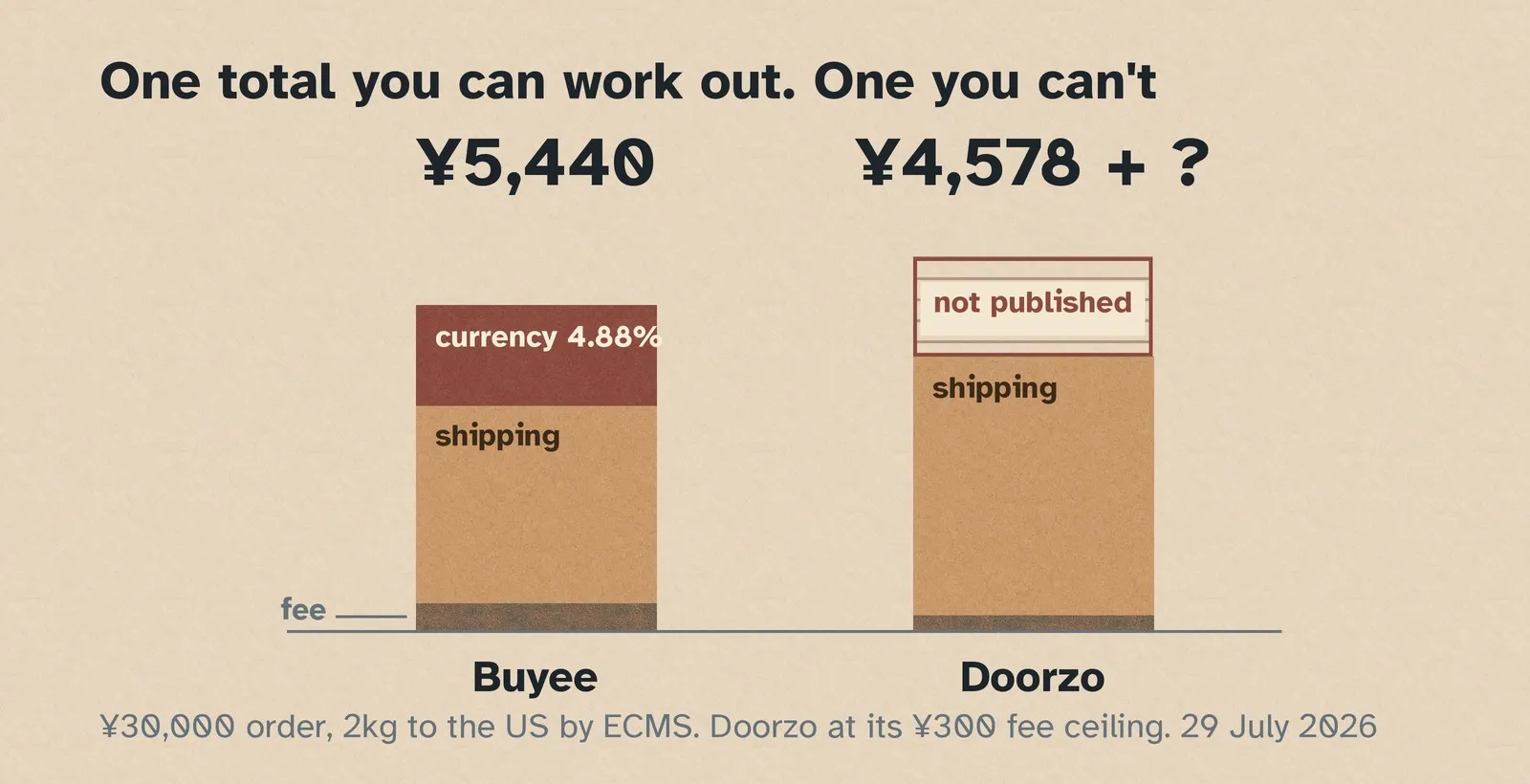
Doorzo's fee is a fraction of Buyee's (¥200–300 per item against ¥500 per order), and its Trustpilot score is the highest of any major proxy (4.6 against Buyee's 3.6). Buyee still costs less to ship. Priced on the same day for the same 2kg parcel to the US: ECMS ¥3,290 on Buyee against ¥4,278 on Doorzo, DHL ¥5,135 against ¥7,142. That gap (¥988 to ¥2,007) is roughly three to seven times the ¥300 at most you save on the fee. On a ¥30,000 order shipped by ECMS, Buyee's fee plus shipping comes to ¥3,790 against Doorzo's ¥4,578. Then currency reverses it: Buyee marks up the exchange rate by 4.88%, about ¥1,650 on that order, which puts Buyee at ¥5,440 and hands the win back to Doorzo by ¥862. Except Doorzo does not publish its exchange rate at all, and we could not measure it. So the fee is genuinely the cheapest; whether the total is cannot be verified. Doorzo also cannot use Japan Post to the US unless the parcel exceeds $800, which locks its cheapest option (¥3,300 sea mail) away from small orders. As of August 2026.
Line up the fees and the contest ends immediately. Doorzo asks ¥200–300 per item. Buyee asks ¥500 per order. Doorzo’s fee comes to 40–60% of Buyee’s, and picking Doorzo on that basis looks like the obvious move.
Then price the same parcel to the US on both, and the order reverses. A 2kg box by ECMS costs ¥3,290 through Buyee and ¥4,278 through Doorzo. That is ¥988. By DHL the gap widens to ¥2,007.
The up to ¥300 you saved on the fee disappears into shipping.
What comes after that is harder. Buyee’s own page lets you measure how much it adds on currency conversion, 4.88%. Doorzo’s does not. The cheaper service is Doorzo. The better-reviewed service is Doorzo. The one whose total you can work out before you order is Buyee.
Is the fee gap real?
Doorzo’s proxy purchase fee is 3% of the item price, with a ¥200 minimum and a ¥300 cap per item (up to ¥500 on Surugaya items), shown once the item is in your cart (official). Buyee charges ¥500 per order, raised from ¥300 on 1 April 2026 (official).
On the numbers, Doorzo wins outright. Two things complicate it.
First: the fee moves with the item price. Below ¥6,667 you pay the ¥200 minimum, above ¥10,000 the ¥300 cap, and in between 3%. Since the figure only settles once the item is in the cart, the safe assumption while comparing is the ¥300 ceiling.
Second is the unit of charging. Buyee’s ¥500 is per order, which is not the same as per shopping trip. On Mercari each listing belongs to one seller, so three items means three orders, ¥1,500. Doorzo charges per item, so three items costs ¥600–900. The more items you buy, the wider Doorzo’s advantage gets.
So on fees there is nothing to argue about. Doorzo is cheaper.
The problem starts after the fee.
Shipping: same day, same parcel, real quotes
Neither service publishes a fixed rate card. Quotes only come from a tool behind a login. So on 29 July 2026 we entered identical conditions (2kg, destination United States) and took the figures each tool returned.
| Method | Buyee | Doorzo | Gap |
|---|---|---|---|
| ECMS (economy) | ¥3,290 | ¥4,278 | Buyee ¥988 cheaper |
| FedEx | ¥5,405 | ¥6,839 | Buyee ¥1,434 cheaper |
| DHL | ¥5,135 | ¥7,142 | Buyee ¥2,007 cheaper |
| Sea mail (cheapest) | — | ¥3,300 | restricted, see below |
| EMS | not offered | restricted, see below | — |
Buyee is cheaper on every method. The gap runs from ¥988 to ¥2,007, which is roughly three to seven times the largest possible fee difference (¥300).
Same day, same conditions, so neither timing nor specification explains it. Comparing fee tables matters less than it looks.
One caveat: these are shipping charges only. US import duty is separate. Doorzo’s quote page notes that DHL ships DDU (duty on delivery) and FedEx DDP (prepaid, base 13.4% plus ¥150 per parcel). How duty is handled varies by carrier. On genuinely expensive orders, duty stops being a footnote and becomes the deciding line, together with compensation ceilings and authentication: we priced all three in what luxury proxy shopping from Japan now costs.
The cheapest method you cannot use
Doorzo’s table shows sea mail at ¥3,300, the lowest figure anywhere in this comparison. If that were available, the whole argument changes.
It is not. Doorzo’s quote screen states it plainly:
When the destination is the United States, Japan Post (EMS, EPL, air mail, sea mail) can only be used if the total value of the parcel exceeds 800 USD. For parcels of 800 USD or less, Japan Post cannot be used
The cheaper your purchase, the cheaper your shipping options are not. A ¥30,000 order is roughly $190, nowhere near $800. What remains is ECMS at ¥4,278 and four costlier options above it.
Buyee sits under a Japan Post restriction too: EMS to the US does not appear as an option. In July 2025 the US removed its de minimis exemption, and from 27 August that year Japan Post stopped accepting US-bound mail containing “goods intended for sale or consumption” and gifts between individuals valued above $100. Proxy purchases fall readily into the first category, so leaving EMS out is coherent as a policy.
Both services live under the same postal rules. The difference is that Doorzo keeps a conditional window open (“available above $800”), and for small orders that window stays shut. Cheap numbers sit in the table without being reachable.
One more line in Doorzo’s terms: on FedEx, DHL and ECMS, volumetric weight is used whenever it exceeds actual weight. Bulky parcels cost more than the 2kg row suggests.
Adding it up on a ¥30,000 order
Take a ¥30,000 item, a 2kg parcel, destination US, shipped by ECMS, the cheapest method available below $800.
| Buyee | Doorzo | |
|---|---|---|
| Proxy fee | ¥500 | ¥300 |
| Shipping (ECMS, 2kg) | ¥3,290 | ¥4,278 |
| Subtotal | ¥3,790 | ¥4,578 |
Buyee comes out ¥788 ahead, having lost the fee comparison by ¥200.
This is the simplest form of a pattern we found across all seven services: the lowest fee does not produce the lowest total. FromJapan charges ¥500 per item and applies the widest currency spread of the three services that convert, which puts it last on total cost among them.
There is one cost the table above does not include.
Currency: the number one of them publishes
A proxy invoice contains the item price, the fee and the shipping: and, if you pay in dollars, a markup on the conversion. It appears on no fee page.
What Buyee’s own page reveals
With Buyee you can measure it. The quote page’s underlying data carries both a market rate (¥157.48 to the dollar) and the rate applied to customers (¥150.15). The spread is 4.88%.
The markup does not fall on the item price alone. It falls on the whole yen invoice at the moment you settle it in dollars. In the example above the invoice is ¥30,000 plus ¥500 plus ¥3,290, ¥33,790. Settled at Buyee’s rate that is $225.04; at the market rate it would be $214.57. The difference is $10.47, about ¥1,650, 3.3 times the ¥500 fee.
Add it to the table and Buyee’s ¥3,790 of non-item cost becomes roughly ¥5,440, above Doorzo’s ¥4,578. Doorzo wins by ¥862.
So Doorzo takes it back. Which would be the conclusion, except it cannot be written that way.
What Doorzo does not publish
We looked for Doorzo’s exchange markup three ways: the quote screen, the responses its internal API returns, and the official help pages. None of them showed it. No published figure, nothing on screen. The honest answer today is that we do not know.
Which leaves the comparison in this shape:
- Buyee’s markup is known to be 4.88%. Its total can be calculated in advance.
- Doorzo’s markup is unknown, including whether there is one. Its total cannot be calculated in advance.
If Doorzo’s spread is below 4.88%, Doorzo is cheaper. Above it, Buyee is. There is currently no way to find out which. The cheapest fee is real; whether it produces the cheapest total is not something either of us can check.
Reputation points the other way
Everything above favours Buyee. The review data reverses direction.
| Doorzo | Buyee | |
|---|---|---|
| Trustpilot score | 4.6 | 3.6 |
| Reviews | 1,144 | 7,782 |
| Checked | 29 July 2026 | 25 July 2026 |
Doorzo holds the highest score among the seven major services; Buyee holds the lowest. The review counts differ sevenfold and the check dates are four days apart, so these are not equally precise numbers. A full point of separation is still more than noise.
Buyee’s complaints cluster around optional charges accumulating and how claims are handled. What recurs in Doorzo’s praise is dispatch speed and careful packing.
One caution on reading Doorzo’s score. Doorzo staff take part actively in r/doorzohaul, the company runs an official Reddit presence and a Discord, and the reviews shown on its own product pages are selected by Doorzo. It is not a neutral sample. The same applies to Neokyo.
On authentication, Doorzo says clearly that it does not do any. Its official FAQ asks you to assess the listing, the photos and the seller’s rating yourself; third-party authentication can be added at checkout. Buyee operates as the official proxy for Yahoo! Auctions and Mercari and sits inside BEENOS, a listed Japanese group.
Cost and reputation are not pointing at the same service. That is what makes this pair awkward to decide.

If you hold items for months, it changes
Everything so far assumed a single purchase shipped once. Change how you buy and the assessment moves.
| Doorzo | Buyee | |
|---|---|---|
| Free storage | 60 days | 30 days |
| Paid extension | 30 days (¥50 per kg per day) | up to 90 days (by weight) |
| Consolidation | 10 orders free, then ¥100 per order | offered (price not published) |
Doorzo’s free storage is twice as long and consolidation is free for the first ten orders. For collecting slowly over months and sending one box, the low fee and the long storage compound. Charging per item rather than per order means the unit cost does not rise as the count does.
And once the parcel’s total passes $800, the window that was shut opens. Japan Post becomes available, and ¥3,300 sea mail enters the list. Only under that condition is the cheapest number in Doorzo’s table a number you can actually pay.
Which one to choose
Choose Buyee if
Buyee fits buying once and shipping promptly, particularly US-bound orders below $800, where you want the total settled before you commit. Also if your buying is Mercari and Yahoo! Auctions heavy and the official-proxy standing matters to you.
Choose Doorzo if
Doorzo fits collecting several items over time and sending them as one box, parcels likely to exceed $800, high item counts where the per-item fee compounds in your favour, and buyers who weight dispatch speed and packing quality.
Neither is the cheapest courier. For 2kg to the US that was Neokyo’s DHL at ¥4,998, below both services here.
FAQ
Why is Doorzo’s fee a range of ¥200–300?
The official fee page sets it at 3% of the item price, with a ¥200 minimum and a ¥300 cap per item (up to ¥500 on Surugaya items). The figure settles once the item is in your cart. Budget for the ¥300 ceiling when comparing.
Is Buyee or Doorzo cheaper overall?
On visible costs (fee plus shipping), Buyee is ¥788 cheaper for a ¥30,000 order shipped 2kg to the US by ECMS. But Buyee adds a 4.88% exchange markup, roughly ¥1,650 on that ¥33,790 invoice, which puts Doorzo ¥862 ahead. Doorzo does not publish its own exchange rate and we could not measure it, so a total-cost comparison cannot be completed today.
Can I use Doorzo’s ¥3,300 sea mail?
Only if the parcel’s total value exceeds $800. Below that, Japan Post (EMS, EPL, air mail and sea mail) is unavailable on US-bound parcels, and ECMS at ¥4,278 becomes the practical floor.
Why does Buyee not offer EMS to the United States?
It is a Japan Post restriction, not a Buyee one. Since 27 August 2025, US-bound mail containing goods intended for sale or consumption, and gifts between individuals valued above $100, is not accepted.
Doorzo is better reviewed, isn’t it the safer choice?
Its Trustpilot score is higher, 4.6 against 3.6. But Doorzo runs its own community and selects the reviews displayed on its pages, so the sample is not neutral. Doorzo also states that it does not authenticate items.
Which is better for buying several items?
Doorzo, and increasingly so as the count rises. Buyee’s ¥500 is per order and on Mercari one listing is one order, so three items costs ¥1,500. Doorzo charges ¥200–300 per item, ¥600–900 for three. Consolidation is free for ten orders and free storage runs 60 days.
The bottom line
The fee gap we started with was real. Doorzo’s fee is genuinely low, and its rating is the highest of the seven services we compare.
Ship 2kg to the US anyway and Buyee costs less in total, because ¥988 to ¥2,007 of shipping difference does not get covered by at most ¥300 of fee difference. Add Buyee’s 4.88% exchange markup and the order may reverse again, may, because no method we tried surfaced Doorzo’s own spread. Seven approaches over two months have now failed, including the four we ran while comparing Doorzo with ZenMarket.
Two of the three numbers can be lined up for both services: the fee and the shipping. Only the third stays half-empty. The column that decides it is usually the one you cannot fill.
The $800 line changes what Doorzo is. Above it, the cheapest method opens. Below it, the lowest figure in the table is visible but out of reach. Which side of that line your order sits on is something you can work out before you buy. What you cannot work out is the percentage added when your money is converted.