Fukuoka / Guide
The Tree-Roofed Hall at Dazaifu Tenmangu Is Coming Down. Go for the Old Hall It Stood In Front Of
Dazaifu Tenmangu太宰府天満宮
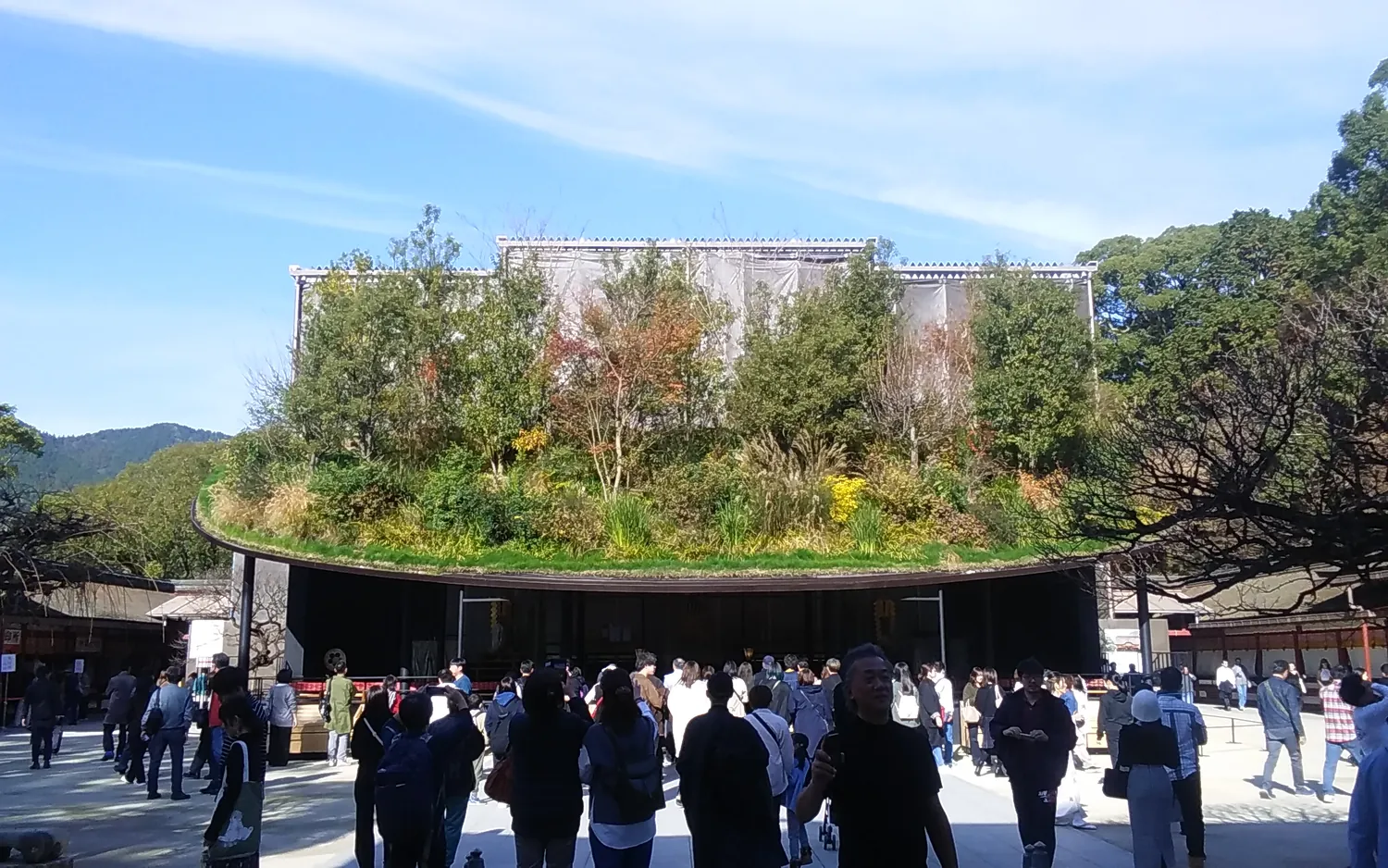
Dazaifu Tenmangu’s hall with a forest on its roof, the one you may have seen in photos, is being taken down. For the first time in about three and a half years, you can pray straight in front of the old main hall again. So plan your visit around the old hall rather than the photo. I was glad to read that even the roof garden is not being thrown away: the shrine plans to replant those trees in its own forest of camphors.
Dazaifu is an easy train ride from Tenjin. Picture the walk up from the station, past shop fronts where rice cakes are grilled as you go by. Past the shrine, you can ride up through a rainbow tunnel to the national museum next door, which usually closes on Mondays.
Stand in front of the old hall again
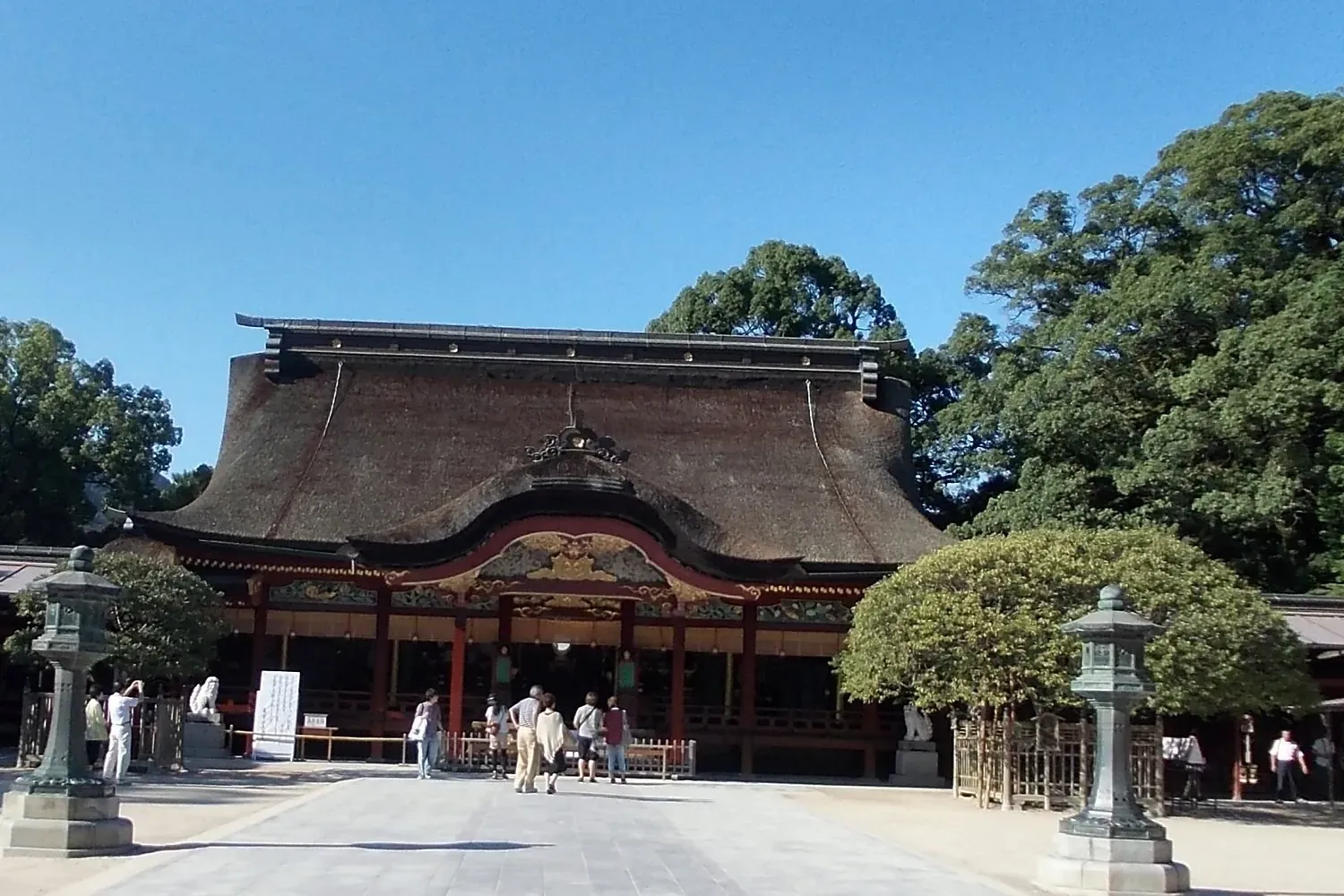
The temporary hall, designed by the architect Sou Fujimoto, stood in front of the main hall as a temporary place of worship while the main hall was being repaired. Now the front of the main hall is open again, and the temporary hall is being taken down. You are facing a hall put up in 1591 by Kobayakawa Takakage, the lord of the province, under a deep roof of Japanese cypress bark. The shrine describes it as a building of the Azuchi-Momoyama style, with sweeping eaves, rich colors and fine carving.
The legend under the main hall is the reason the shrine is here at all. When Sugawara no Michizane, the scholar now worshipped here as Tenjin, died in Dazaifu, the ox pulling his coffin is said to have lain down in the road and refused to move, so he was buried on that spot, and the main hall stands over it.
The shrine describes careful handwork: craftsmen lay the bark roof sheet by sheet with bamboo pegs, and the hall’s decorative metal fittings, roughly 800 of them, were all taken off and sent to Kyoto for repair. If they are back in place when you visit, those are what I would look at longest.
The photo at the top of this page was taken in 2011, before the repair began, so the roof you see now has been worked on since.
If you come between mid-November and early December, walk around behind the main hall before you leave. The shrine says that is where the autumn color gathers thickest.
Cross the three bridges on the way in
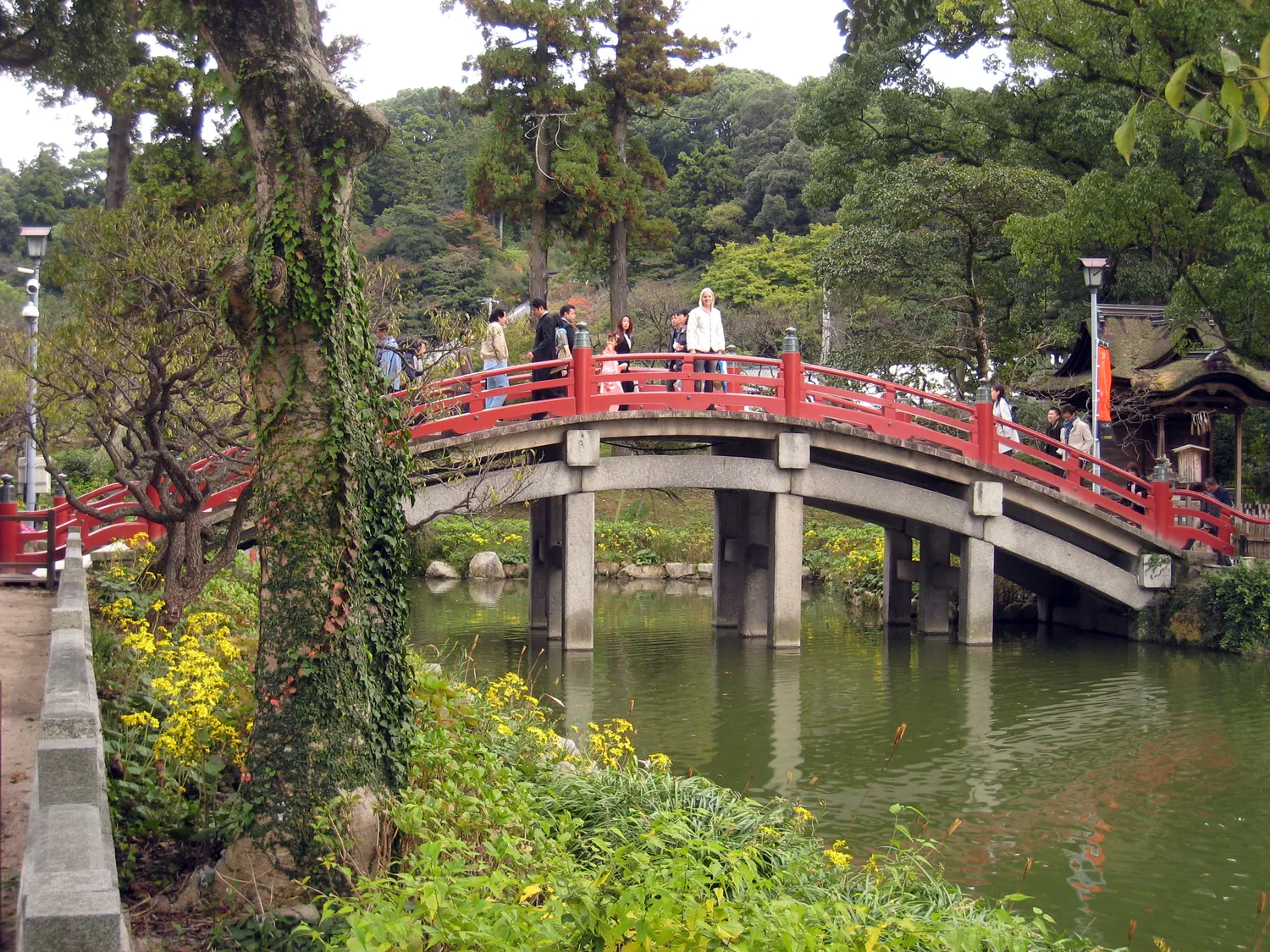
You cross a pond on three red bridges just inside the grounds, and they stand for the past, the present and the future. The bridges at either end are arched. The middle one, the present, lies flat, and the shrine’s English page points out that from it you cannot see what is ahead. I like that the one bridge that hides the way forward is the one called now.
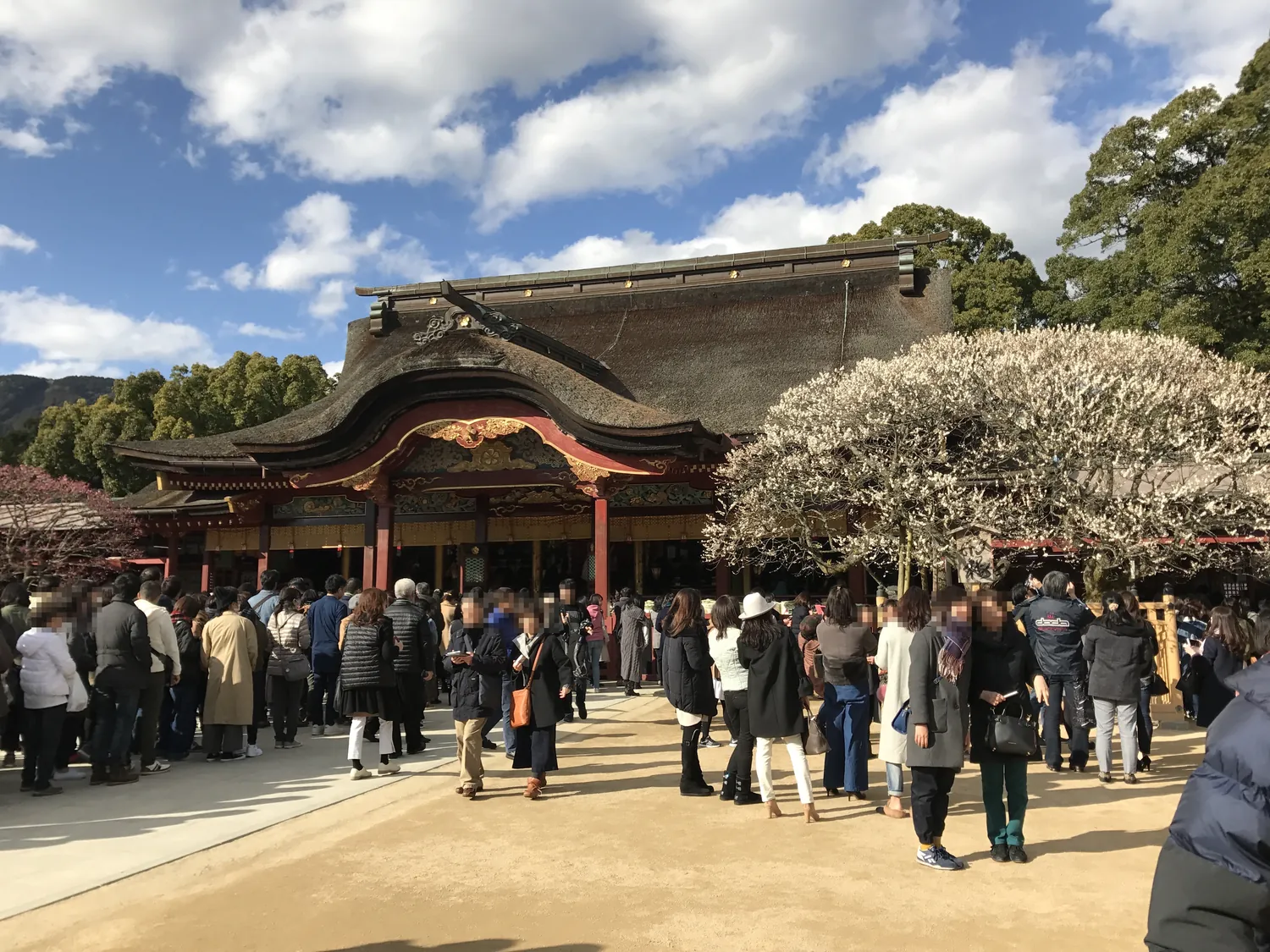
Look near the entrance for the largest of the shrine’s ox statues, the bronze one, with a head rubbed shiny by visitors who pat it hoping to get wiser. Then, at the hall, look to the right for Tobiume, the “flying plum”: the story is that the tree Michizane loved in Kyoto could not bear to be left behind when he was sent into exile, and flew here to be with him.
Eat the umegae mochi on the way up
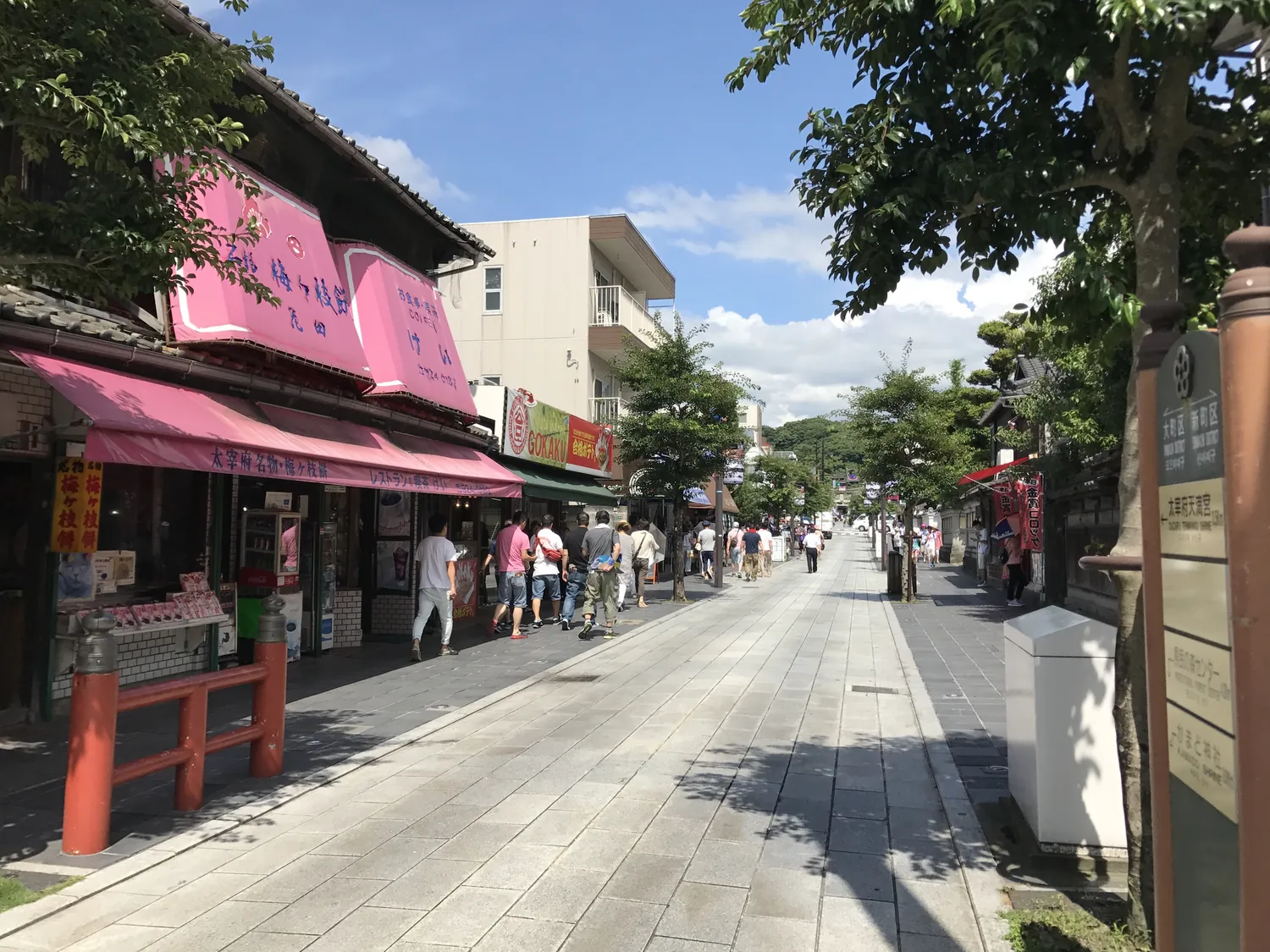
You walk up from Dazaifu Station along a shopping street about 400 meters long, and the thing to look for on it is umegae mochi, a rice cake grilled at the shop fronts. The shrine itself calls that sight something special to Dazaifu, so buy one at a counter where you can watch it being grilled.
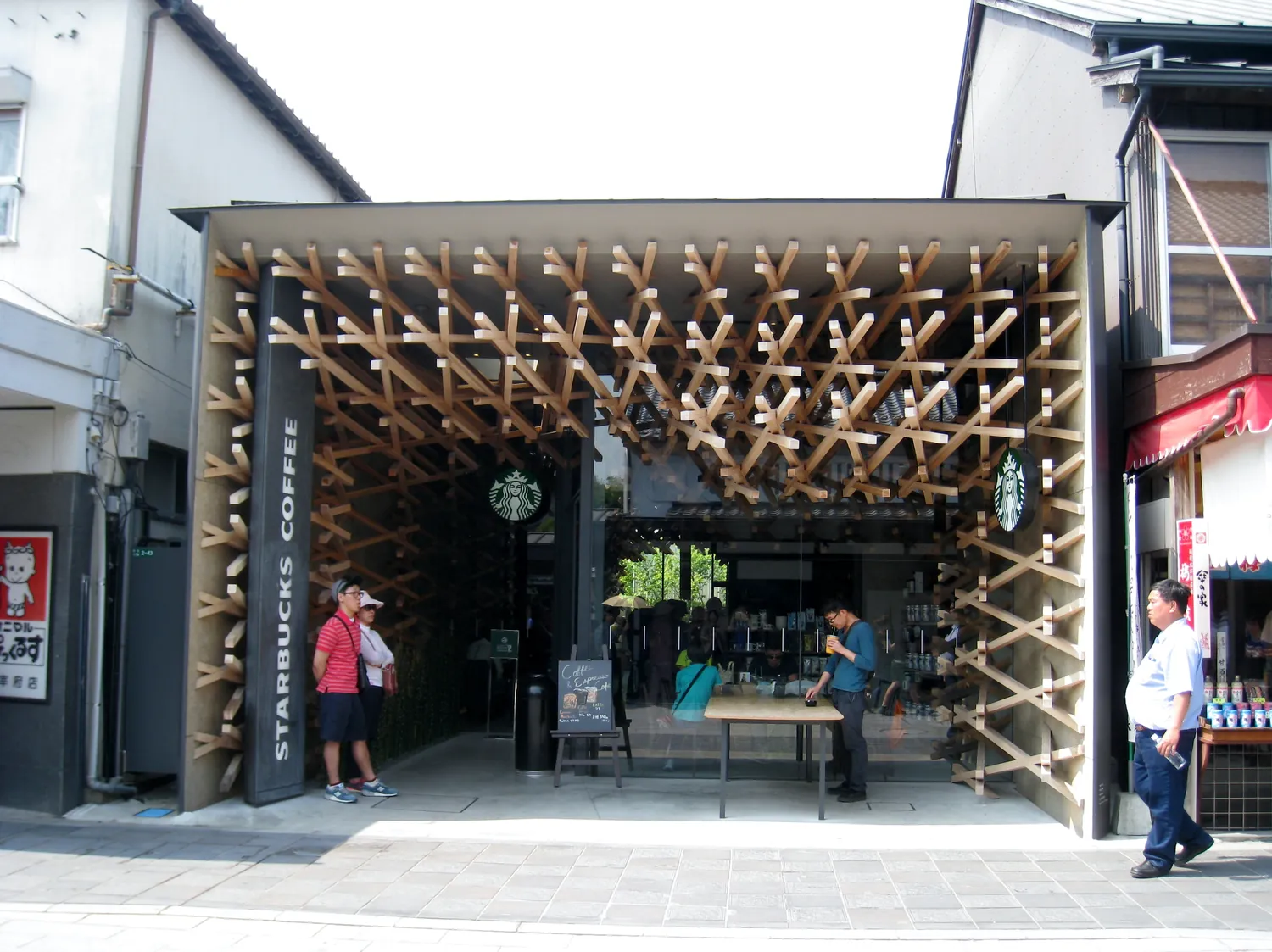
By a torii gate on the approach, the Starbucks designed by Kengo Kuma uses traditional wooden joinery from the entrance into the shop, with a plum tree in the garden at the back. Look in from the door if you like, but buy the mochi first.
One more stop: the museum through the rainbow tunnel
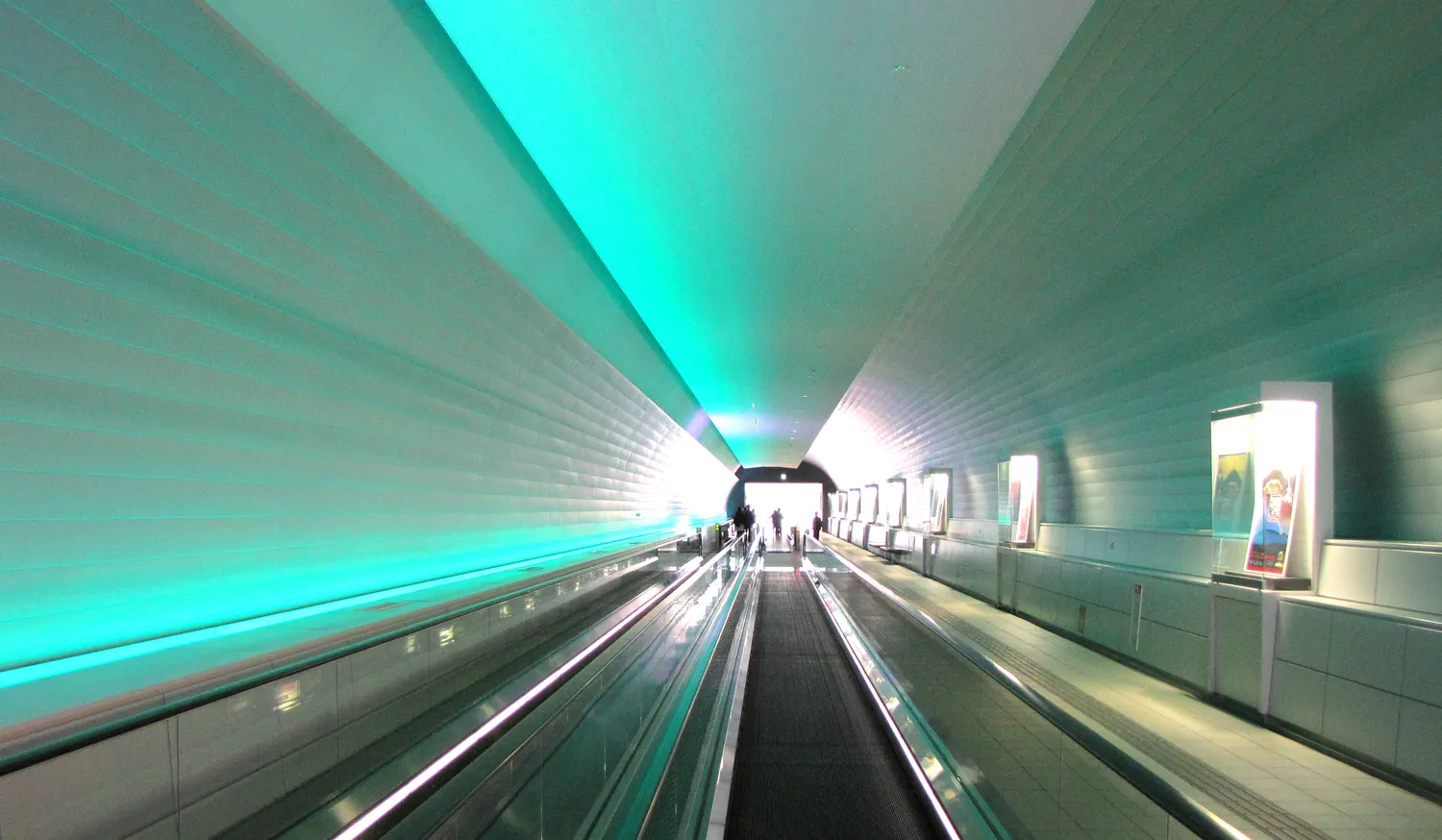
Take the escalator and the moving walkway past the shrine’s own museum, up through what the museum calls its rainbow tunnel, to the Kyushu National Museum. With an hour or two to spare, I would spend it there instead of on a second lap of the shopping street.
Both the national museum and the shrine’s Treasure Hall usually close on Mondays; the table below has the holiday exceptions.
Before you go
| Dazaifu Tenmangu | Free to enter. Gates open 6:30 from the autumn equinox (6:00 from the spring equinox). Gates close 19:00 in April–May and September–November, 19:30 in June–August, 18:30 in December–March |
| Dazaifu Tenmangu Museum (Treasure Hall) | 9:00–16:30 (last entry 16:00). Closed Monday except public and substitute holidays; also closed for exhibition changes. Adults 500 yen |
| Kanko Historical Museum (in the shrine) | 9:00–16:30 (last entry 16:00). Closed Tuesday and Wednesday. Adults 200 yen |
| Kyushu National Museum | 9:30–17:00 (last entry 16:30); during special exhibitions, Saturdays until 19:00 (last entry 18:30). Closed Monday (the next day if Monday is a holiday) and at the end of the year. Collection galleries: adults 700 yen; free for visitors aged 70 and over |
| Combined ticket | Dazaifu Tenmangu Museum, Kanko Historical Museum and the national museum’s collection galleries, adults 1,000 yen |
| Getting there | Nishitetsu train from Tenjin, changing at Nishitetsu Futsukaichi for Dazaifu: about 35 minutes. Or the Tabito express bus from Hakata Bus Terminal (platform 11, ground floor): about 40 minutes, 800 yen, no booking. The shrine is about 5 minutes’ walk from Dazaifu Station |
Checked 11 and 13 October 2026.
What I would do
I would give most of the visit to the old hall. For about three and a half years you could not pray in front of it, so I would stand back as far as the dismantling work allows to take in the roof, then go up close to the eaves. The bridges, the mochi and the museum can fit around that.
We have not visited Dazaifu for this guide. The facts here come from the official sources below, checked on 11 and 13 October 2026.
- Dazaifu Tenmangu (Japanese) — the main hall open again for worship at the front; the temporary hall, its architect, and its trees to be replanted; the main hall’s repair and history; the bridges; gate hours; the shrine’s museums and the combined ticket; the approach and umegae mochi; access: dazaifutenmangu.or.jp/archives/1980, dazaifutenmangu.or.jp/keidaiannai, dazaifutenmangu.or.jp/keidaiannai/kariden, dazaifutenmangu.or.jp/omairi, dazaifutenmangu.or.jp/art, dazaifutenmangu.or.jp/shikinen-taisai/project, dazaifutenmangu.or.jp/shuhen-wo-meguru
- Dazaifu Tenmangu (English) — the ox legend and the bronze ox, the three bridges, Tobiume, the main hall’s date, autumn color behind the main hall, free entry: dazaifutenmangu.or.jp/en/discover-dazaifu-tenmangu/shrine-grounds/, dazaifutenmangu.or.jp/en/plan/faq/, dazaifutenmangu.or.jp/en/discover-dazaifu-tenmangu/nature-and-seasons/
- Kyushu National Museum — hours, closing days, fees and the tunnel from the shrine: kyuhaku.jp/visit/visit_top.html
- Nishitetsu — the Tabito bus from Hakata Bus Terminal
- Starbucks Japan — the Dazaifu Tenmangu Omotesando store
- Photographs: the lead image of the main hall by STA3816, September 2011, before the repair (CC BY-SA 3.0); the temporary hall by 水だらけのプール (CC0); the bridge by Josh Berglund (CC BY 2.0); Tobiume and the shopping street by そらみみ (Soramimi) (CC BY-SA 4.0); the Starbucks by Saka320 (CC BY-SA 3.0); the museum tunnel by Yoshio Kohara (CC BY 3.0). All from Wikimedia Commons.
More in Fukuoka
- Yatai food stalls — For a night at the counter, and a reason to try Tenjin on a Sunday
- Hakata Old Town (Kushida Shrine to Joten-ji) — For the Yamakasa float that stays up, and the walk to where the festival began
- Yanagawa canal boats — For an hour on the moats under low bridges, and steamed eel at the end
- Kurume ramen and yakitori — For the bowl said to have started tonkotsu ramen at lunch, then yakitori after dark
Explore other areas
- Hokkaido — Sapporo
- Kanto — Hakone
- Hokuriku — Kanazawa
- Koshin-Tokai — Fuji Five Lakes
- Kansai — Nara
- Chugoku — Hiroshima
- Kyushu — Fukuoka · You are here
- Okinawa — Naha
