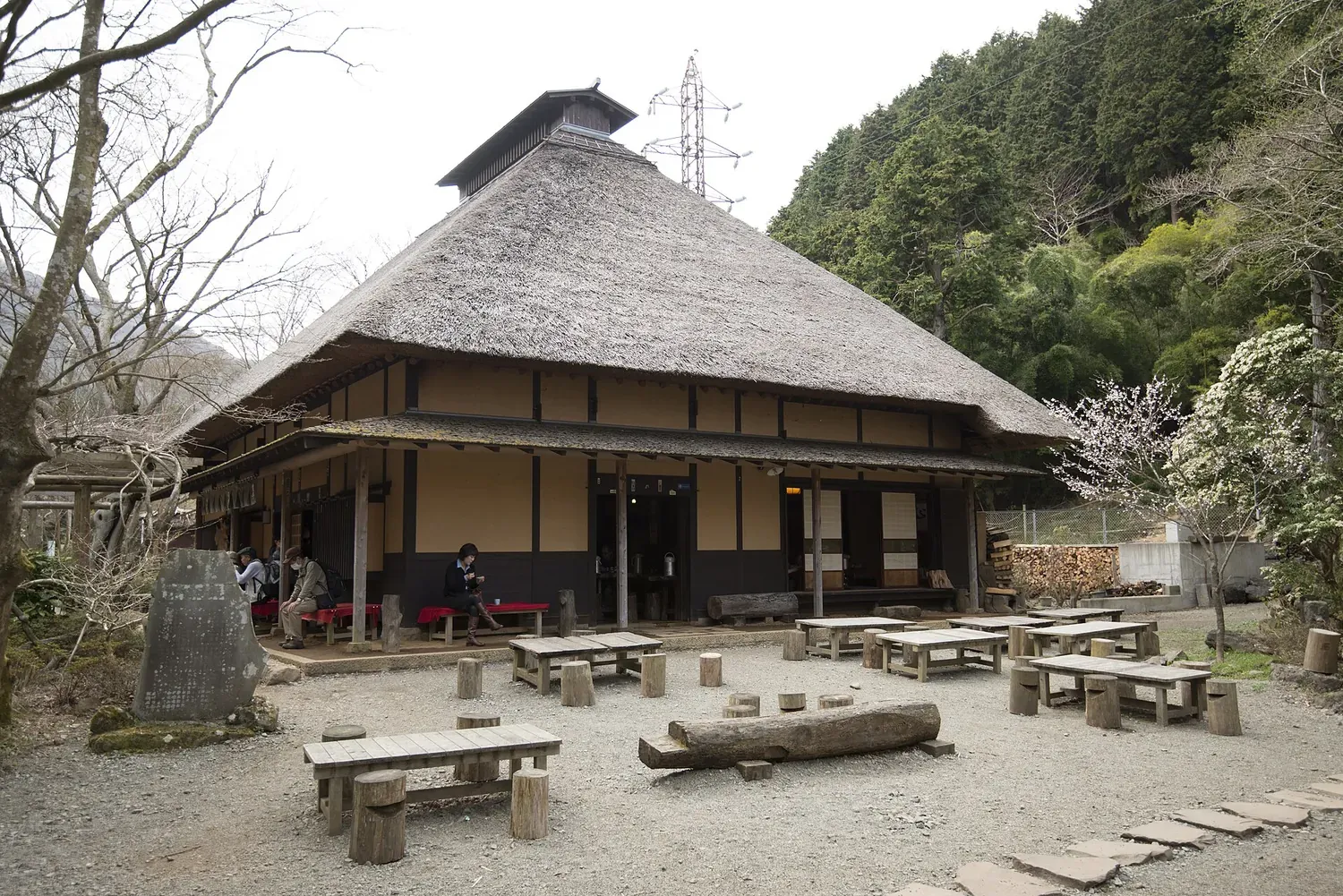
Hakone / Guide
Hakone's Old Road Was Mud to the Shins: Walk the Stones to the Amazake Teahouse
Amazake-chaya甘酒茶屋
If you finish at Lake Ashi, walk the old stone road from Moto-Hakone to the thatched teahouse instead of riding the bus straight back to Yumoto: the old-road bus stops at its door, and it opens at 7:00 every day of the year.
In the early Edo period this pass turned, in rain and snow, into mud that swallowed a traveler to the shins, and before anyone laid stone, the path was covered with bamboo. What I love about the road is that it began as a repair, and that the teahouse along it has been serving a sweet rice drink to walkers since the early Edo period.
Why the stones are there
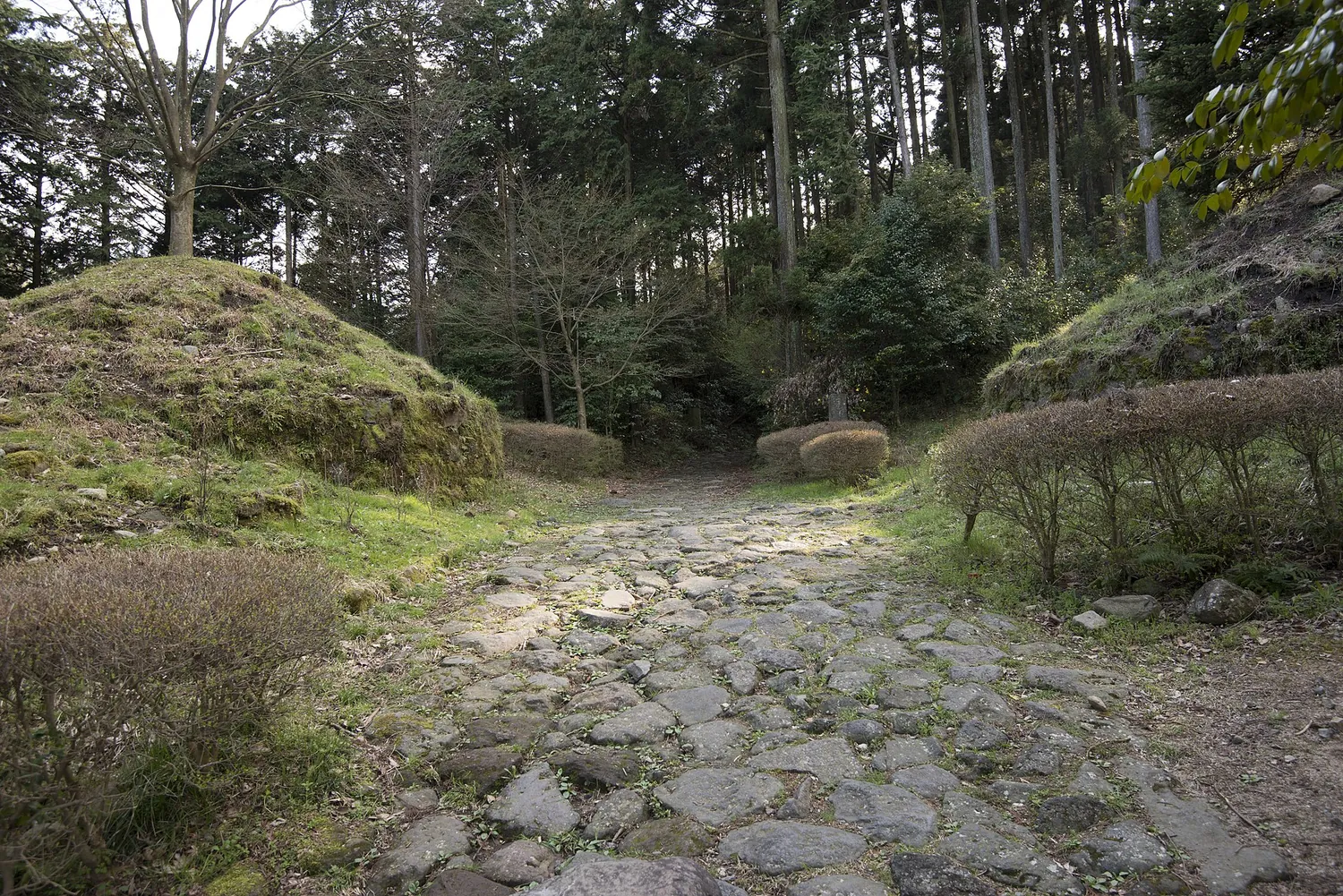
The first answer to the mud was bamboo: Hakone-dake, a small bamboo common on Mount Hakone and the hills around it, laid across the path because in rain and snow it turned into a bog to the shins. Later it was replaced with stone found nearby.
In 1680 stones were laid across a width of two ken, about 3.6 meters, and from then on it was a stone road. This was the Tōkaidō, the highway between Edo and Kyoto, and the Agency for Cultural Affairs says that for a mountain pass, its stone paving was the largest in scale in Japan at the time. In places, moss has since grown over them.
It was busy. Lords from the west on their way to Edo walked it, and so did the heads of the Dutch trading post, envoys from Korea and the magistrates of Nagasaki. The paving that survives has been kept up from Hatajuku to the lakeside, and it is a national historic site now.
Walk as much of it as you like
You don’t have to walk the whole thing. The old road from Yumoto up to the lake is 9.5 kilometers by the stone route, and that is exactly why this road beats the main one: you can take a piece of it and ride the rest.
Look for the Hakone Tozan Bus K line. It runs along the old road between Hakone-Yumoto Station and Moto-Hakone, and it stops at the teahouse itself: the stop is called Amazake-chaya, about 23 minutes from Yumoto. Hatajuku, the craft village further down, has its own stop about 15 minutes from Yumoto. So walk from the lake to the teahouse, sit down, and decide there whether your legs want more.
Leaving Moto-Hakone, you climb first. The road’s highest point on this side is a flat called Hatchōdaira, and between it and the lake runs the Gongen slope, where the water shows between the trees and Hakone Shrine’s first torii stands by the shore below. You climb it with the lake behind you, and I would turn around on it more than once.
Official pages give no walking time for the stretch between Moto-Hakone and the teahouse, and I won’t make one up. Start at Moto-Hakone in the morning, walk only as far as the teahouse, and treat the bus stop outside as your safety net. If rain has soaked the stones, ride to the teahouse rather than walk to it.
A teahouse in its thirteenth generation
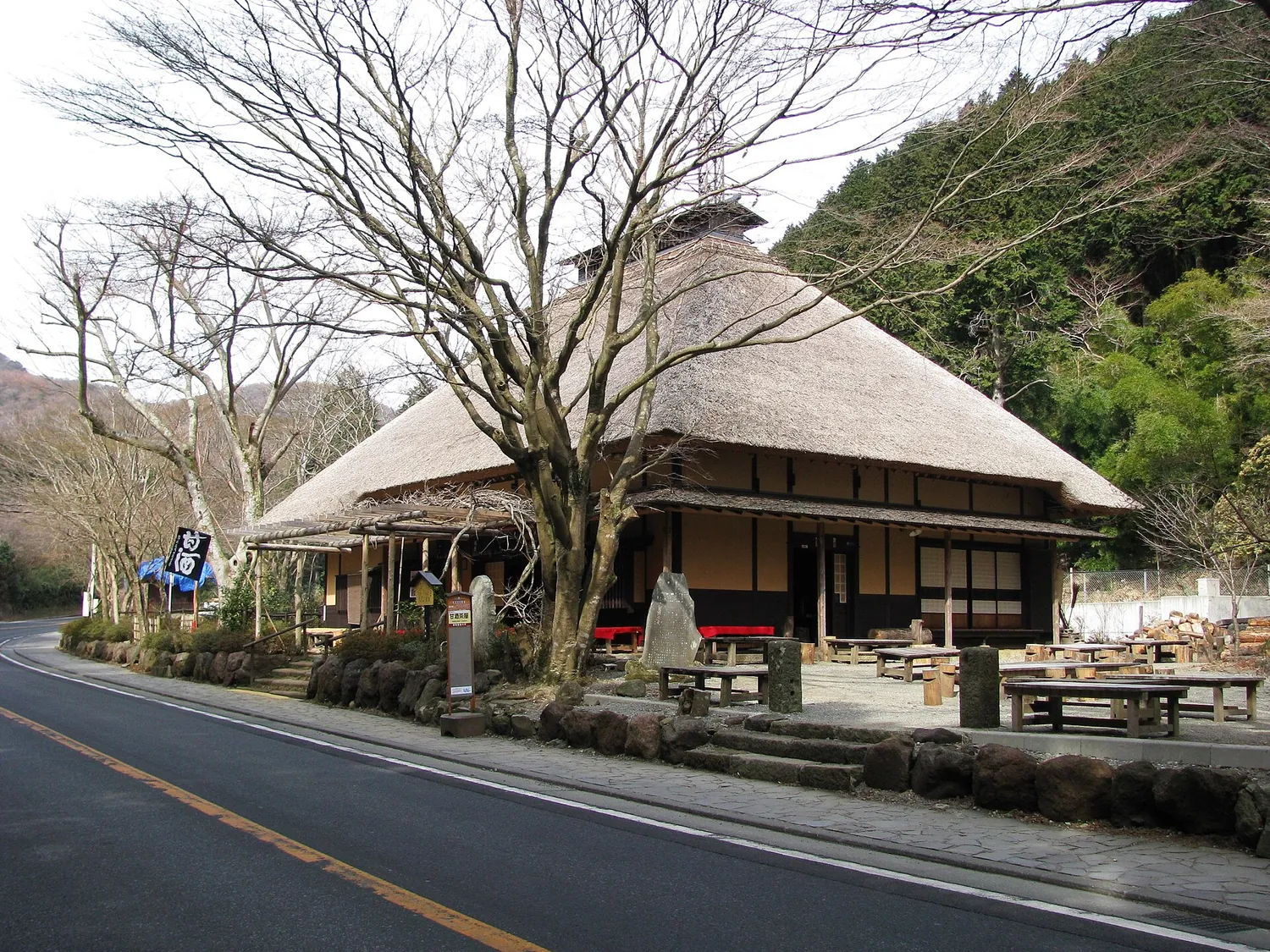
Edo travelers climbing from Hatajuku met it after several slopes, and the Agency for Cultural Affairs still describes it that way: a teahouse with a straw roof, just as in the Edo period. Inside, you can sit by the sunken hearth and drink what travelers drank to get their strength back.
Amazake-chaya opened in the early Edo period and has run for about 400 years. The old building wore out, and in April 2009 it reopened in a new house with a thatched roof, built to keep the feel the teahouse has had since it opened.
The owner today is the thirteenth, and the teahouse tells one story about the third. In 1701, the story goes, Kanzaki Yogorō, one of the forty-seven rōnin of Akō, was hurrying to Edo on Ōishi Kuranosuke’s orders to scout their enemy, Kira Kōzukenosuke. At the teahouse a packhorse driver picked a quarrel with him. With the attack still ahead of him, Yogorō swallowed his pride, wrote the driver an apology and left; when the driver later learned who he had been, the story says, he deeply regretted it, became a monk and prayed for Yogorō. The story lives on in storytelling and plays. The teahouse tells its own part with a care I find touching: the owner at the time, it says, “is said to have been” the third, a family that counts its generations back to a legend and still says only “is said to”.
They still mark it. If you are in Hakone on 14 December, go early: the teahouse holds a Yogorō festival that day, “quietly (?)”, in its own words, and amazake is free from opening at 7:00 until 10:00, then 400 yen.
What is in the cup
Amazake here is made from rice koji and rice, nothing else. There is no sugar in it and no alcohol; the sweetness is the rice’s own starch, turned to sugar by the koji, and the teahouse says the method has not changed since the Edo period. I like that its page takes the trouble to explain the chemistry, down to the enzyme.
It began as a summer drink, taken cold or hot, and it was what the teahouse gave travelers crossing the mountain to get their strength back; the teahouse calls it the sports drink of its day. In summer, cold amazake joins the menu.
The menu, with prices including tax:
- Amazake: 500 yen a cup
- Chikara-mochi: 600 yen for a plate of two rice cakes, toasted over binchōtan charcoal, in isobe (soy sauce and nori), uguisu (lightly sweet soybean flour) or kurogoma (soybean flour with fresh-ground black sesame, in limited numbers)
- Miso oden: 500 yen for five konjac balls in homemade miso and sesame
- Tokoroten: 600 yen, pushed through the press after you order
- Iced matcha: 500 yen, with a red shiso jelly
- Shiso juice: 500 yen
Everything except the tokoroten can be taken away, so if your bus is close, eat the tokoroten at the table and carry the rest. You can take the taste home too: the teahouse sells its amazake base, 400 grams for 850 yen. Dissolve it in the same amount of water, bring it to the boil twice and finish with a pinch of salt.
A print from 1881
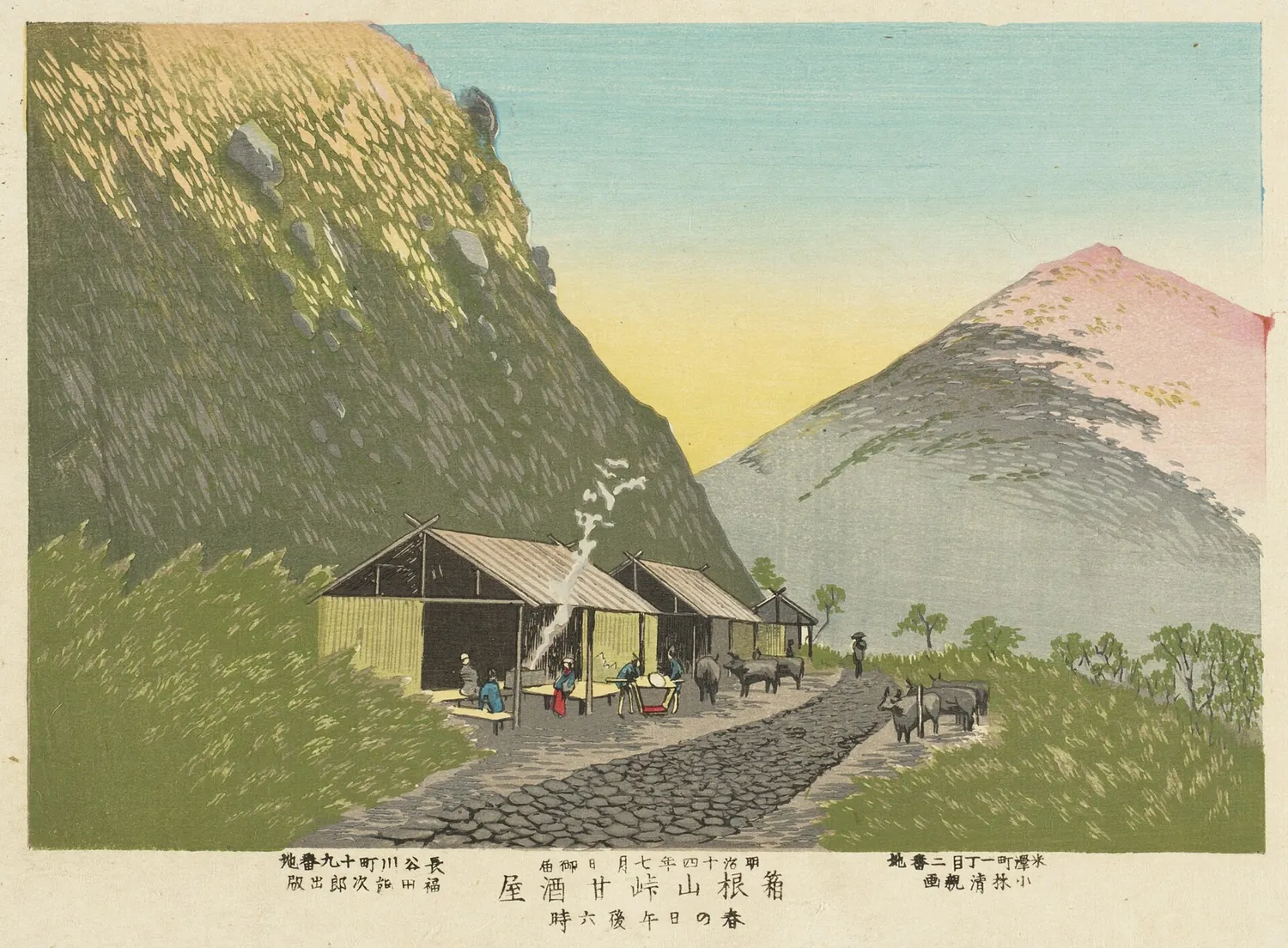
On its own homepage, where you would expect a photo of the house, the teahouse shows a woodblock print instead. It is by Kobayashi Kiyochika, an artist the teahouse describes as said to be the last ukiyo-e painter, and it is one of several prints he made of Hakone on a visit at 34; the print is dated July 1881. Its title reads, in full, The amazake house on the Hakone pass, a spring day, 6 p.m.
He put the stone path in the foreground and a low thatched house beside it, a mountain wall on one side and a far peak catching the last light. A copy of this print now belongs to a museum in Los Angeles. The teahouse in it, in a newer thatched house since 2009, still opens every morning at 7:00.
Hatajuku, further down the road
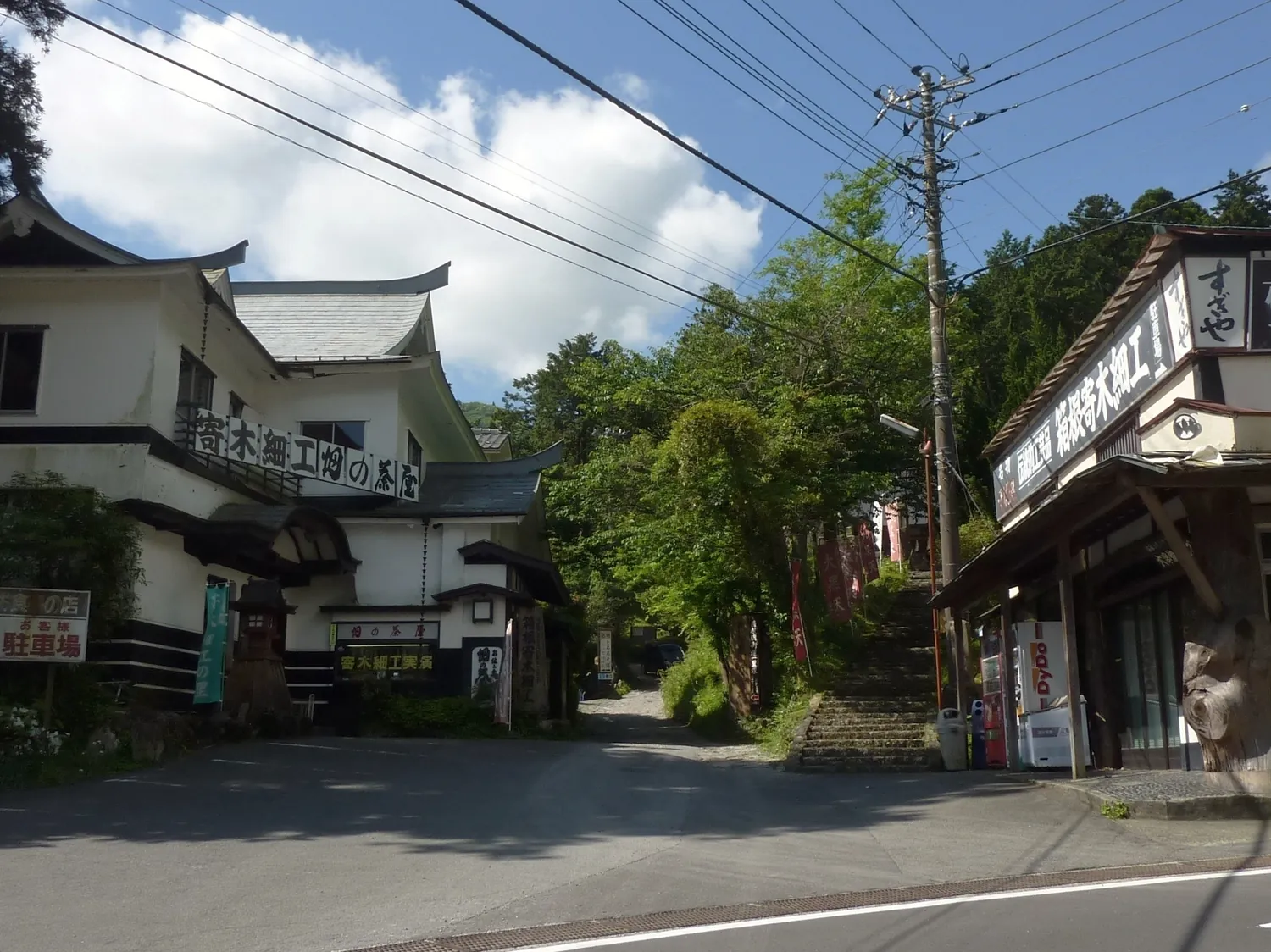
If you still have the legs after the teahouse, keep going down the stones to Hatajuku instead of boarding at the door; the K line stops there too, and the village is the home of Hakone’s best-known souvenir craft.
On the way down, watch for two small mounds facing each other across the road: the twenty-third ri from Nihonbashi in Edo, a milestone the shogunate raised so travelers could tell how far they had come. Of the three that stood in Hakone town, this is reportedly the only one that keeps its shape.
Hatajuku itself was the rest stop where travelers bought yosegi-zaiku, the Hakone marquetry made by fitting natural woods of different colors into geometric patterns. Wood for the work is still stacked under the eaves, and the Agency for Cultural Affairs compares watching a craftsman build a pattern to watching a magic trick, a line I did not expect from a government page. The Hatajuku Yosegi Kaikan shows how it is made, sells it and runs hands-on sessions, and entry is free; its closing day differs between the prefecture’s and the town’s tourist sites, so check before you go.
Before you go
| Amazake-chaya | 7:00–17:30 (last order 17:00), open every day; longer during events. Amazake 500 yen. Everything except tokoroten can be taken away |
| Getting there | Hakone Tozan Bus K line from Hakone-Yumoto Station, about 23 minutes to the Amazake-chaya stop, in front of the teahouse. About 15 minutes to the Hatajuku stop |
| The old road | 9.5 km from Yumoto to the lake by the stone route. No official walking time is given for the stretch between Moto-Hakone and the teahouse |
| Next door | The Old Road Rest House, in front of the Amazake-chaya bus stop, is free, with a few items once shown at the Old Road Museum |
| Official website | amasake-chaya.com. The teahouse says its old address ending in .jp now belongs to an unrelated site; the Kanagawa prefectural tourism site still links to that old address |
| Hatajuku Yosegi Kaikan | Free entry. Official listings disagree on its closing day; check before you go |
Checked 26 September 2026.
What I would do on the old road
I would take the stones from Moto-Hakone in the morning, look back at the lake from the Gongen slope, and stop walking at the teahouse, whatever time the next bus came.
By the hearth I would order a hot amazake and one plate of chikara-mochi, and think about the third owner and the thirteenth, and about a print in Los Angeles of a teahouse that is still pouring.
We have not visited Amazake-chaya or the old road for this guide. The facts here come from the official sources below, checked on 26 September 2026.
- Amazake-chaya — hours, menu and prices, takeaway, the amazake base, the thirteenth owner, the Yogorō story and festival, how the amazake is made, the Kiyochika print and the change of web address: amasake-chaya.com
- Agency for Cultural Affairs (Japan Heritage) — bamboo and mud, the 1680 paving and its width and scale, the travelers on the road, the Gongen slope and Hatchōdaira, the teahouse’s hearth, Hatajuku and its milestone: japan-heritage.bunka.go.jp/ja/culturalproperties/result/3884/, japan-heritage.bunka.go.jp/ja/stories/story062/; the historic-site designation: online.bunka.go.jp/heritages/detail/216199
- Hakone Tourist Association — the teahouse’s founding and 2009 rebuilding: hakone.or.jp/504; paving kept from Hatajuku to the lake: hakone.or.jp/6316; the whole course length: hakone.or.jp/6392; the Hatajuku milestone mound: hakone.or.jp/561; the rest house: hakone.or.jp/550; Hatajuku Yosegi Kaikan and the Hatajuku bus stop: hakone.or.jp/5518
- Hakone Geopark — Hakone-dake bamboo: hakone-geopark.jp/area-guide/hakone1/006sekisyotoisidatami.html
- Hakone Navi (Odakyu Hakone) — the K line and the Amazake-chaya stop: hakonenavi.jp/spot/1252
- Kanagawa Prefecture tourism site — Hatajuku Yosegi Kaikan: kanagawa-kankou.or.jp/spot/218; its listing for the teahouse with the old address: kanagawa-kankou.or.jp/spot/194
- Photographs: the hero image and the stone road by Maarten Heerlien (CC BY 2.0); the teahouse by Aimaimyi (CC BY-SA 3.0); Hatajuku by Quercus acuta (CC BY-SA 4.0); the Kiyochika print, Los Angeles County Museum of Art (public domain) — all from Wikimedia Commons
More in Hakone
- Owakudani — For the steaming ground itself, on one of four guided walks a day
- Hakone Shrine — For the dragon shrine across the water, reached by the shrine’s boat on the 13th
- Lake Ashi — For a one-way crossing between a caldera wall and old lava, and a walk under the cedars
- Where to Stay — For choosing where to sleep by the water you end the day in: Gora, Sengokuhara, Lake Ashi or Miyanoshita
Explore other areas
- Hokkaido — Sapporo
- Kanto — Hakone · You are here
- Hokuriku — Kanazawa
- Koshin-Tokai — Fuji Five Lakes
- Kansai — Nara
- Chugoku — Hiroshima
- Kyushu — Fukuoka
- Okinawa — Naha
