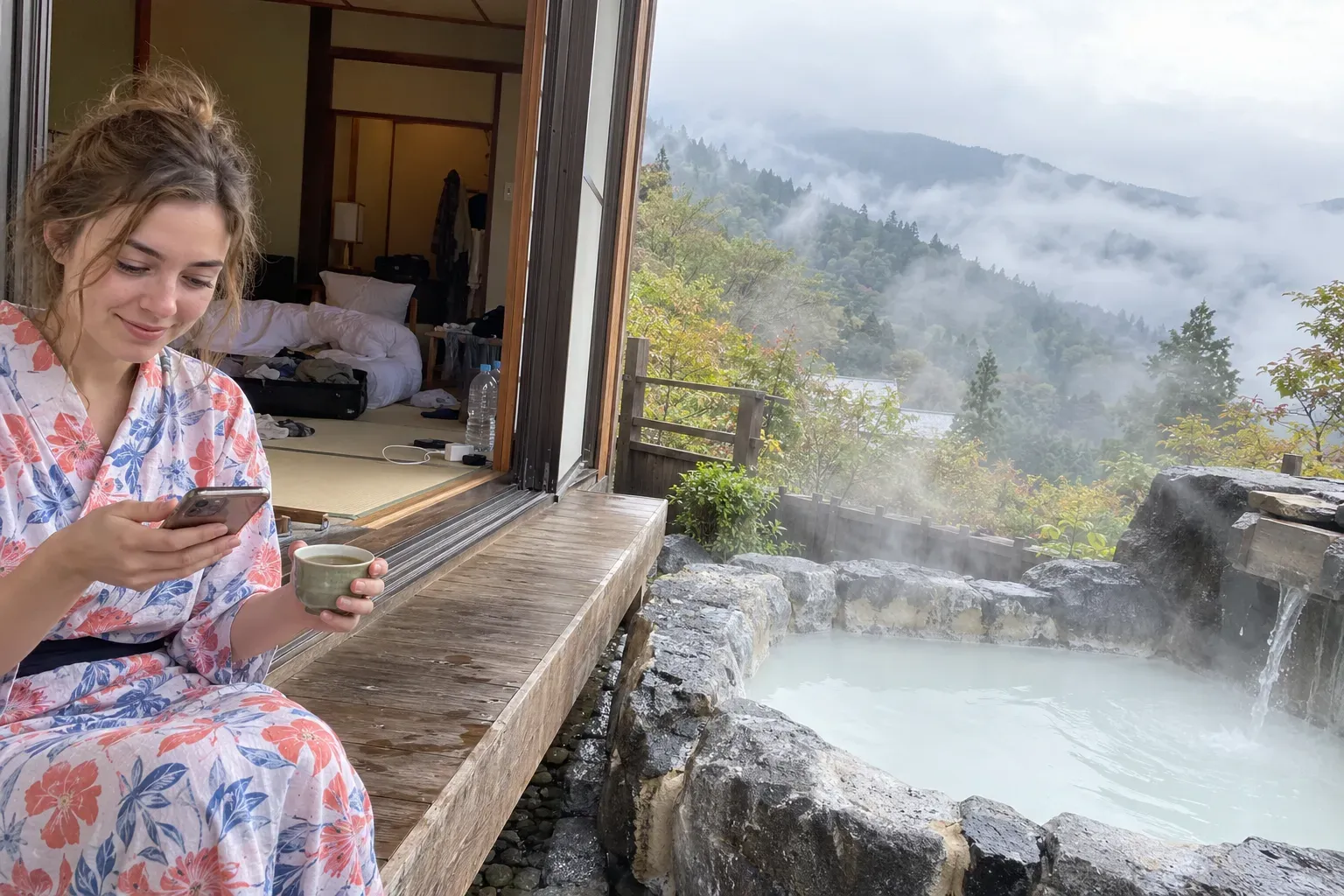
Hakone / Stay
Where to Stay in Hakone: Choose the Bath, Then the Town
Where to Stay箱根の宿
If the water in your Gora or Sengokuhara bath is milky white, it most likely did not rise beneath your inn. It came down the mountain from Owakudani, where volcanic steam is blown into well water to make it, and the company that makes it has piped it down to the inns since 1933. If the cloudy water is what you came for, choose the inn by its bath, not by the town. In Gora, the inn up a mountain path may pour you a milky bath, and the one by the station water from its own springs instead.
Trains, a cable car, the ropeway, buses and boats connect Hakone’s valley, its lake and the old stone road. What changes from area to area is the water you end the day in, and what you see when you open the curtains in the morning. I would choose the water first.
The bath that is made in the valley
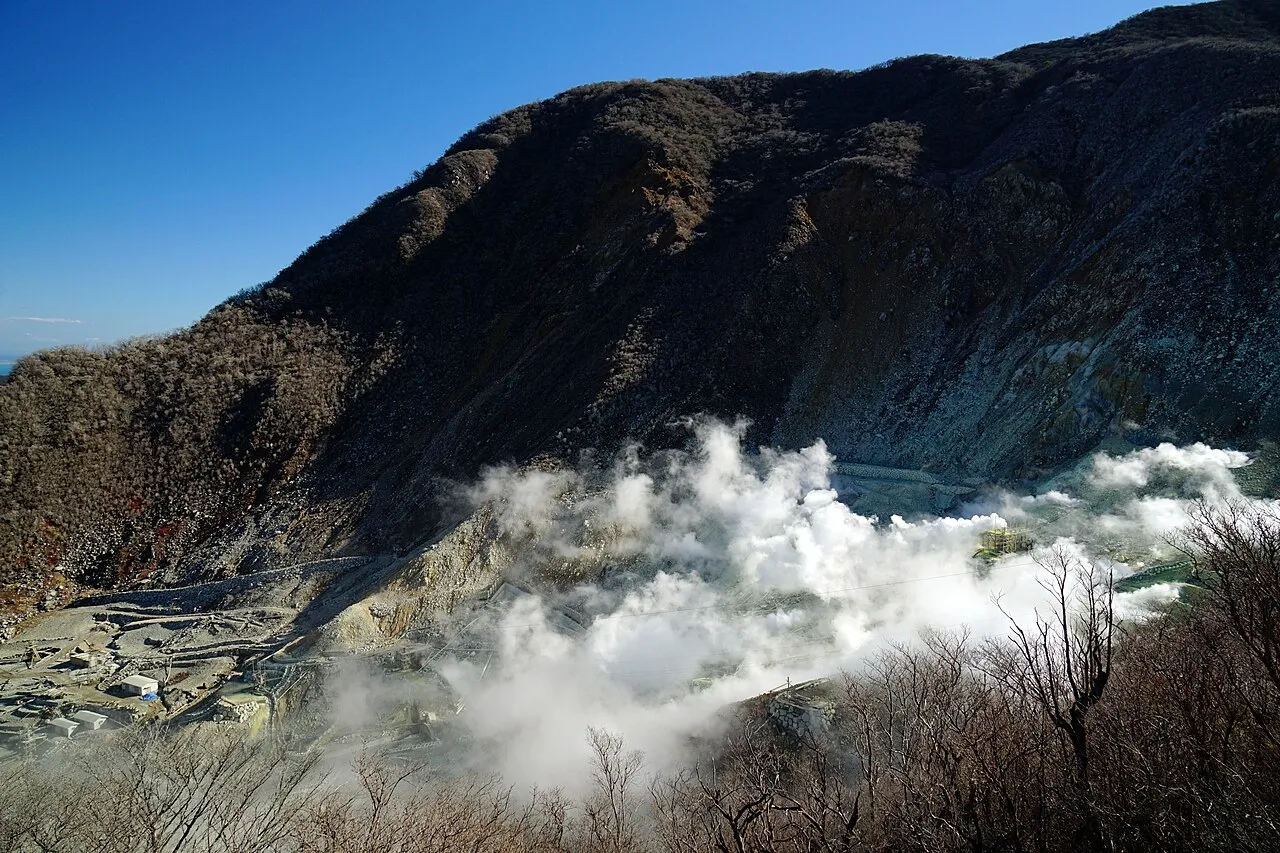
Owakudani has little hot water of its own that rises naturally, says the company that supplies it. So it makes it. Water pumped from wells in the Sengokuhara marshes is carried up to the valley, and there, in tanks and towers, volcanic steam is blown into it until it becomes hot spring water. The little that does rise on its own is mixed in, about 30 percent of all it sends out.
The sulphur is the hard part. The company says it coats the equipment overnight, and in places can block a pipe in half a day. So workers in gas masks strike the towers from outside to shake it loose from the walls, and scrape it out through cleaning windows, a few times a week. After reading that, a milky bath stopped looking effortless to me. It is kept flowing by people working in the valley the ropeway passes over.
Expect this water to be acidic. The inns’ cooperative notes that an acidic bath can sting a little, and that rinsing with plain water afterwards is a good idea.
If you want the milky water and the train, stay in Gora
Gora was open grassland without a single house, Hakone Navi says, until hot water was piped in from Sōunzan. Then the mountain railway reached it, and politicians, businessmen and writers built large villas up the slope. The train still climbs here the old way: it reverses three times on the way up from Yumoto, and at each reversal the driver and the conductor change ends. You can ride the cable car on up from Gora to Sōunzan, where the ropeway leaves for Owakudani.
You are in a town of slopes and baths, and Gora’s tourist association lists five colours of water within it: clear, pale yellow, milky white, pale brown and pale green. If you are choosing in Gora, read an inn’s bath page before its room page.
One inn we would look at: Gora Kaze no Oto. It pipes cloudy sulphate water straight from Owakudani, and says its baths use nothing but water from the source, something rare even in Gora. Think about your bags before you set off: it is a small inn at the end of a mountain path from Gora Station.
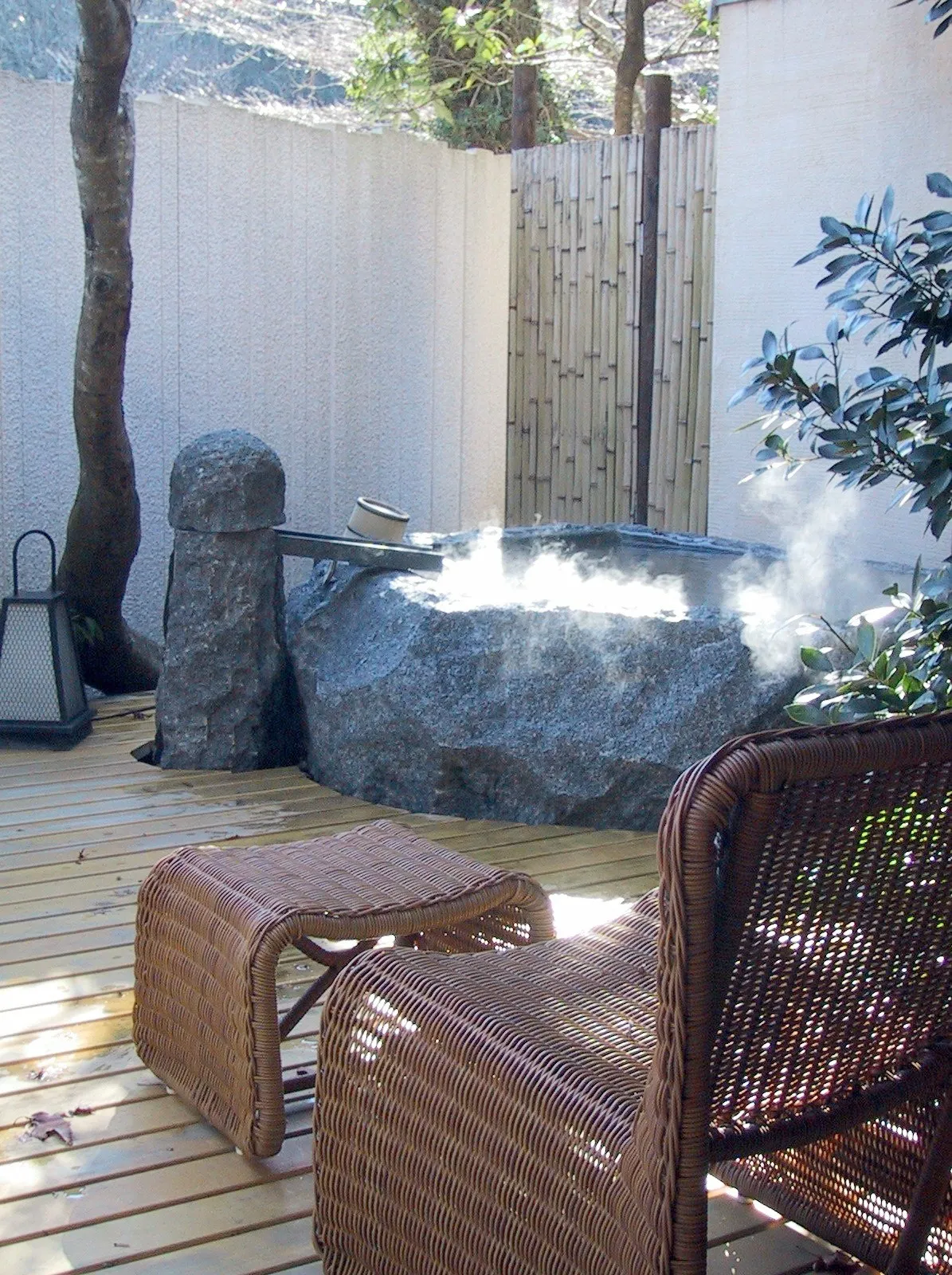
Or: Gora Kadan, a short walk from Gora Station, on the site of a former villa of Prince Kan’in. If you choose it, you choose different water. It owns its own springs of mildly alkaline water, and two of them rise inside its garden. The inn says it is thought to have been the first in Japan to give its guest rooms open-air baths.
If you want milky water on a high plain, stay in Sengokuhara
You sleep on a high plain in Sengokuhara, one that, Hakone Navi says, was once part of the bed of Lake Ashi, until an eruption of Kamiyama held back the water and left marshland. It is not a hot-spring street. Its inns range from large ryokan to small ones, and the head of the local tourist association says you can bathe in milky water at each of them. Still, check the bath page of the inn you choose before you book.
The wells that supply Owakudani’s water are here, in those marshes. So the water in a Sengokuhara bath may have made a round trip: pumped from the plain, carried up to the valley, turned into hot spring by the steam, and sent back down. That round trip is why I would sleep out here on the plain.
One inn we would look at: Senkyoro. It opened in 1870 as the Ishimura inn, drew water from Owakudani for its bathers in its early years, and is still known as the Sengoku Motoyuba, the original bathhouse of Sengoku. Its water is strongly acidic, and it runs downhill into the hot spring baths on its own, day and night. The white flakes floating on it, the inn says, are sulphur from Owakudani that has not dissolved. If you want it in your room, book a room with an open-air bath: the inn says its other in-room baths use ordinary heated water.
It is also one of the inns the Hakone Carry Service delivers to. You can leave your bags at Hakone-Yumoto Station in the morning, ride the bus up empty-handed, and find them waiting at the inn in the afternoon.
If you want Fuji over the lake, stay by Lake Ashi
People in Hakone used to say, one lakeside hotel tells you, that hot water never rises where you can see Fuji and Lake Ashi. The lakeshore had no hot spring baths of its own until the 1960s, when water was first piped in from Ashinoyu.
Sleep here for the view instead. You can watch the pirate ships come and go from Moto-Hakone and Hakone-machi, and on a good day, Hakone Navi says, see Fuji upside down in the lake. From Moto-Hakone, you can walk to Hakone Shrine and its torii in the water or take a pirate ship across Lake Ashi. For the old stone road, a bus climbs from there to Amazake-chaya.
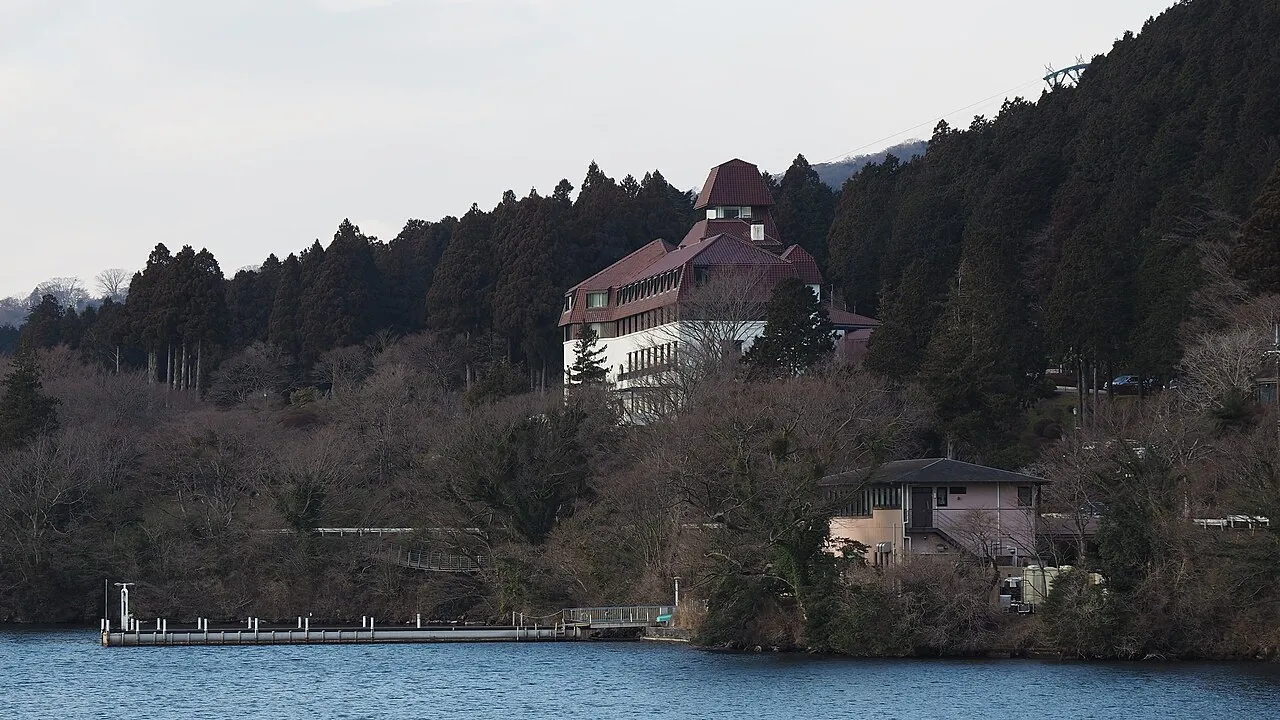
One hotel we would look at: Hotel de Yama. It stands where Baron Koyata Iwasaki built a villa, and its garden still holds the azaleas planted in his time. In May, the hotel says, about 3,000 of them flower like a carpet.
It also took on the old saying. It drilled down about a kilometre and found a spring of its own, clear and colourless, which Hakone Navi calls the only private spring in the Lake Ashi hot spring area. I enjoy that the hotel built for the view is the one that proved the saying wrong.
Or: Hakone Hotel, by the water at Hakone-machi. It opened in the summer of 1923 and was wrecked by the Great Kanto Earthquake that September, then rebuilt. From its half-open-air bath, the hotel says, on a clear day you can see Fuji rising beyond the caldera’s outer ridge.
If you want to sleep in history, stay in Miyanoshita
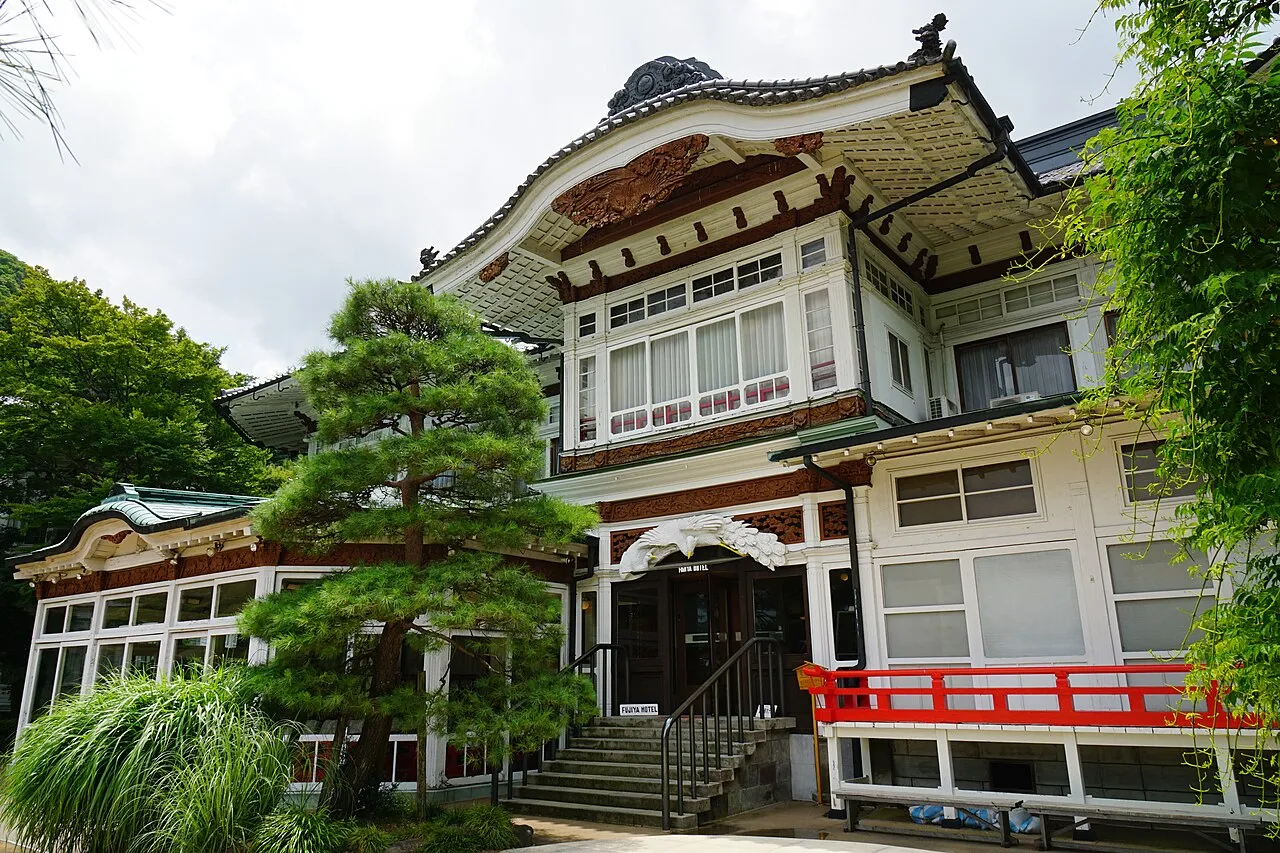
If you stay here, stay for the building, not the water. Fujiya Hotel’s Main Building has a tiled roof and a curved karahafu gable over its door, the kind you would expect on a temple, on the front of a Western hotel. In the evening, you can walk back up to that roof from the old shops nearby.
One hotel we would look at: Fujiya Hotel. It opened in 1878 and calls itself Japan’s first full-scale resort hotel. Its water is its own, too: the hotel has several springs of Miyanoshita water, and every room’s bath runs with it.
You are midway up the mountain here, on the railway. From the end of the Edo period, Hakone Navi says, so many foreigners stayed here that the town took on an exotic air, and photographers and antique dealers set up shop for them around the hotel. Many old shops still stand on what is now called Sepia Street.
Or, down in Yumoto: Bansuiro Fukuzumi. It has been taking guests since 1625. Its early Meiji buildings, Japanese with Western touches, were the first at a working inn to be named an Important Cultural Property of Japan. Its water is clear and alkaline, from a spring that flows out on its own.
Before you go
| Hakone Tozan Railway from Hakone-Yumoto | Miyanoshita about 25 minutes, Gora about 35–40. The train reverses at Deyama, Ōhiradai and Kami-Ōhiradai; only Ōhiradai is a station you can use |
| From Gora | Cable car to Sōunzan about 10 minutes, then the Hakone Ropeway over Owakudani to Tōgendai about 30 |
| To Sengokuhara | Hakone Tozan Bus bound for Tōgendai from Hakone-Yumoto, about 30 minutes to Senkyoro-mae |
| To Lake Ashi | Hakone Tozan Bus from Hakone-Yumoto, about 35 minutes to Moto-Hakone port or Hakone Hotel-mae |
| Hakone Carry Service | Leave bags at Hakone-Yumoto Station 8:30–12:00, collect at the inn from 15:00. Going home, hand them in at the inn by 10:00 and collect at the station 13:30–18:30. Partner inns only; ask yours |
| Water made at Owakudani | Supplied since 1933. Acidic calcium sulphate(-chloride) spring, pH about 2 (supplier’s 2018 analysis) |
| Gora Kaze no Oto | 15 rooms. About 15 minutes on foot from Gora Station, on a mountain path |
| Gora Kadan | About 3 minutes on foot from Gora Station. Own springs, mildly alkaline |
| Senkyoro | Opened 1870; on this site since 1913. Water pH 2.0, 64°C at the source. Main bath open 24 hours. Hakone Carry Service partner |
| Hotel de Yama | Opened 15 May 1948. Own spring, about 1,000 m deep (2006), pH 8.9, colourless. Free shuttle bus from Moto-Hakone port. About 3,000 azaleas of 84 varieties, in flower in May |
| Hakone Hotel | Opened June 1923. Simple sulphur spring |
| Fujiya Hotel | Opened 1878; Main Building 1891. About 7 minutes on foot from Miyanoshita Station. Four springs; hot spring water in all 120 rooms |
| Bansuiro Fukuzumi | Since 1625. Important Cultural Property since 2002. No station pick-up at present |
Checked 8 October 2026. We list no room rates.
Where I would sleep
I would spend one night in Sengokuhara, in water drawn from its marshes and sent back down from the steam, and the next by the lake, in the clear water that was never supposed to be there.
For every area on this page, see hotels in Hakone on Expedia. That is an affiliate link: if you book through it, we earn a commission.
We have not stayed at any of the places on this page or visited the areas described. The facts here come from the official sources below, checked on 8 October 2026.
- Hakone Onsen Kyokyu (Hakone Hot Spring Supply) — how Owakudani’s water is made, the sulphur, the history and the analysis: hakoneonsen.com
- Hakone Navi (Odakyu Hakone) — Gora, Sengokuhara, the Lake Ashi hot springs, Miyanoshita, the railway, the Hakone Carry Service and travel times: hakonenavi.jp
- Gora tourist association — the colours of Gora’s water: goura-kanko.jp
- Hakone hot spring ryokan and hotel cooperative — water types, acidic baths and access to Gora Kadan: hakone-ryokan.or.jp
- Gora Kaze no Oto — water, rooms and access: gora-kazenone.jp
- Gora Kadan — site, springs and history: gorakadan.com
- Senkyoro — history, water and access: senkyoro.co.jp
- Hotel de Yama — history, garden, spring and access: hakone-hoteldeyama.jp
- Hakone Hotel — history and baths: hakonehotel.jp
- Fujiya Hotel — history, buildings, springs and access: fujiyahotel.jp
- Bansuiro Fukuzumi — history, water and pick-up: 2923.co.jp
- Photographs: Owakudani and Fujiya Hotel by 663highland (CC BY 2.5; CC BY-SA 4.0); an open-air bath at Gora Kadan by Chris 73 (CC BY-SA 3.0); Hotel de Yama by Ka23 13 (CC BY-SA 4.0). All from Wikimedia Commons. The hero image is an AI-generated photo illustration, not a photograph of any place to stay on this page.
More in Hakone
- Owakudani — For the steaming ground itself, on one of four guided walks a day
- Hakone Shrine — For the dragon shrine across the water, reached by the shrine’s boat on the 13th
- Lake Ashi — For a one-way crossing between a caldera wall and old lava, and a walk under the cedars
- Amazake-chaya — For a walk on the Edo stone road and a cup of sugar-free amazake at a thatched teahouse
Explore other areas
- Hokkaido — Sapporo
- Kanto — Hakone · You are here
- Hokuriku — Kanazawa
- Koshin-Tokai — Fuji Five Lakes
- Kansai — Nara
- Chugoku — Hiroshima
- Kyushu — Fukuoka
- Okinawa — Naha
