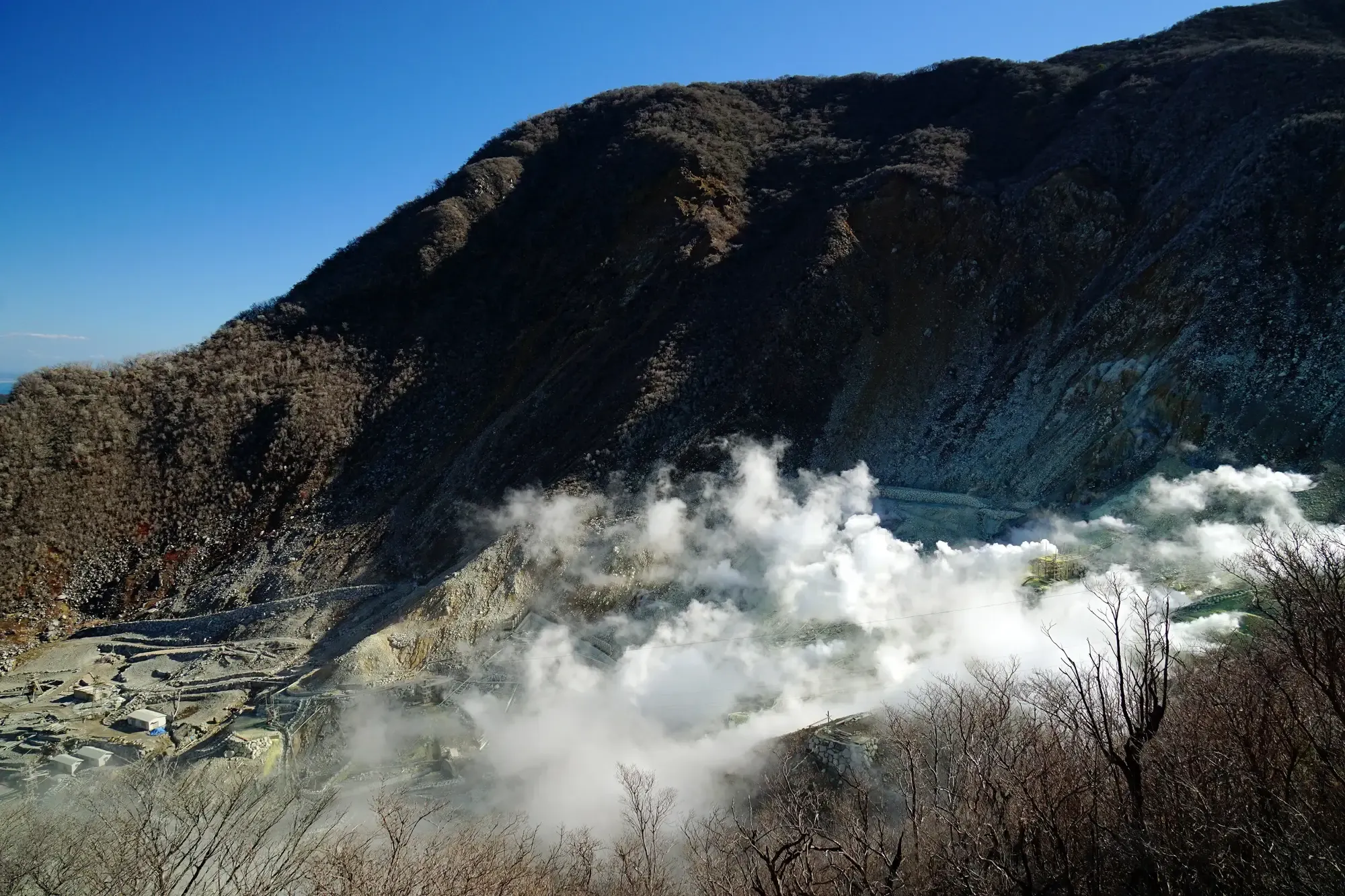
Hakone / Guide
Owakudani: Book the Guided Walk Before You Plan the Ropeway
Owakudani大涌谷
If you want to stand in Owakudani’s steam instead of just watching it slide under the gondola, book one of the four daily guided walks first — 30 people each, helmets on — and fit the ropeway around it.
The steaming ground you see from the Hakone Ropeway can be entered on foot only this way. The walk lasts about 40 minutes, with a monitor at the front of the line and another at the back, and seven shelters along the path against debris from an eruption. Helmets and rock shelters for a 40-minute stroll: learning that made the place more thrilling to me, not less.
If anyone in your group has asthma or a heart condition, the plan is different, and it is further down. Read that part first.
Four walks a day, thirty people each
You can join at 10:00, 11:30, 13:00 or 14:30. Book online in advance: each group is capped at 30. The path is a loop of about 700 metres from the Owakudani park area, and it goes close to the steaming vents. The park operator describes it as heavy with the smell of volcanic gas, with boards along the way explaining how the volcano was made.
When you book, you are not yet sure it will go ahead. Each walk is described as planned, with the final decision made 30 minutes before, depending on the weather and the volcano. That the answer comes so late struck me as honest. It means the call is made on the day, against that day’s gas and weather — excess gas, rain, strong wind or fog can each stop a walk — not from a calendar drawn up months ahead.
Check two conditions before you book. Everyone in your group must be of elementary-school age or older and able to run to safety on their own if needed. And you cannot join with a respiratory or heart condition.
On the day, check in at the Owakudani Information Center, on the ground floor of the Kurotamago-kan building, at least 20 minutes before your start, as the booking page asks. Bring a card or a transport IC card: the fee is cashless only.
Picture a group of up to thirty in helmets, one monitor at the front and one at the back, the smell of volcanic gas in the air, and the path running close to the steaming vents.
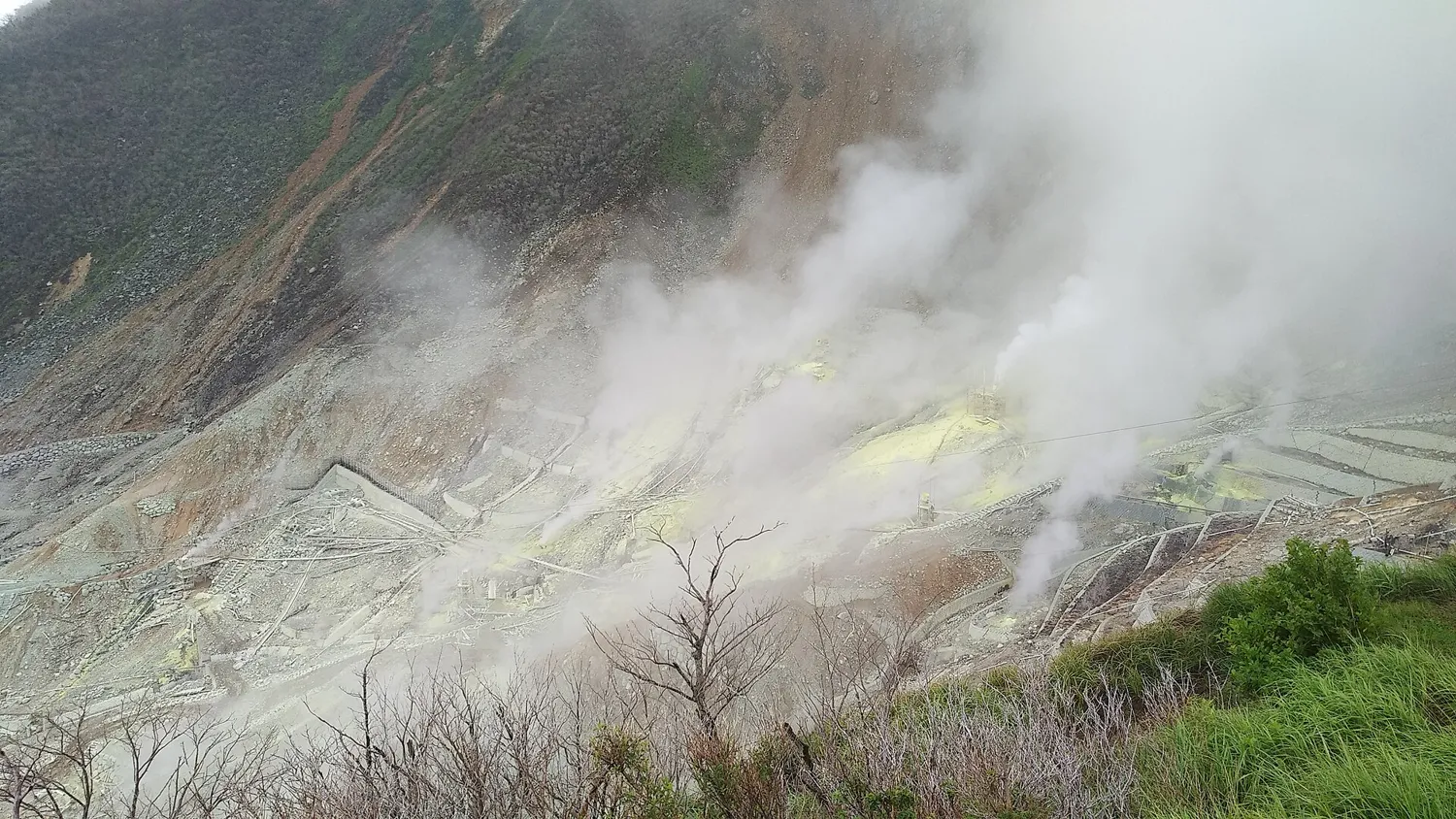
If every slot is full, the ropeway still gives you the valley from above. Between Sōunzan and Owakudani, the operator says, the line crosses a valley about 130 metres above the ground, and on a clear day Mount Fuji can be seen from the gondola and from Owakudani. Picture the valley floor opening beneath you, and Fuji far off on the other side of the window.
A gondola every minute, over the steam
You ride the Hakone Ropeway through four stations. From Sōunzan, where the cable car from Gōra arrives, you climb to Owakudani, then continue past Ubako to Tōgendai on the shore of Lake Ashi. Allow about 10 minutes for each stretch.
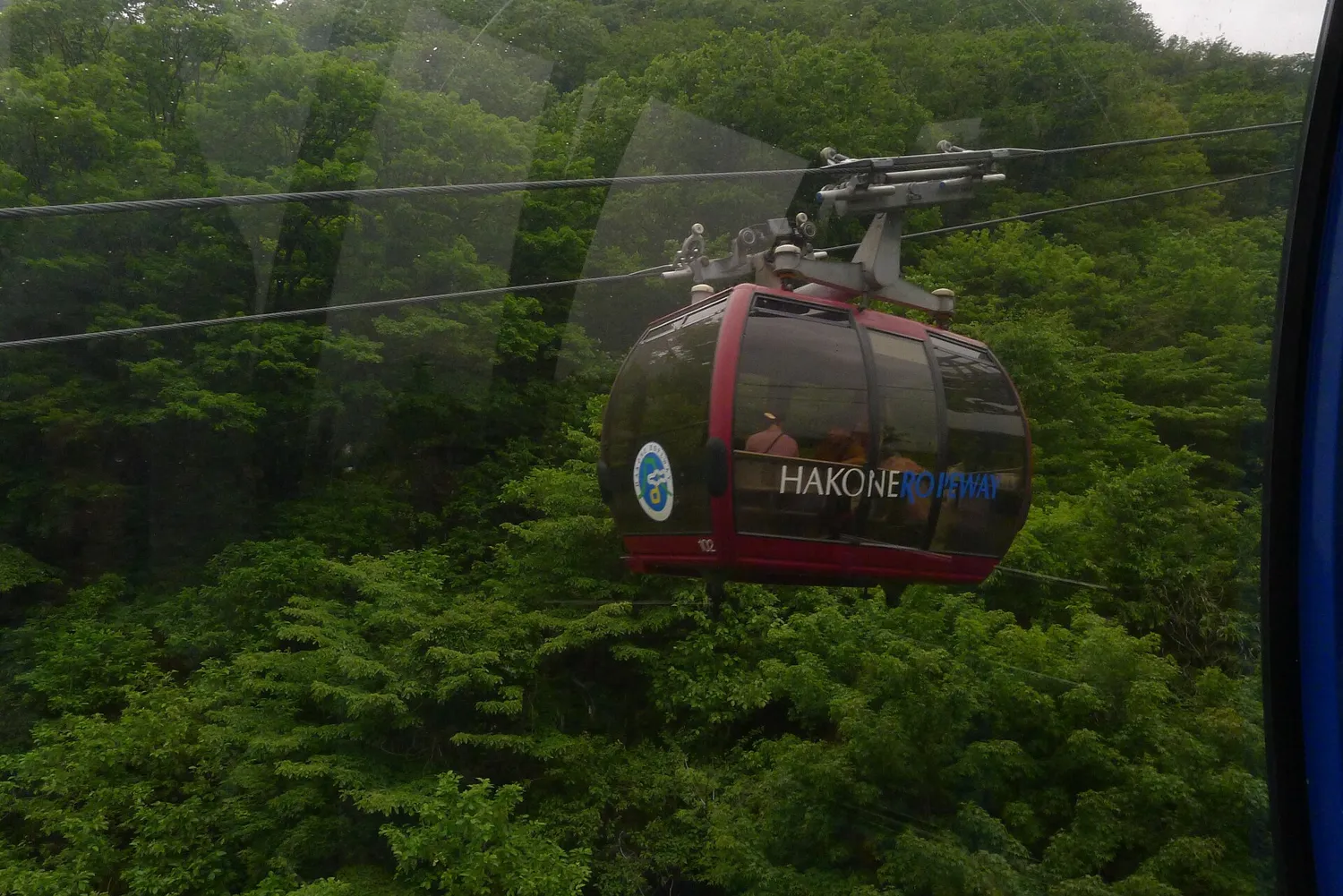
Each gondola holds up to 18 people, and one leaves about once a minute. The operator notes that the bare slopes and drifting steam are why the valley was once called Jigokudani, Hell Valley. What I kept picturing was that chain of small cars, one after another all day, crossing over a slope that is still venting gas.
On the stretch from Sōunzan through Owakudani to Ubako, the operator provides wet towels for covering your mouth and nose, keeps first-aid kits with oxygen in the gondolas, and has a first-aid room at every station. Learning that a sightseeing ride comes with wet towels told me more about the valley than any photograph.
If someone in your group has asthma or a heart condition
Skip Owakudani altogether. The operator says that, because of volcanic gas, people with asthma, bronchial or lung disease, heart disease, a pacemaker, or who feel unwell cannot ride between Sōunzan and Ubako — the section that passes over the valley. The Hakone tourism association goes further: people with asthma or other respiratory conditions, heart conditions, or who feel unwell cannot visit Owakudani at all.
The operator also asks pregnant riders, those travelling with newborns or infants, older travellers and people with allergies to think carefully about whether to ride.
So for a mixed group, start from the Lake Ashi end instead. Tōgendai is the transfer point for the lake’s sightseeing boats and buses.
When the gas decides
Be ready for the ropeway to stop: it may halt along its whole length depending on gas levels, and also when strong wind, thunder or an approaching typhoon is expected.
In the valley, the tourism association sets out three steps: an announcement asking you to take care, then a call to go indoors, when the guided walks stop, and finally a call to leave Owakudani. The paths also close when a typhoon or heavy rain brings a risk of mudflows.
Hakone Navi shows live status for its transport, the ropeway included, and its ropeway page shows the gas concentration. I would look at both that morning, before leaving the hotel, not at the station.
If you drive, note the car park: its exit gate shuts at 16:40.
Eggs that turn black in the spring
Owakudani’s black eggs are ordinary eggs boiled in the hot spring pools. The shells are full of tiny pores, and the components of the spring water cling to them and turn them black. At a pool at a spot called Enmadai, people known as mushikata, “the steamers”, make them every day.
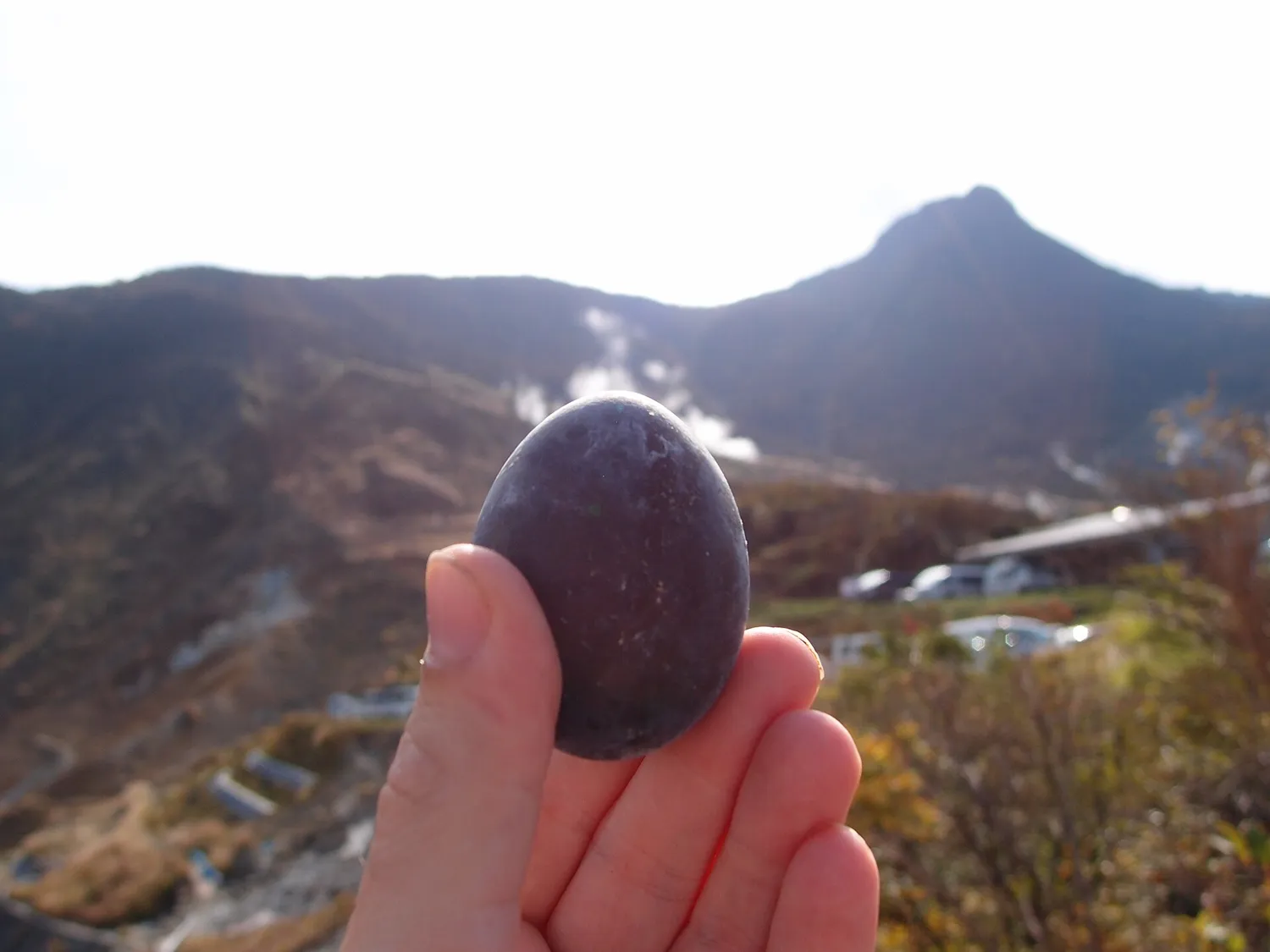
You can buy them only here, at the Kurotamago-kan and at Gokuraku-jaya, and only the eggs made that day. The rule is that unsold eggs are thrown away, but these days, to avoid waste, they go into smoked eggs and furikake. I was glad to learn that the leftovers become something else instead of going in the bin.
Eating the eggs is said to lengthen your life, and the saying usually comes with a number: seven years. The company that sells them explains both on its own page. There is a Jizō statue in the valley for long life and for raising children, said to have been made by the monk Kōbō Daishi, and the belief that the eggs lengthen your life grew from it. The “seven years”, they write, simply came to be said at some point, because seven is a lucky number in Japan, as in the Seven Lucky Gods. I liked that it is the egg sellers’ own page that tells you where the number came from.
Before you go
| Guided valley walk | 10:00, 11:30, 13:00 and 14:30 daily, 30 people each, about 40 minutes, online booking required. Final go/no-go 30 minutes before each start. Elementary-school age and up; not for anyone with a respiratory or heart condition. Check in at the Owakudani Information Center at least 20 minutes before. Fee 800 yen per person, cashless only |
| Hakone Ropeway | 9:00–17:00 from February to November; 9:00–16:15 in December and January. About 10 minutes per stretch, a gondola about every minute |
| Who cannot ride Sōunzan–Ubako | people with asthma, bronchial or lung disease, heart disease, a pacemaker, or who feel unwell |
| Maintenance closures | stretches close for scheduled maintenance on set dates, with replacement buses about every 15 minutes for holders of valid ropeway tickets such as the Hakone Free Pass. Check Hakone Navi for the dates |
| Information Center | 9:00–16:30, ground floor of the Kurotamago-kan |
| Car park | 9:00–16:20 from February to November; 9:00–16:00 in December and January. Exit gate shuts at 16:40 |
| Volcano | Hakone is an active volcano. The Japan Meteorological Agency’s current level for Hakone is 1, “be aware that this is an active volcano”; check its page before you go |
| Live status | Hakone Navi: transport status, including the ropeway; gas concentration on the ropeway page |
Checked 25 September 2026.
What I would do at Owakudani
I would book the walk before anything else, and choose a morning slot, so that a called-off walk still leaves the afternoon for the lake.
Then I would come up on the ropeway from Sōunzan, early enough to be at the Information Center 20 minutes before the start, and leave the eggs for after the walk, so that nothing eats into those 20 minutes.
If the walk were called off 30 minutes before, I would check whether the ropeway was still running, and if it was, I would not count the day as lost: from the gondola, the valley needs no booking.
We have not visited Owakudani for this guide. The facts here come from the ropeway operator, the Owakudani park operators, the Hakone tourism association and the Japan Meteorological Agency, checked on 25 September 2026.
- Hakone Ropeway (Odakyu Hakone) — stations, journey times, gondola size and frequency, hours, the 130-metre crossing, the Fuji views and the old name Jigokudani: hakonenavi.jp/hakone-ropeway/; who cannot ride and the safety measures: hakonenavi.jp/volcanic_gas_info/caution/; maintenance closures and replacement buses: hakonenavi.jp/groupnews/15097/; live status: hakonenavi.jp/transportation/
- Owakudani Kurotamago-kan — the guided walk, its conditions and the egg pool at Enmadai: owakudani.com/nature/; black eggs, the Jizō and the “seven years”: owakudani.com/secret/; volcanic gas: owakudani.com/gas/
- Hakone Tourism Association — walk times, the 30-minute decision and booking: hakone.or.jp/od-booking/; the three gas steps, rain closures, car park and Information Center hours: hakone.or.jp/6318
- Japan Meteorological Agency — volcanic alert level for Hakone: data.jma.go.jp/vois/data/report/activity_info/315.html
- Photographs: the hero image by 663highland (CC BY 2.5); the vents by Alvinz (CC0); the gondola by De-Shao Liu (CC BY-SA 4.0); the black egg by Guilhem Vellut (CC BY 2.0) — all from Wikimedia Commons
More in Hakone
- Hakone Shrine — For the dragon shrine across the water, reached by the shrine’s boat on the 13th
- Lake Ashi — For a one-way crossing between a caldera wall and old lava, and a walk under the cedars
- Amazake-chaya — For a walk on the Edo stone road and a cup of sugar-free amazake at a thatched teahouse
- Where to Stay — For choosing where to sleep by the water you end the day in: Gora, Sengokuhara, Lake Ashi or Miyanoshita
Explore other areas
- Hokkaido — Sapporo
- Kanto — Hakone · You are here
- Hokuriku — Kanazawa
- Koshin-Tokai — Fuji Five Lakes
- Kansai — Nara
- Chugoku — Hiroshima
- Kyushu — Fukuoka
- Okinawa — Naha
