Hiroshima / Guide
Hiroshima Castle: The Keep Is Closed — Look for the Tree That Came Back
Hiroshima Castle広島城
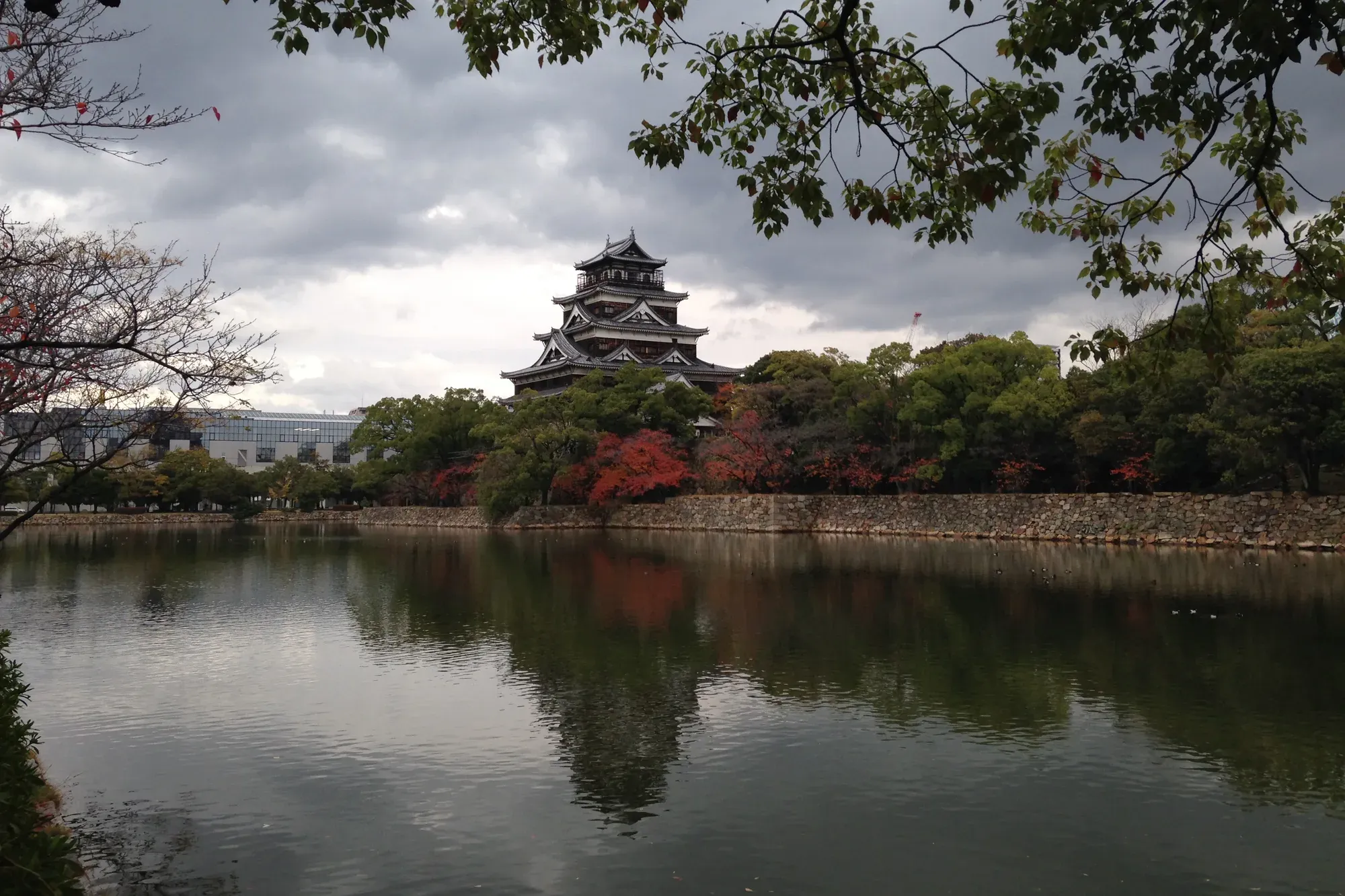
Don’t come to Hiroshima Castle to climb the keep. You can no longer go inside it; you can only look at it from outside.
Come instead for what the fire did not take. About 740 metres from the hypocentre stands a eucalyptus that survived while the buildings beside it burned — and when a typhoon later snapped off its top, it sprouted again.
The keep in front of you was already a copy. The atomic bomb brought the old one down; what stands now is a concrete rebuild from 1958, made to look like the original from outside. The castle’s own site says concrete deterioration and ageing equipment are why it has now closed, after about 68 years. Learning that, I stopped minding the closure: what you would have climbed was never the part that survived.
What the keep is now
The keep has not been knocked down, and the city says there is no plan to demolish it. You can still look at it from outside.
Its job as a museum is moving to a new building, the Hiroshima Castle Sannomaru History Museum, which the city is preparing. What the keep becomes is still open. A city review found rebuilding it in wood to be the strongest option, but the city says the detailed study will take at least five years before it decides.
So for now it is a thing to see, not a thing to enter. If that is all you had planned, it will not take long. Give the rest of your visit to the grounds.
Three trees
The castle’s map lists three trees that survived the bombing.
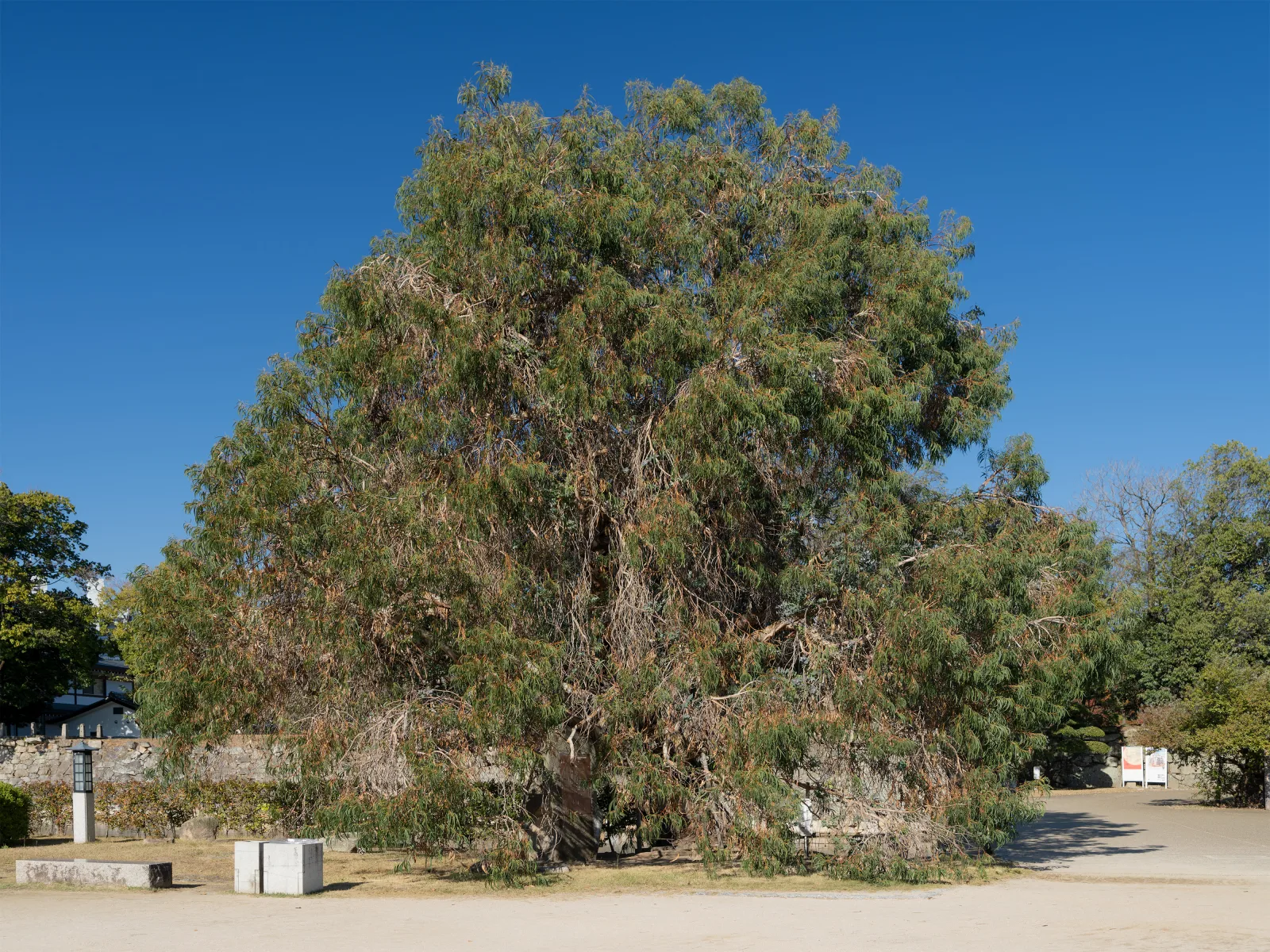
The eucalyptus, about 740 metres from the hypocentre, survived while the Ninomaru buildings right beside it burned. A typhoon in 1971 broke off its upper part. It sprouted again.
A willow, about 770 metres away, also lived through the burning of the gate and the Ninomaru buildings. The castle notes that it is in full green leaf today, although its trunk is badly damaged and hollow. I could not read that sentence quickly: hollow inside, and still green.
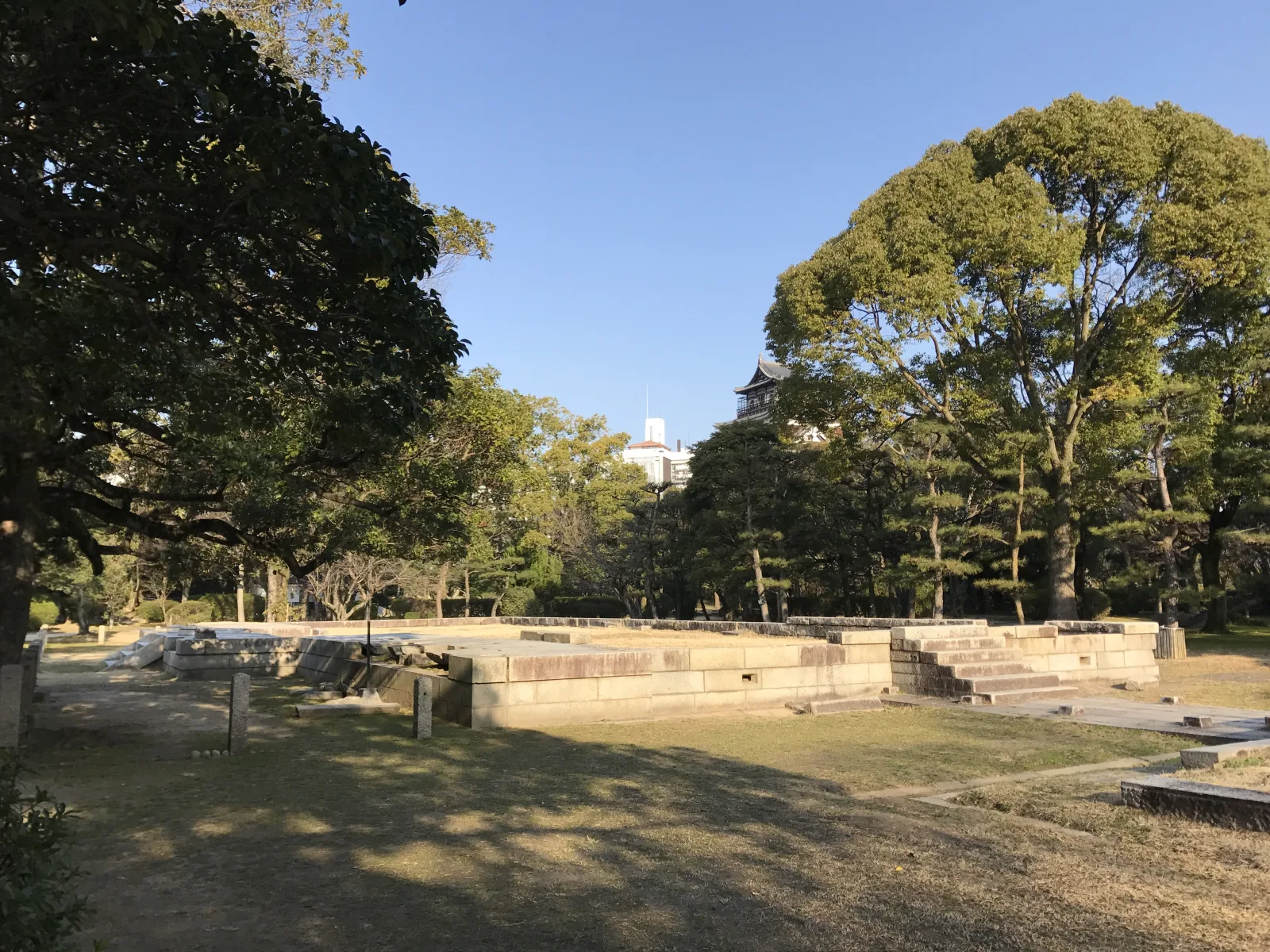
A holly, 910 metres from the hypocentre, was planted in front of the Imperial General Headquarters, a building inside the castle that the bomb brought down; only stones from its foundations remain. The tree outlived the building it was planted to stand in front of. I had to stop and read that twice.
That the eucalyptus broke in a typhoon and grew back anyway is the line about this castle I keep thinking of. It had lived through the bombing. Then the weather took its top, and it sprouted again.
Stones that were burned red
Look at the stones where the Nakagomon gate stood. The castle says the heat of the fires after the bombing turned them red along with the gate, and cracked them. The gate is gone. The colour is still in the stone. Of everything on the castle’s map, that detail stayed with me more than the closed keep did.
Elsewhere, on the north and west sides, the stone walls carry small carved marks. The castle says these walls are thought to date from the time of Fukushima Masanori, once lord of Hiroshima.
The Ninomaru: free, wooden, shoes off
If you want to go inside something, go into the Ninomaru.
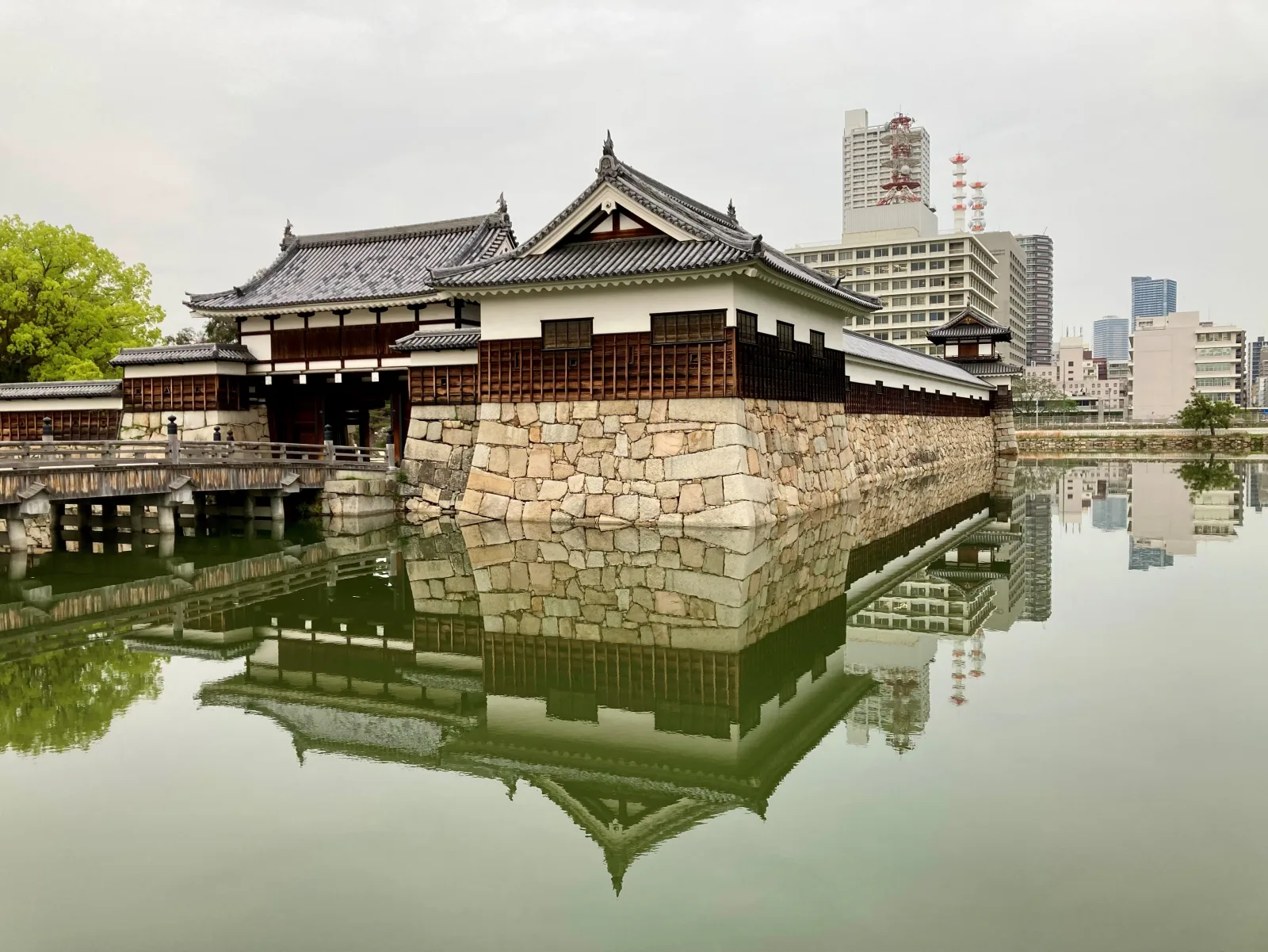
The main gate burned in the bombing. It was rebuilt between 1989 and 1994 together with the Hira-yagura, the long Tamon-yagura and the Taiko-yagura, all wooden inside. They are open, and they are free. You take your shoes off to go in, to protect the wooden buildings. I liked that more than I expected: the one place here you can still go inside is the one that asks you to take your shoes off first.
The Tamon-yagura runs about 63 metres. Picture walking its length in your socks, inside a building that is wooden within — the opposite of the concrete keep outside.
The Taiko-yagura was where a drum told the time and signalled the gates to open and close. Its ground floor is open.
If you have an hour
I would walk around the keep once, to see it, and not linger. Then the three trees, and the red stones at Nakagomon, and last the Ninomaru, shoes in hand.
If you have more time, Shukkeien garden is about 13 minutes’ walk away.
Before you go
| Keep | closed on 22 March 2026; seen from outside only. No plan to demolish it |
| Ninomaru | free. April–September 9:00–17:30 (last entry 17:00); October–March 9:00–16:30 (last entry 16:00). Closed 8 December and 29–31 December. Shoes off inside |
| From the A-Bomb Dome | about 18 minutes on foot |
| From Hiroshima Station | trams 1, 2 or 6 from the tram stop in front of the station’s south exit. From Kamiyacho-higashi or Kamiyacho-nishi stops, use the underground passage |
| Shukkeien garden | about 13 minutes on foot. Adults 350 yen. 16 March–15 September 9:00–18:00 (last entry 17:30); 16 September–15 March 9:00–17:00 (last entry 16:30); closed 29–31 December |
Checked 24 September 2026.
What I would take away
The keep was always the part that had to be made again. What I would come for is what was never rebuilt: a hollow willow still in leaf, stones that kept the colour of the fire, and a eucalyptus that survived the fire and then grew back.
We have not visited Hiroshima Castle for this guide. Everything here comes from the castle’s official site, the City of Hiroshima and Shukkeien’s official site, checked on 24 September 2026.
- Hiroshima Castle (official site) — the keep’s closure and exterior viewing: hiroshimacastle.jp; the trees, the Nakagomon stones, the Imperial General Headquarters site, the stone walls and the Ninomaru buildings: hiroshimacastle.jp/castle/castle-map/; the Ninomaru rebuild: hiroshimacastle.jp/castle/castle-ninomaru/; hours, fees and closing days: hiroshimacastle.jp/information/; the bombing and the 1958 rebuild: hiroshimacastle.jp/history/history04/; walking times: hiroshimacastle.jp/faq/; trams: hiroshimacastle.jp/access/
- City of Hiroshima — no plan to demolish, and the new Sannomaru History Museum: city.hiroshima.lg.jp (Hiroshima Castle keep closure); the review of rebuilding in wood: city.hiroshima.lg.jp (study on restoring the keep)
- Photographs: the hero image by そらみみ (CC BY-SA 3.0); the eucalyptus by かるちる (CC0); the gate and moat by Dudva (CC0); the Imperial General Headquarters site by そらみみ (CC BY-SA 4.0) — all from Wikimedia Commons
- Shukkeien (official site) — hours, fees and closing days: shukkeien.jp/guide/
More in Hiroshima
- Peace Memorial Park — For the A-Bomb Dome, seen down the line the park was laid out on
- Itsukushima Shrine — For the great torii in the sea, and the walk out to it when the tide allows
- Saijo Station Street — For brick-chimneyed breweries by day, and the station street's izakaya from five
- Where to Stay — For choosing where to sleep: Miyajima after dark and at dawn, the Peace Park, or the station
Explore other areas
- Hokkaido — Sapporo
- Kanto — Hakone
- Hokuriku — Kanazawa
- Koshin-Tokai — Fuji Five Lakes
- Kansai — Nara
- Chugoku — Hiroshima · You are here
- Kyushu — Fukuoka
- Okinawa — Naha
