Sapporo / Guide
Jozankei Onsen: Follow the Kappa Back to the Pool Where the Story Began
Jozankei Onsen定山渓温泉
The kappa began with a drowning
If you come to Jozankei only for the hot water, you will still meet its kappa, the river creatures of Japanese folklore with a dish of water on their heads. They are on bridges, by foot baths and on the main road. Jozankei is a hot-spring town inside Sapporo’s own city limits, in Minami Ward, and the town’s own kappa story is not a cheerful one.
The tourism association tells it like this. Back when the Toyohira River still ran strong enough to float logs down from the hills, a young man working on the road was fishing in a deep pool when he sank, as if something had pulled him under. The log drivers nearby dived in after him, but the pool was too deep, and he was never found. A year later, on the night of the first anniversary of his death, he appeared to his father in a dream. “I am living happily now,” he said, “with my kappa wife and family.”
The pool has been called Kappa-buchi, the kappa’s pool, ever since, and the association adds that, so the story goes, no one has drowned there since.
I keep coming back to that dream. A family lost a son to the river, and the story the town kept gives him a wife and a child instead of an empty riverbed. I find it hard to picture the cheerful kappa statues on these streets without thinking of that kindness.
So do not just soak. If you have an afternoon, walk Jozankei by its kappa instead of going from bath to bath, from the pool where the story began to the hand bath on the main road, and let the hot water come in between.
Start at the pool, outside winter
If you can, begin at Futami Park rather than in the middle of town, because the path to the pool starts there. The Kappa King stands here, the statue the association calls the symbol of the spa, and on the riverbank nearby is a second kappa, called Koron Koron, roughly “roly-poly.”
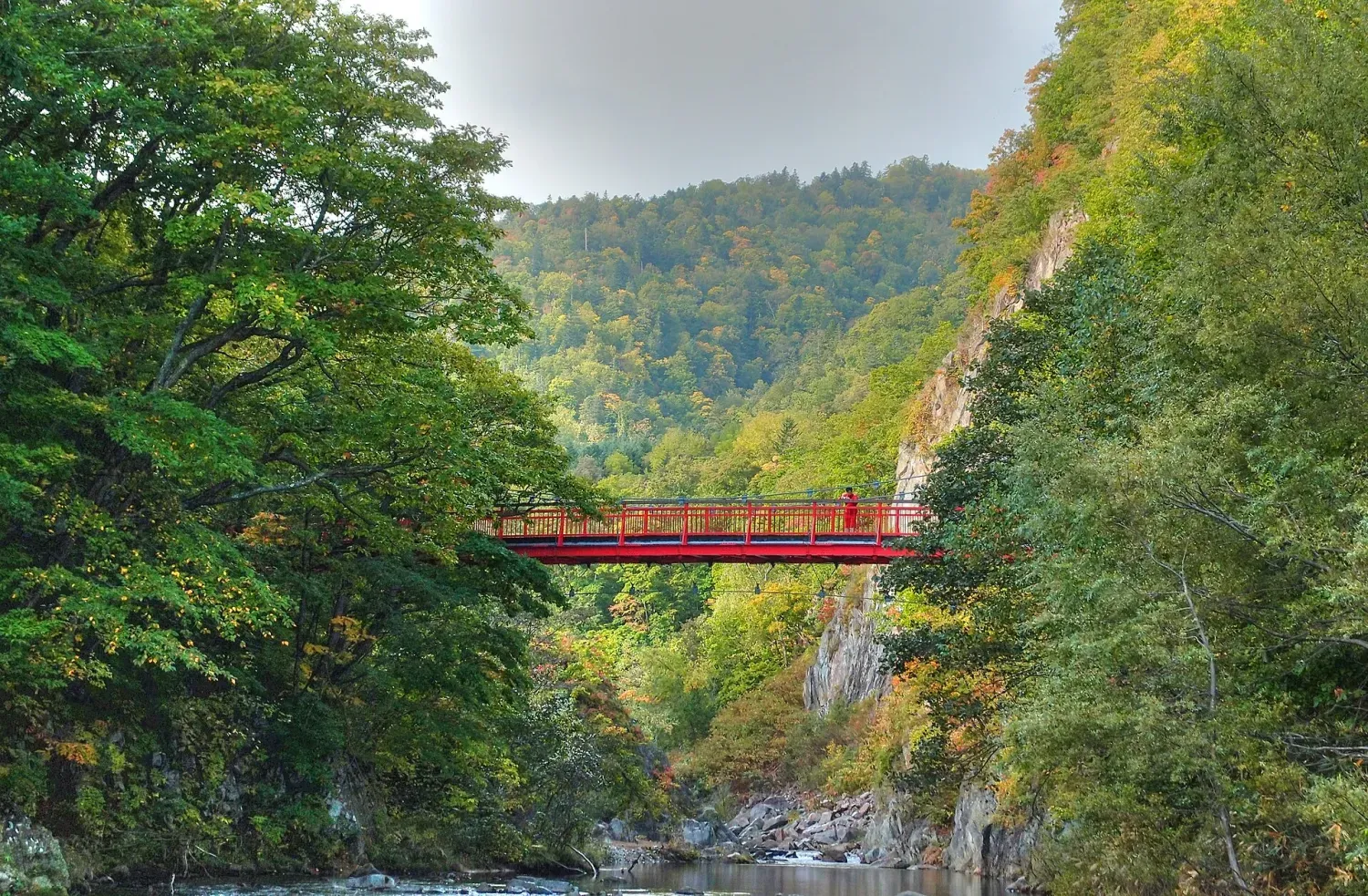
From the park, the red Futami Suspension Bridge crosses the Toyohira. Look down from it and you see Kappa-buchi itself, and two rocks in the river called Futami-iwa. This is where the legend belongs: the riverside path runs from Futami Park over the bridge to Kappa-buchi.
On that path, beside the pool, a kappa by the sculptor Abe Norihide is called Ā, Itaita, roughly “Ow, ow, that hurts.” Reading the name, I found it funny, and then felt guilty for finding it funny, given where the statue stands.
The park’s name has its own story of homesickness: Satō Iseizō, who ran the bathhouse from 1880, is said to have named it Futami because the scenery reminded him of Futamigaura in his home province of Ise. Two stories of people far from where they belonged, one above the water and one under it.
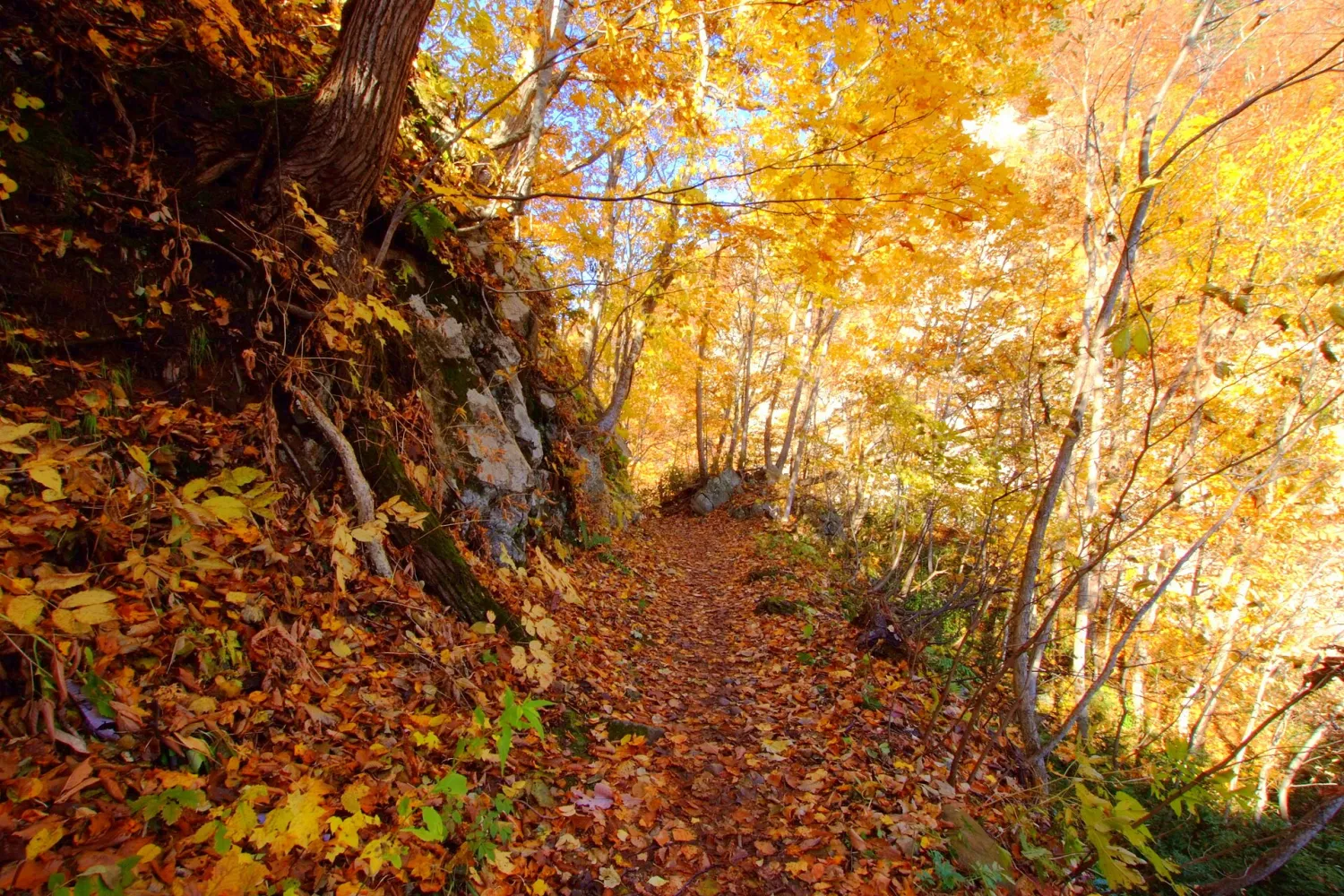
If you come in October, this is also where the leaves turn; the association calls Futami Park a place known for them. Riverbank work is under way around the park, with a signposted detour for walkers, so check the association’s notice before you set out.
Back in town: kappa by the hot water
From the pool, walk back over the bridge and into the hot-spring streets. Here the kappa turn up in ones and twos, and several of them keep company with the town’s free hot water.
At Tsukimi Bridge, in the middle of town, one of the two kappa is called Boku to Kinen Shashin, “a souvenir photo with me.” After the story of the pool, I was glad to read of a kappa that only wants to be in your picture.
At the foot of the same bridge, in Jozan Gensen Park, named for the monk who gave the town its name, look for Yu no Taki no Kappa, the kappa of the hot-water fall. This is also the place to sit at a foot bath, or to cook an egg in spring water above 80°C.
If you come in by car or bus from Sapporo, the first foot bath you pass, Taro-no-yu, has its own kappa, Kappa Taro, beside a wide eight-sided tub where about fifteen people can sit together; it sells towels if you forgot one. And across from the tourism association’s office, another of Abe Norihide’s kappa is called Ii Yu da na: “Nice hot water, isn’t it.” After the drowning legend, I like reading a kappa with something so ordinary to say. The water it praises is a salt spring, clear, tasteless and without smell, so do not expect sulphur.
The hand bath, last
Save the hand bath for the end of the walk; it never closes. The Kappa Family Wish-Making Hand Bath stands on Route 230, uphill from the park, and a family of kappa statues watches over it.
After the story at the pool, I find it hard to see that family as decoration. The young man in the legend said he had a kappa wife and family. Here, on the main road, a family of kappa you can pour hot water over keeps reminding me of his.
The ritual asks something of you. Face toward the Kappa King in Futami Park and put your hands together. Pour hot water over the dish on top of a kappa’s head, rinse your hands in the water that spills from its mouth, and chant “On kappa ya un ken sowaka” three times before you make your wish, which is said to come true.
If you come in winter
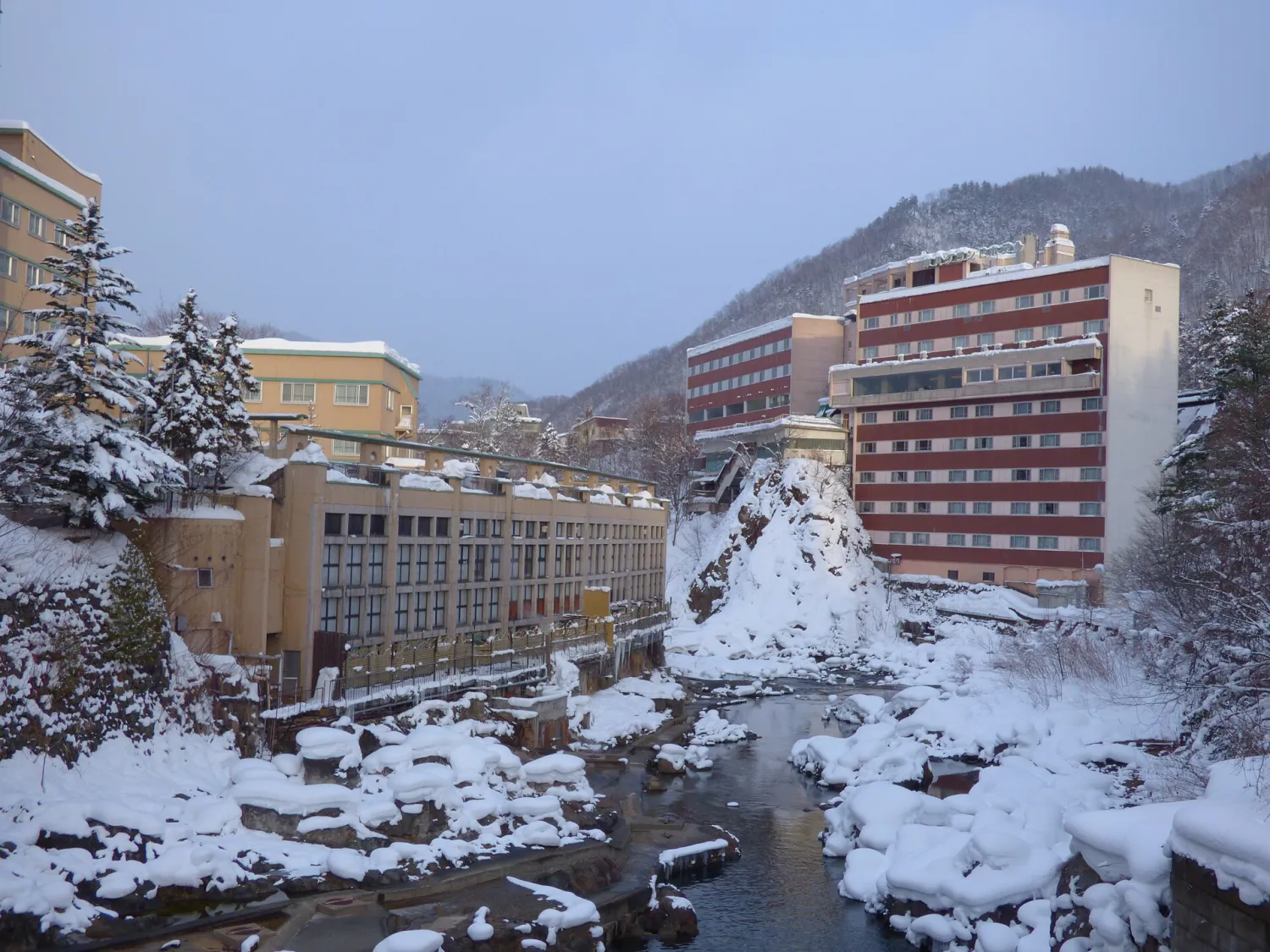
In winter the association says snow keeps you from reaching the Futami bridge, and the detour around the riverbank work closes too. So in the snow, skip the pool and walk only the town’s kappa: the pair on Tsukimi Bridge, the kappa by the hot water in Jozan Gensen Park, Kappa Taro and Ii Yu da na on the main road, and the family at the hand bath. Picture steam rising off the basin in the park while the snow sits on a kappa’s dish.
The legend does not need the pool to be seen. You will already know where it is: Kappa-buchi, the pool you would see from the red bridge in any other season.
Getting there, and getting back
The simplest way from central Sapporo is the Jotetsu Bus Kappa Liner, a reservation bus from Sapporo Station, with further stops at Ōdōri Nishi 1-chōme and Susukino. It takes an hour or a little more, and booking closes at five o’clock the evening before.
The Kappa Liner is a daytime bus, and its last run back leaves the Jozankei stops a little after five in the afternoon. Jotetsu’s regular buses run later, into the evening; the times are in the table below. If you want the hand bath at an hour when the town is quiet, stay the night rather than coming for the day.
Before you go
| Kappa statues | 21 listed by the Jozankei Tourist Association, most in Jozankei, two at Koganeyu Onsen and three in the park below Jozankei Dam. In town: two on Tsukimi Bridge, one in Jozan Gensen Park, Kappa Taro at Taro-no-yu, the Kappa King and Koron Koron at Futami Park, Ā, Itaita on the Kappa-buchi path, Ii Yu da na across from the association’s office |
| Jozan Gensen Park | Foot bath and Ontama-no-yu (onsen eggs). 7:00–21:00, open every day. Free. Jozankei Onsen Higashi 3-chōme |
| Taro-no-yu foot bath | On National Route 230, the first foot bath coming from Sapporo. 7:00–20:00. Free. Towels 200 yen from a vending machine |
| Kappa hand bath | On National Route 230. Open 24 hours. Free |
| Futami Suspension Bridge | Free. Jozankei Onsen Nishi 4-chōme. Not reachable in winter because of snow. Riverbank work around Futami Park: follow the signposted pedestrian detour, which is closed in winter |
| Day bathing in hotels | The association lists more than ten places that take day visitors, mostly hotels and inns; hours and days off vary, so check each hotel’s own site |
| Kappa Liner bus | Jotetsu Bus, from Sapporo Station stop 27, Ōdōri Nishi 1-chōme and Susukino; 60 to 70 minutes. Eleven buses a day each way (from Sapporo Station first 9:10, last 16:00; the last bus back leaves Jozankei Shako-mae at 17:06, timetable revised 1 October 2026). Reservation bus: booking from one month ahead until 17:00 the day before; without a booking you can ride only if seats are free. Sapporo Station to Jozankei Shako-mae 1,700 yen one way, 1,460 yen if booked and paid online. Check the current timetable before you go |
| Regular buses | Jotetsu Bus Rapid 8, no booking information on the timetable. Last bus from Jozankei Shako-mae to Sapporo Station: 20:48 on weekdays (arrives 22:07), 20:40 on Saturdays, Sundays and holidays (arrives 21:58). Timetable revised 1 April 2026, checked 18 October 2026 |
| By car | Times Jozankei Kankō car park near Futami Park, 500 yen a day |
Checked 27 September and 18 October 2026.
What I would do in Jozankei
I would come for the night. I would walk up to Futami Park first, outside winter, and stand on the red bridge over Kappa-buchi long enough to remember the young man and his father’s dream. Then I would walk back into town from kappa to kappa, cook an egg in the monk’s park, and end late at the hand bath, pouring hot water over the head of a kappa with a family of its own.
We have not visited Jozankei for this guide. The facts here come from the official sources below; where you are asked to picture a scene, that is what it is.
- Jozankei Tourist Association — the kappa legend and Kappa-buchi: jozankei.jp/about/ ; the list of 21 kappa legend spots, with each statue’s sculptor and location: jozankei.jp/kappa/ ; the official Jozankei pamphlet 2025 (the Futami-Jozan Road from Futami Park via the bridge to Kappa-buchi, and the legend), from jozankei.jp/download/pamphlet/. Checked 18 October 2026.
- Jozankei Tourist Association — the town’s history and the monk Miizumi Jozan, Futami Park, the Kappa King statue, the naming by Satō Iseizō, winter access to the bridge, the riverbank work notice and the day-bathing list: jozankei.jp/about/history/, jozankei.jp/spot/1116/, jozankei.jp/en/spot/1269/, jozankei.jp/en/spot/163/, jozankei.jp/news/futami-park-notice/, jozankei.jp/en/oneday/; Jozan Gensen Park open 365 days: jozankei.jp/en/oneday/jozan-gensen-park/. Checked 27 September 2026.
- Sapporo Tourism Association (Welcome to Sapporo) — Jozan Gensen Park, Ontama-no-yu, the foot bath and the hand bath: sapporo.travel/spot/facility/jozankei_onsen/, sapporo.travel/spot/facility/jozangensen-park/. Checked 27 September 2026.
- City of Sapporo (Minami Ward) — the type and character of the spring water: city.sapporo.jp/minami/ishibumi/chiku10.html. Checked 27 September 2026.
- Jotetsu Bus — the Kappa Liner, booking, stops and fares: jotetsu.co.jp/bus/kappa_liner/ ; the printed timetable for the Kappa Liner and Rapid 7 and 8 (revised 1 April 2026, Kappa Liner revised 1 October 2026): jotetsu.co.jp/bus/times/260401/download.html. Checked 18 October 2026.
- Photographs: the hero image and the autumn path by t-konno (CC BY-SA 3.0); the winter town by Selixshiraii (CC BY-SA 4.0) — all from Wikimedia Commons
More in Sapporo
- Sapporo Clock Tower — For the 1881 clock that still strikes the hour, heard from the free terrace across the street, then a walk south to Tanukikoji
- Susukino — For a night of lamb at a fourteen-seat counter, then Sapporo miso ramen in the old alley or a parfait after midnight
- Otaru Canal — For the blue sky over the warehouses just after sunset, and a cruise by day or by night
- Sapporo Beer Museum — For the red star on the chimney, followed in English from the top floor down to the tasting hall
- Where to Stay — For choosing where to sleep by where your night ends: Susukino after the last bowl, the station for early trains, one night in Jozankei
Explore other areas
- Hokkaido — Sapporo · You are here
- Kanto — Hakone
- Hokuriku — Kanazawa
- Koshin-Tokai — Fuji Five Lakes
- Kansai — Nara
- Chugoku — Hiroshima
- Kyushu — Fukuoka
- Okinawa — Naha
