Sapporo / Guide
Susukino at Night: Miso Ramen or a Parfait to End It
Susukinoすすきの
Susukino gives you two ways to end a night. One is a bowl of Sapporo miso ramen in the alley that began as eight shops in 1951. The other is a tall glass of parfait, a habit that seven Sapporo shops set out to give a name in 2015. If you have room for only one, choose the glass instead of a second bowl. What I enjoy about that choice is how new one side of it is: the ramen alley has more than seventy years behind it, and the parfait got its name only in 2015, from shops that set out to spread it across Japan.
You will not find Susukino on a map, not as an official place name. Its own tourism association points out that no Sapporo map shows it that way; you see it on subway and streetcar station signs, and that is about all. Even the name is unsettled: the usual story traces it to Usui Ryūshi, the official who marked out the district in 1871, and another to the idea that the area was simply a kayano, a field of tall susuki grass.
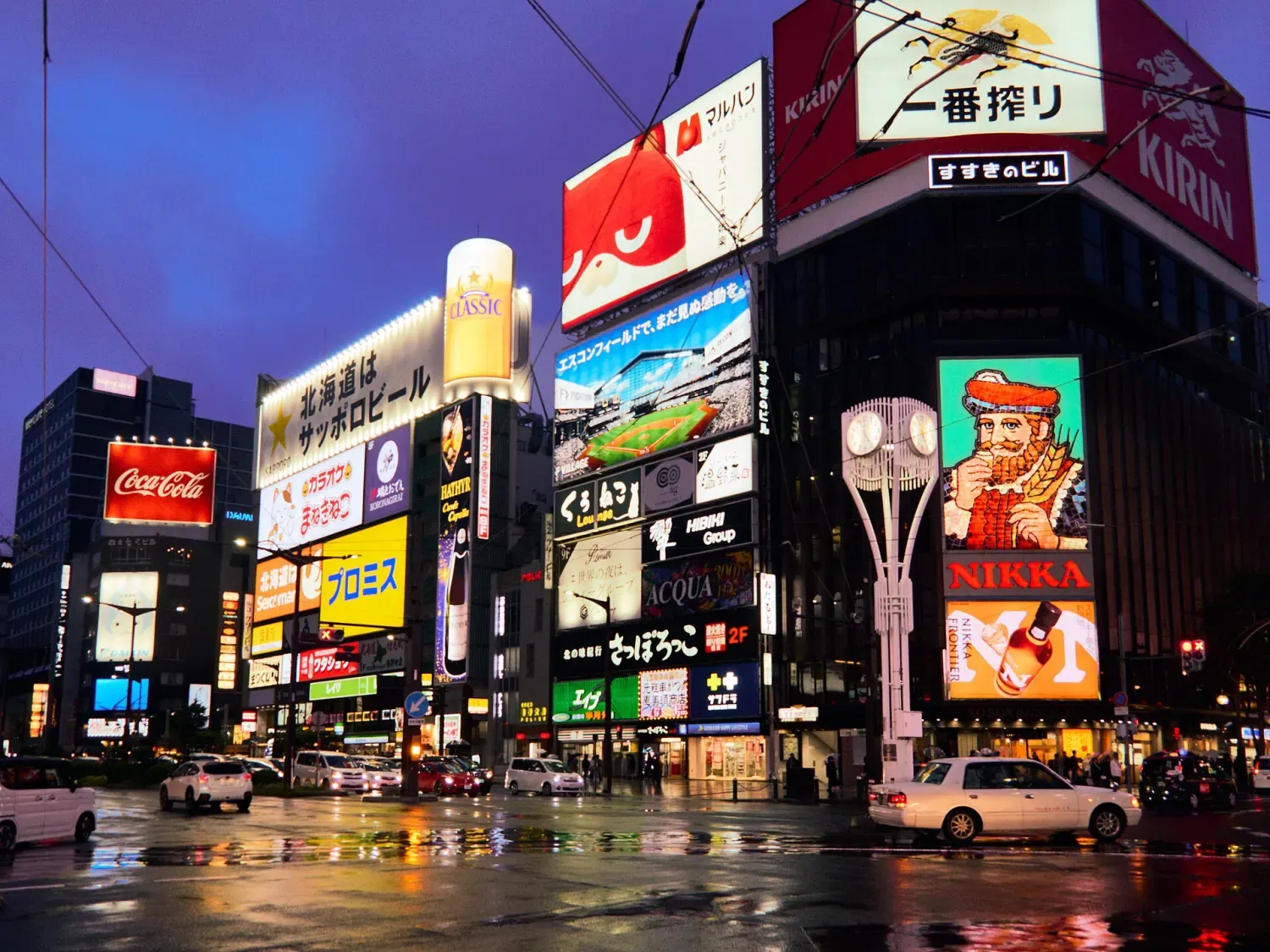
Picture coming up from Susukino Station after dark into a block of tall buildings where the shops do not stop at street level but climb floor after floor, one above another. The association calls it the town that never sleeps and puts its night-time population at about 80,000.
Plan the night backwards from the glass. All but one of the places below sit between Minami 4- and 5-jō and Nishi 3- and 5-chōme, around Susukino Station.
First, lamb at a fourteen-seat counter
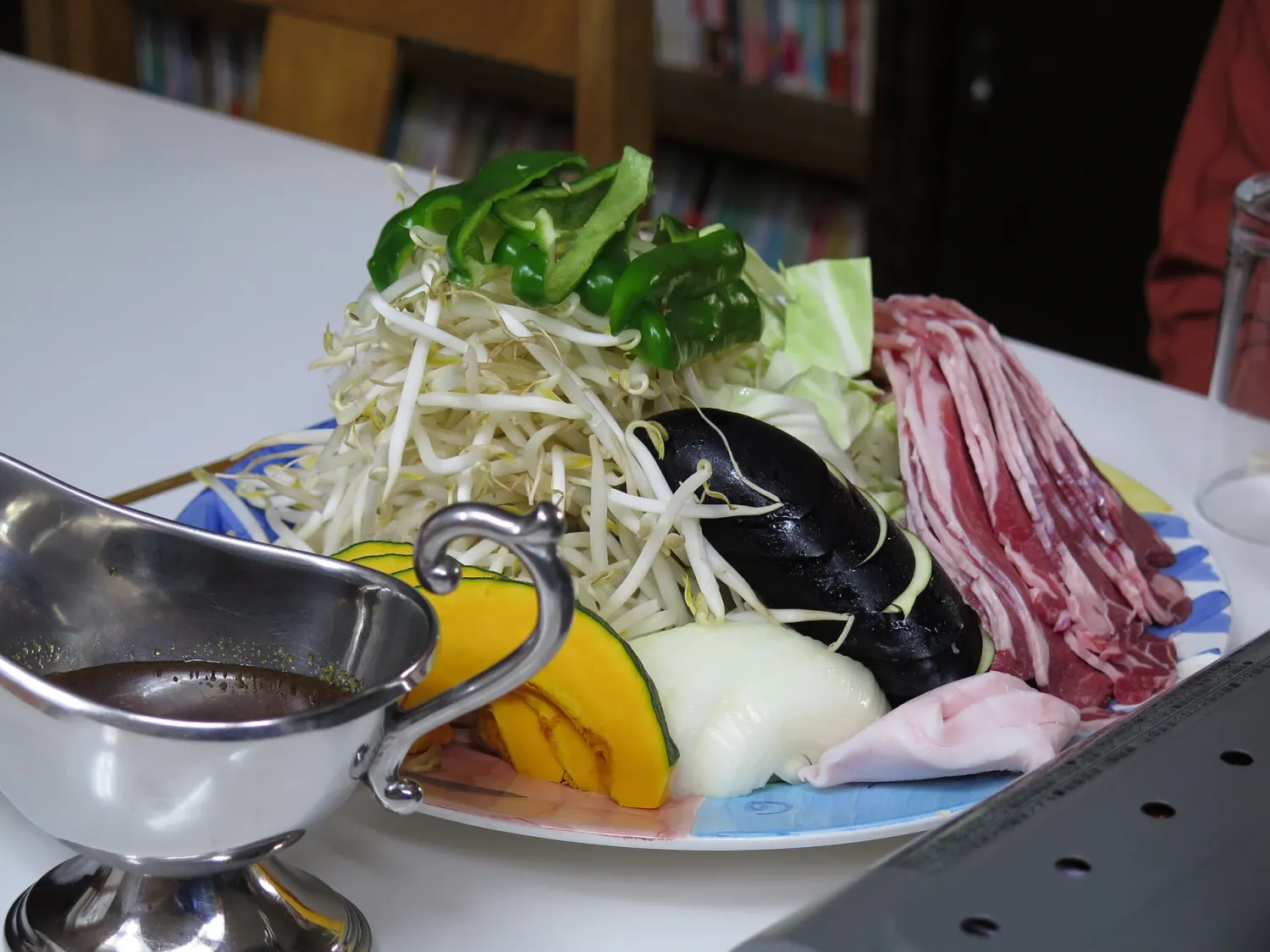
If you start early, eat before you drink much. Daruma, a Genghis Khan grill — Hokkaido’s lamb barbecue — founded in 1954, keeps its main shop at Minami 5-jō Nishi 4-chōme, and the whole shop is one counter of fourteen seats. It takes no reservations and cannot be booked out for groups.
What won me over is how honest Daruma is about its queue. On its own site it says that people often wait outside, that 7 to 8 in the evening can take time, and that around 9 the line is usually shorter — then adds that writing this on the website may send everyone at 9. Picture fourteen stools along a single counter, and the line outside the door waiting for one of them to come free.
It opens at 17:00 and serves until 5:00 the next morning, last order 4:30, every day except 31 December to 2 January. Cards are accepted (Visa, Mastercard, JCB, Amex); electronic money is not.
The ramen: which bowl, and why not the “first” one
According to the Sapporo tourism association, miso ramen was born in 1955, when the owner of a ramen shop called Aji no Sanpei took a hint from miso soup, or so it is said. Aji no Sanpei is still there, on the fourth floor of a building at Minami 1-jō Nishi 3-chōme, a walk north of Susukino — and it closes at 18:20. If you want the first bowl, make it an early supper. It cannot be your late-night one.
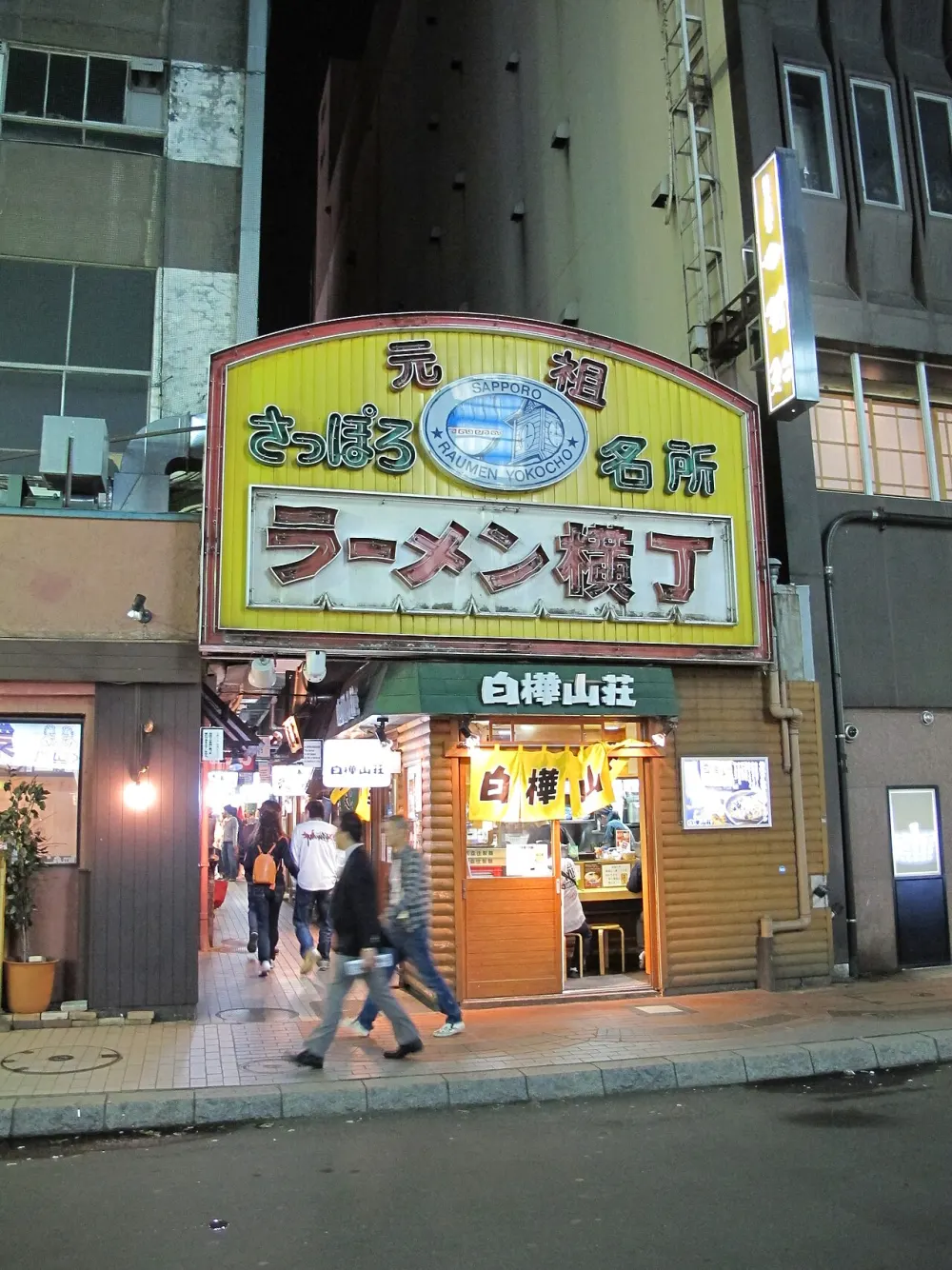
For the last bowl, walk to Ganso Sapporo Ramen Yokochō, the original ramen alley, on the ground floor of the N Grande building at Minami 5-jō Nishi 3-chōme. It calls itself the birthplace of miso ramen too, and its history starts in 1951, when eight shops beside the Tōhō Kōraku cinema became known as the Kōraku Ramen Meitengai. One of its shops dates the alley under its present name to 1971. Its history page keeps a photograph captioned simply “the neon sign until 2016”.
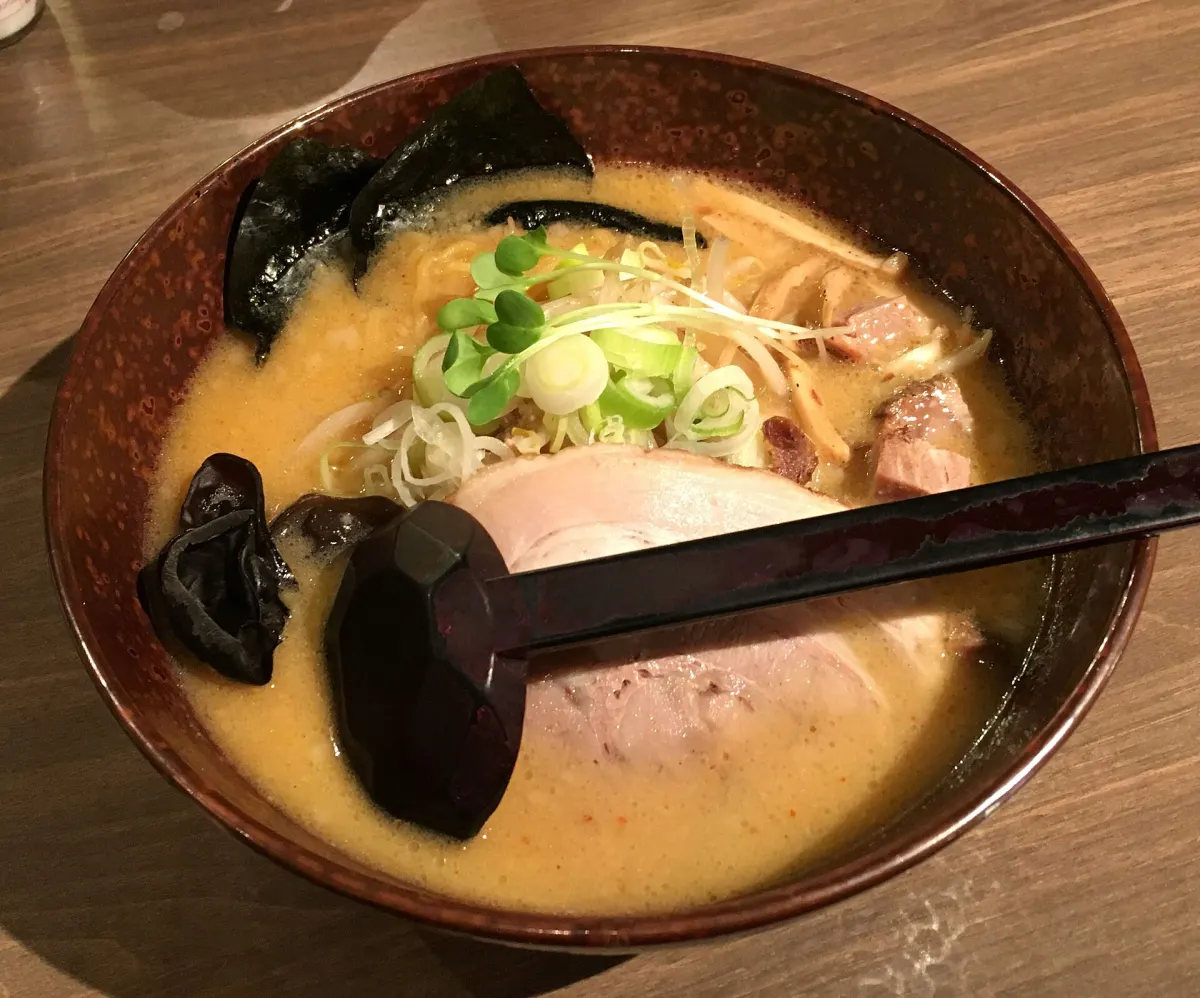
Each shop keeps its own hours and days off, the alley says, so choose the shop before you choose the time.
- Tenhō, founded in 1974 and now run by the third generation, calls its miso ramen the old-fashioned bowl it has made since the day it opened. It is open 11:00 to 2:00 Monday to Saturday and 11:00 to midnight on Sunday, sometimes closing between 15:00 and 17:00 to prepare, or earlier when ingredients run out, and it closes irregularly. It takes cards, electronic money and QR payments. This is the one to aim for after midnight.
- Kunimitsu simmers its soup for a full day and calls Sapporo miso ramen “the strongest”. It serves until 22:00 or until it sells out, closes on Tuesdays and Wednesdays, and takes no cards, electronic money or QR payments. Go here if your night is an early one.
Then the glass
In September 2015, seven Sapporo shops came together to put a name to something people here already did, a food culture they described as distinctly Sapporo’s: finishing, in any season, with a cold, sweet parfait after drinking or after dinner. They called it Sapporo Shime Parfait; shime is the closing dish of a meal. Picture a tall glass set down in front of you after midnight, with the street below still lit.
Two members are a short walk from the ramen alley:
- Nanakamadō, a night-parfait shop on the second floor of a building at Minami 4-jō Nishi 5-chōme, two minutes from Susukino Station, is, in its operator’s words, the only night-parfait shop to bring in Japanese flavours such as sake. It opens at 18:00 and closes at midnight from Sunday to Thursday and on holidays, and at 2:00 on Fridays, Saturdays and the nights before holidays, with no regular day off. It takes no reservations. Minors may enter only until 22:00, the shop says.
- Shiawase no Recipe Sweet Plus, on the fifth floor at Minami 4-jō Nishi 3-chōme, opens at 19:00 and serves until 3:00, last order 2:00, every day. It takes no reservations. Its recommended glass is built around pistachio and bitter chocolate gelato, made to go with a drink.
If you have room for only one more thing after the lamb, skip the second bowl and go upstairs for the glass.
The other Susukino: hostess bars and touts
Some of the floors in those tall buildings belong to hostess bars, which the tourism association lists by type — new clubs, clubs, lounges, snack bars, girls’ bars — with an address, the hours and a rough budget per person for each. For the ten new clubs on its list, that budget runs from about 6,000 yen to about 20,000 yen, and most open at 20:00.
If you want to try one, choose it from that list and walk in yourself. Do not follow anyone who approaches you on the street. A Sapporo city ordinance bans touting in public places within a designated central area that includes Susukino, and shops are not allowed to let in customers a tout in that area has brought to them, so someone soliciting you on the pavement there is breaking the rules. Before you sit down, I would ask what the total will be.
Before you go
| Daruma (main shop) | Minami 5-jō Nishi 4-chōme, Crystal Building 1F. 17:00–5:00 (last order 4:30). Open daily except 31 Dec–2 Jan. No reservations; 14 counter seats. Cards accepted, no electronic money |
| Aji no Sanpei | Minami 1-jō Nishi 3-chōme, Daimaru Fujii Central 4F. 11:00–15:30 and 17:00–18:20. Closed Mondays and some Tuesdays (posted monthly on its site) |
| Ganso Sapporo Ramen Yokochō | Minami 5-jō Nishi 3-chōme, N Grande Building 1F. Hours and days off vary by shop |
| Tenhō (in the alley) | Mon–Sat 11:00–2:00, Sun 11:00–0:00; may close 15:00–17:00 or when ingredients run out. Irregular days off. Cards, electronic money and QR payments accepted |
| Kunimitsu (in the alley) | 11:00–15:00 and 17:00–22:00, or until sold out. Closed Tuesday and Wednesday. No cards, electronic money or QR payments |
| Nanakamadō | Minami 4-jō Nishi 5-chōme, 2F. Sun–Thu and holidays 18:00–0:00; Fri, Sat and nights before holidays 18:00–2:00. No regular day off. No reservations. Minors until 22:00 |
| Shiawase no Recipe Sweet Plus | Minami 4-jō Nishi 3-chōme, 5F. 19:00–3:00 (last order 2:00). No regular day off. No reservations |
| Hostess bars | The Susukino Tourism Association lists them by type with a rough budget per person. Touting is banned in a designated central area that includes Susukino |
Checked 27 September 2026.
What I would do in Susukino
I would queue at the fourteen-seat counter a little after 9, knowing the shop half-expects everyone to have read the same advice. After that, the only real decision of the night is bowl or glass, and I would take the glass.
We have not visited Susukino or the shops in this guide. The facts here come from the official sources below, checked on 27 September 2026.
- Susukino Tourism Association — the name of the district, its origin in 1871, the two stories behind the name, the tall buildings, and the list of hostess bars with hours and budgets: susukino-ta.jp/history/, susukino-ta.jp/history/index2.html, susukino-ta.jp (new club list)
- City of Sapporo — the ordinance on touting, in force since 1 July 2022: city.sapporo.jp/shimin/chiiki-bohan/kyakuhikikouitouboushijourei/kyakuhikiboushijourei.html
- Sapporo Tourism Association (Welcome to Sapporo) — the birth of miso ramen in 1955 at Aji no Sanpei: sapporo.travel/gourmet/feature/miso-ramen/
- Aji no Sanpei — location, hours and days off: ajino-sanpei.com
- Ganso Sapporo Ramen Yokochō — its history from 1951, the old neon sign, and the pages of Tenhō and Kunimitsu: ganso-yokocho.com/rekishi/, ganso-yokocho.com/shop_list/tenho/, ganso-yokocho.com/shop_list/kunimitsu/
- Daruma — its founding, seats, hours, payment and the note on the queue: sapporo-jingisukan.info/main
- Sapporo Shime Parfait — its start in September 2015 and the member pages of Nanakamadō and Shiawase no Recipe: sapporo-parfait.com/open, sapporo-parfait.com/shop-nanakamadou, sapporo-parfait.com/shop-shiawasenorecipe
- GAKU (Nanakamadō’s operator) and Innovegg (Shiawase no Recipe’s operator) — hours, seats and age limits: yoru-parfait-gaku.com/parfait/shop-info/, innovegg.info/shop-list
- Photographs: the hero image by lumoplank (CC0); the Genghis Khan plate by Douglas Perkins (CC0); the ramen alley by Sgroey (CC BY-SA 4.0); the bowl of miso ramen by 毒島みるく (CC0); the highball by Ttsuchitori (CC BY-SA 3.0) — all from Wikimedia Commons
More in Sapporo
- Sapporo Clock Tower — For the 1881 clock that still strikes the hour, heard from the free terrace across the street, then a walk south to Tanukikoji
- Otaru Canal — For the blue sky over the warehouses just after sunset, and a cruise by day or by night
- Sapporo Beer Museum — For the red star on the chimney, followed in English from the top floor down to the tasting hall
- Jozankei Onsen — For free hot water on the street: a kappa hand bath, foot baths and a spring that cooks eggs
- Where to Stay — For choosing where to sleep by where your night ends: Susukino after the last bowl, the station for early trains, one night in Jozankei
Explore other areas
- Hokkaido — Sapporo · You are here
- Kanto — Hakone
- Hokuriku — Kanazawa
- Koshin-Tokai — Fuji Five Lakes
- Kansai — Nara
- Chugoku — Hiroshima
- Kyushu — Fukuoka
- Okinawa — Naha
