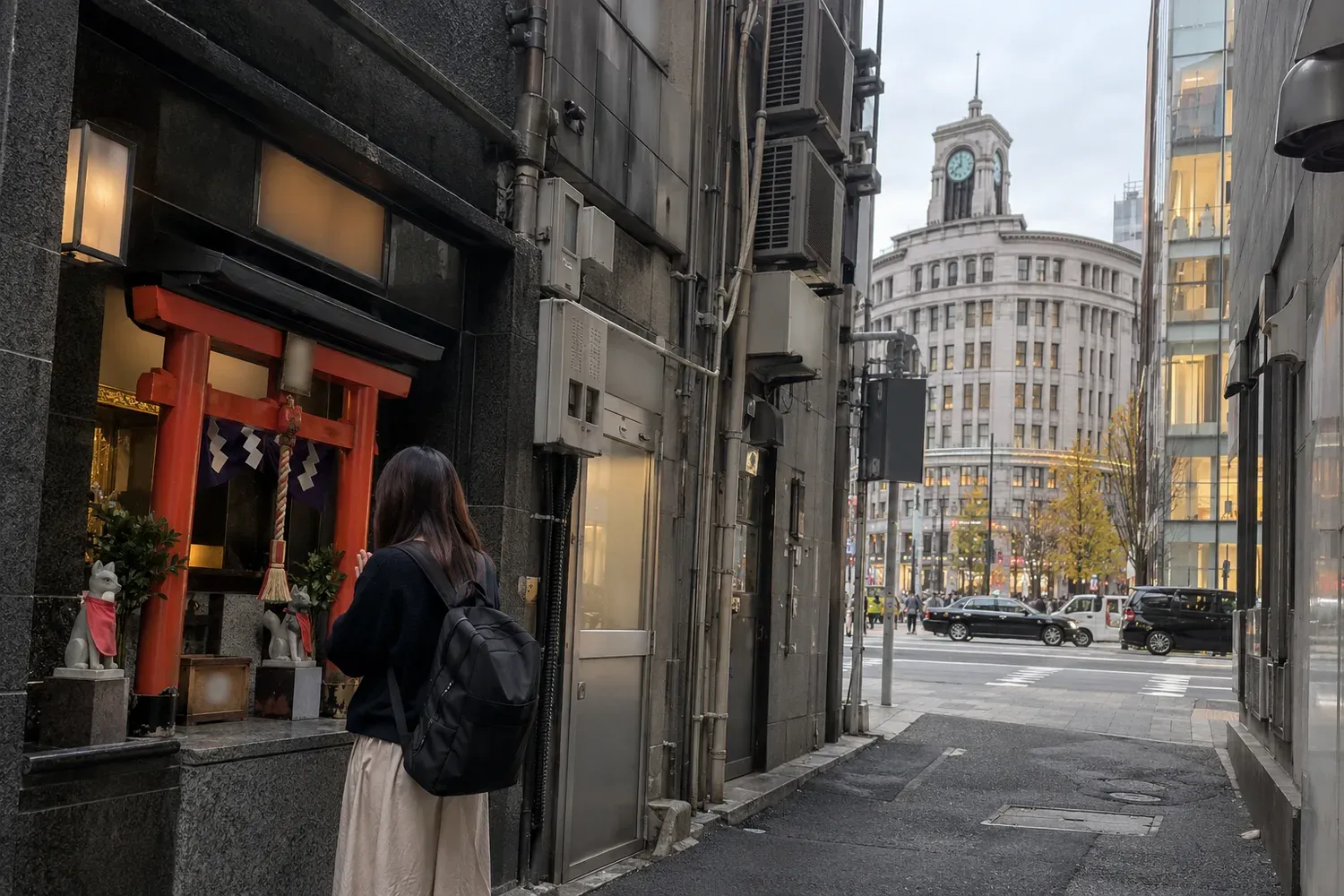
Tokyo / Guide
Ginza: Look Into the Windows, Then Look Up
Ginza銀座
Ginza’s shrines are not in the shop windows. They are on the roofs above them and in the alleys behind them. Turn east off Chuo-dori onto Matsuya-dori, walk past Oji Hall, and on the corner of a small crossroads you will find Asahi Inari’s little hall, set into the ground floor of a building. Above it, the wall is shaped like a pipe climbing to the roof. It is more than decoration: there is soil packed inside, so the main shrine up on the roof still touches the ground. Look into the windows, then look up.
That wall turned Ginza, for me, from a street of shops into a street with an upstairs.
Asahi Inari: a hall on the street, a shrine on the roof
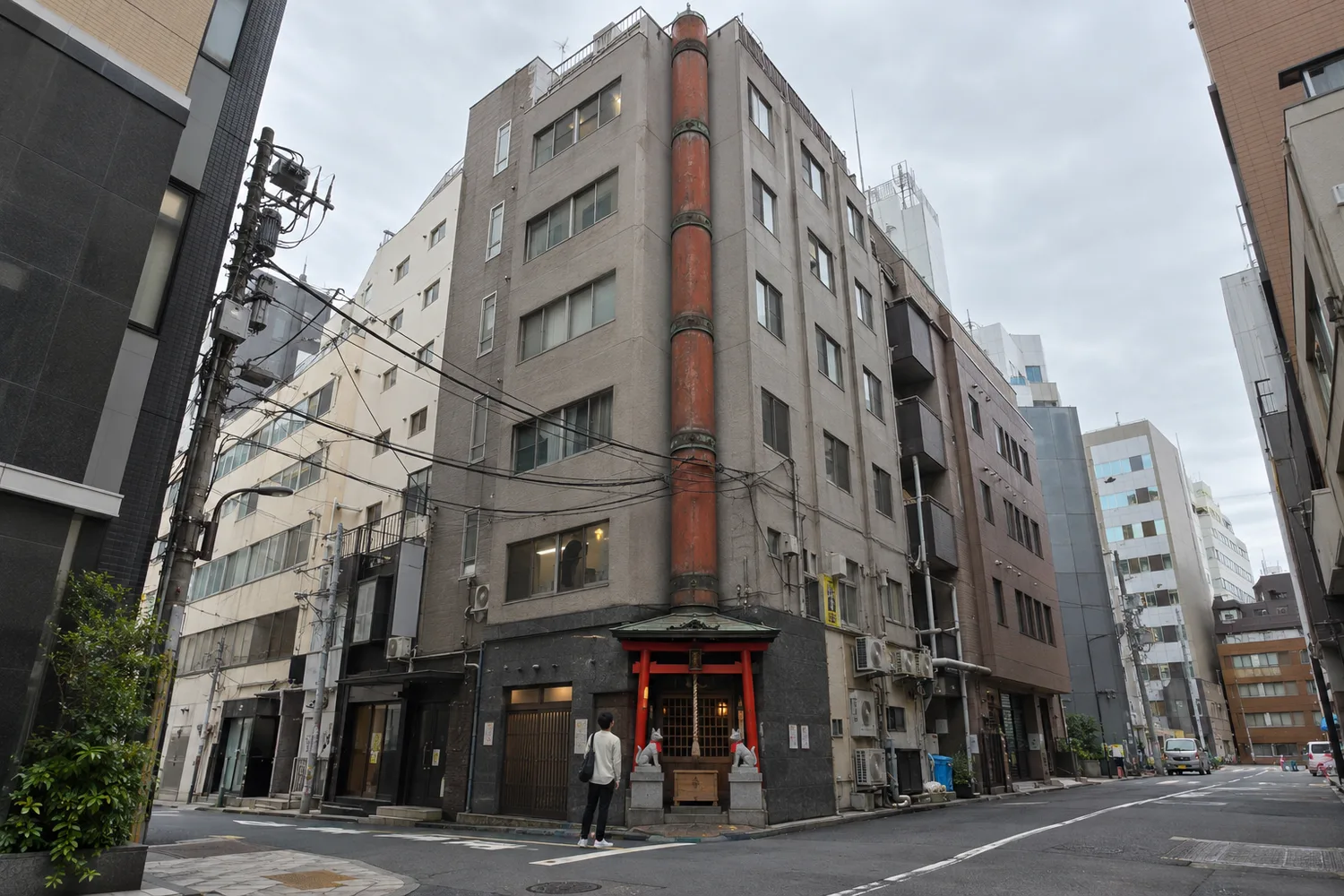
If you have time for only one stop off Chuo-dori, I would make it this one. The hall at street level is where you pray from a short distance. The main shrine is on the roof, and the whole rooftop is its grounds, with its own torii gate and a basin for rinsing your hands. A microphone in the hall downstairs picks up what happens there, the clapping and the sound of offered coins, and plays it through a speaker on the roof, so that sounds and wishes can reach the god in the main shrine.
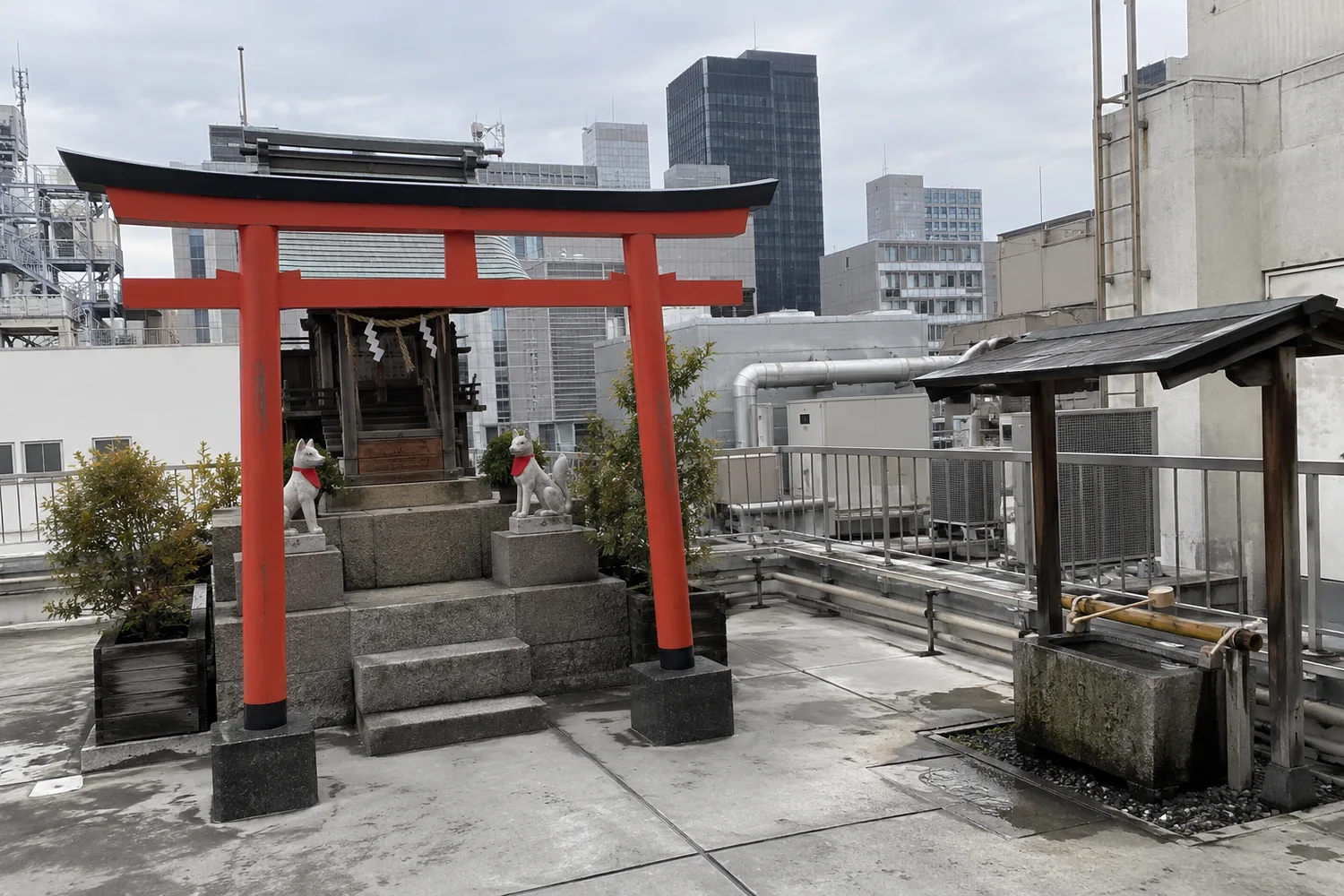
The pipe is there because of a rule. The shrine’s own history, quoted on Ginza’s official website, says a shrine’s roof must be open to the sky and its pillars must touch the earth. A rooftop answers the first half easily, and I love how literally the shrine took the second: it ran a soil-filled pipe up the wall, joining the roof to the ground.
The shrine has lost its sacred object once already. An earthquake in the Edo period sent it into a canal that once ran through Ginza. After the Great Kanto Earthquake of 1923, the water in the canal fell, the bottom showed, and the object was found again; the shrine was rebuilt with it at the centre. What it is, nobody can say. Even the people at the shrine office told Ginza’s website they have never seen it.
I could not confirm whether the roof is open to visitors today. The hall on the corner is the visit.
Toyoiwa Inari: the shrine the building made room for
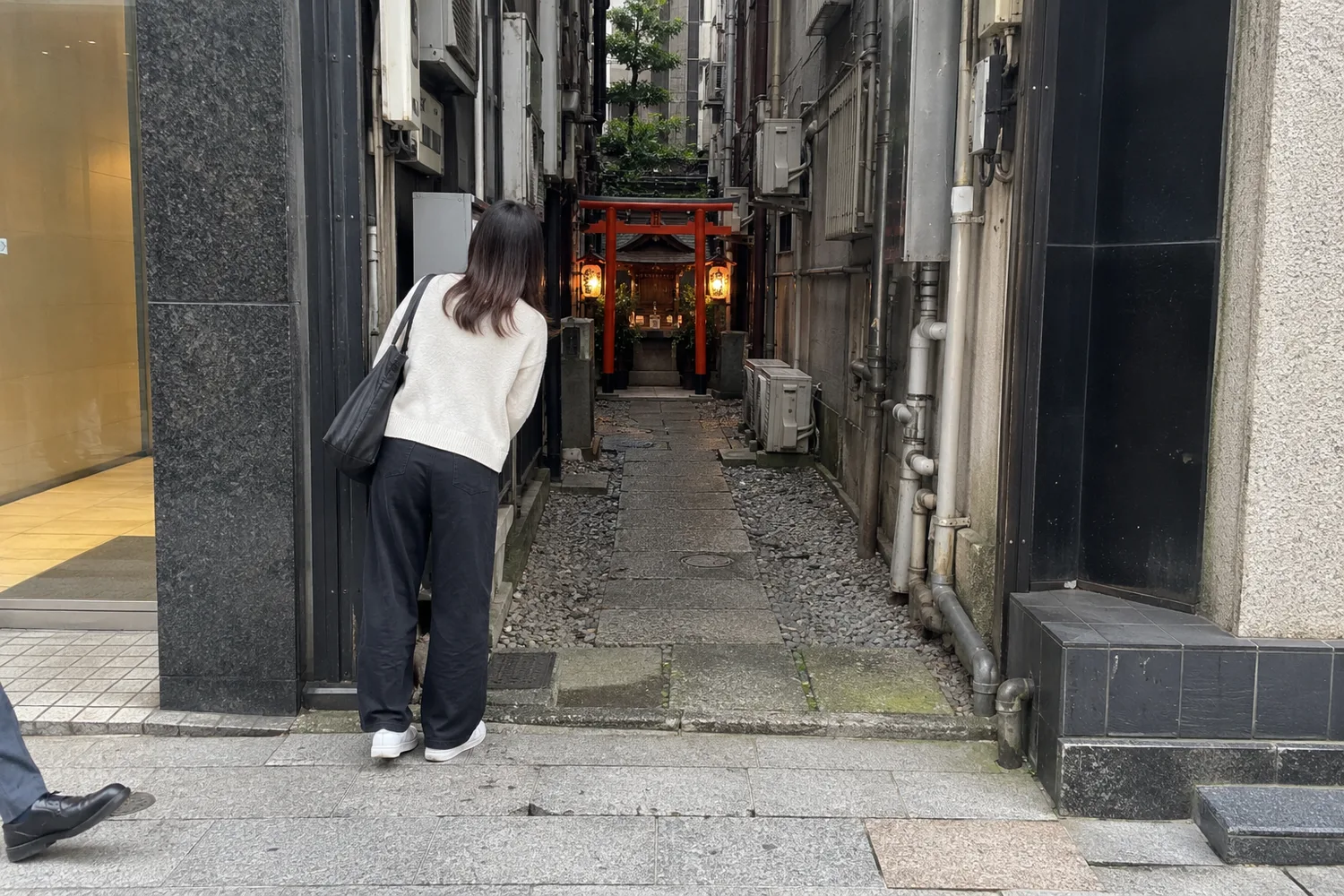
For another alley, walk down to 7-chome. Toyoiwa Inari sits at the end of a gap between two buildings, and you can reach it from Hanatsubaki-dori on one side or Suzuran-dori on the other. Ginza’s own column admits that first-timers wonder whether they are allowed to walk in. You are.
The hall and the shrine office beneath it belong to the shrine, so when the building went up, the shrine set one condition: it would not move. I like that stubbornness. Today you reach the hall through a slot between walls, with the office in the basement below.
People have come here since the early Edo period to pray against fire and for good matches. Ginza’s column says the “ties” go wider than romance, with stories of a family member recovering and a good new hire arriving after a visit.
A jizo on the department store roof
To stay near the big crossing, go into Ginza Mitsukoshi. A sign at the entrance announces the Ginza Shusse Jizo, “promoted from Tsukiji Sanjukkenbori”. Ride up to the terrace garden on the ninth floor, and at the far end you will find Mimeguri Shrine, the guardian shrine of the Mitsui family that founded Mitsukoshi, and beside it the small hall of the jizo.
The jizo’s story reads like a small career. The statue is said to have been dug out of the canal during embankment work in the Meiji era and set on an empty lot near the crossing; then, in 1968, it was carried up to the roof when the store was renovated. One account links the “promotion” name to that rise from the roadside to a department-store roof, though Ginza’s column points out that an old map already shows the name before the move.
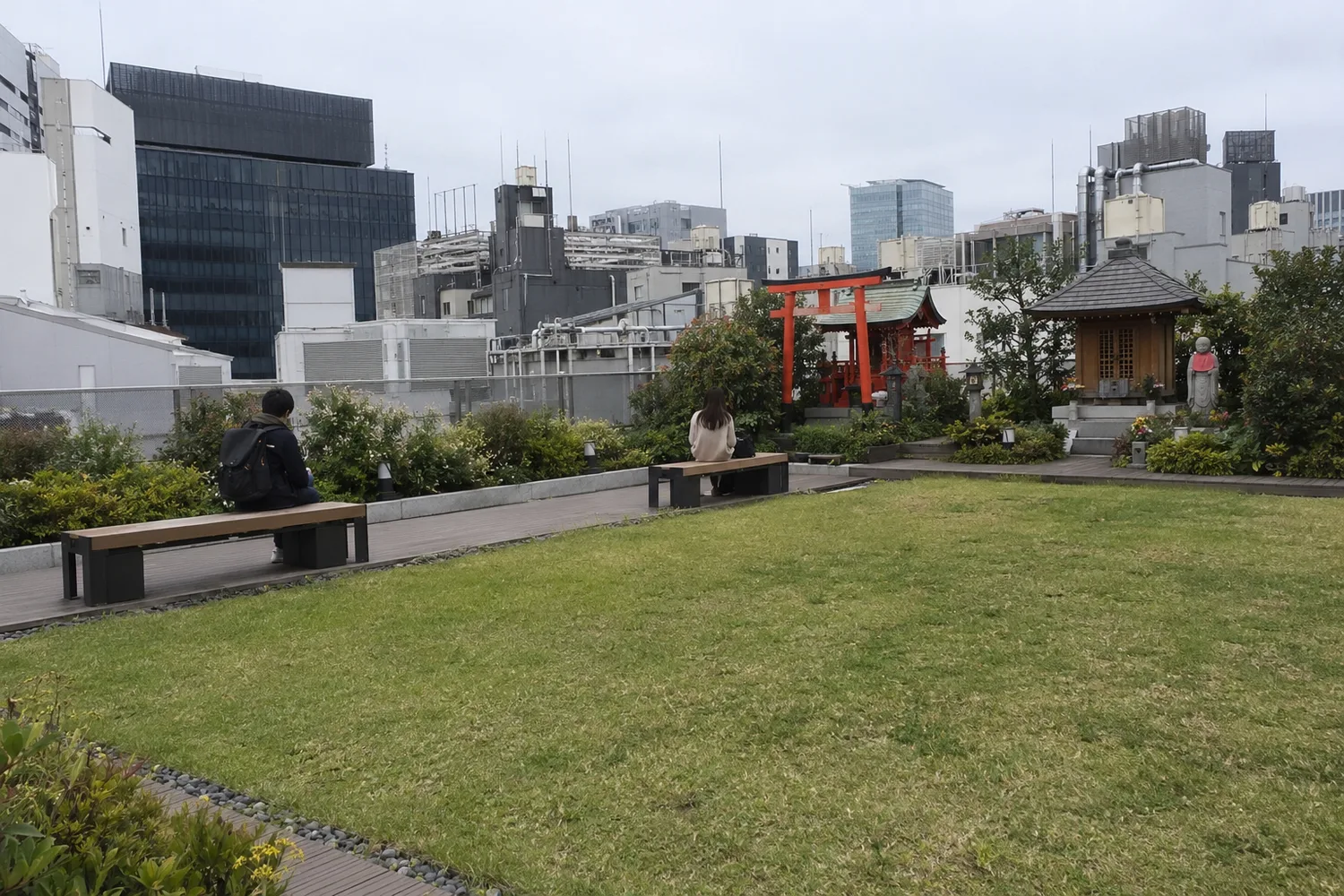
Matsuya Ginza and GINZA SIX also keep places of worship on their roofs. Their rooftop hours are not something I was able to confirm, so ask in the store if you are shopping there anyway.
Before or after kabuki
Kabuki-za has its own shrine, and you do not need a roof for it. Look to the right of the theatre’s front: Kabuki Inari prays for the safety of the shows, the audience and everyone on stage.
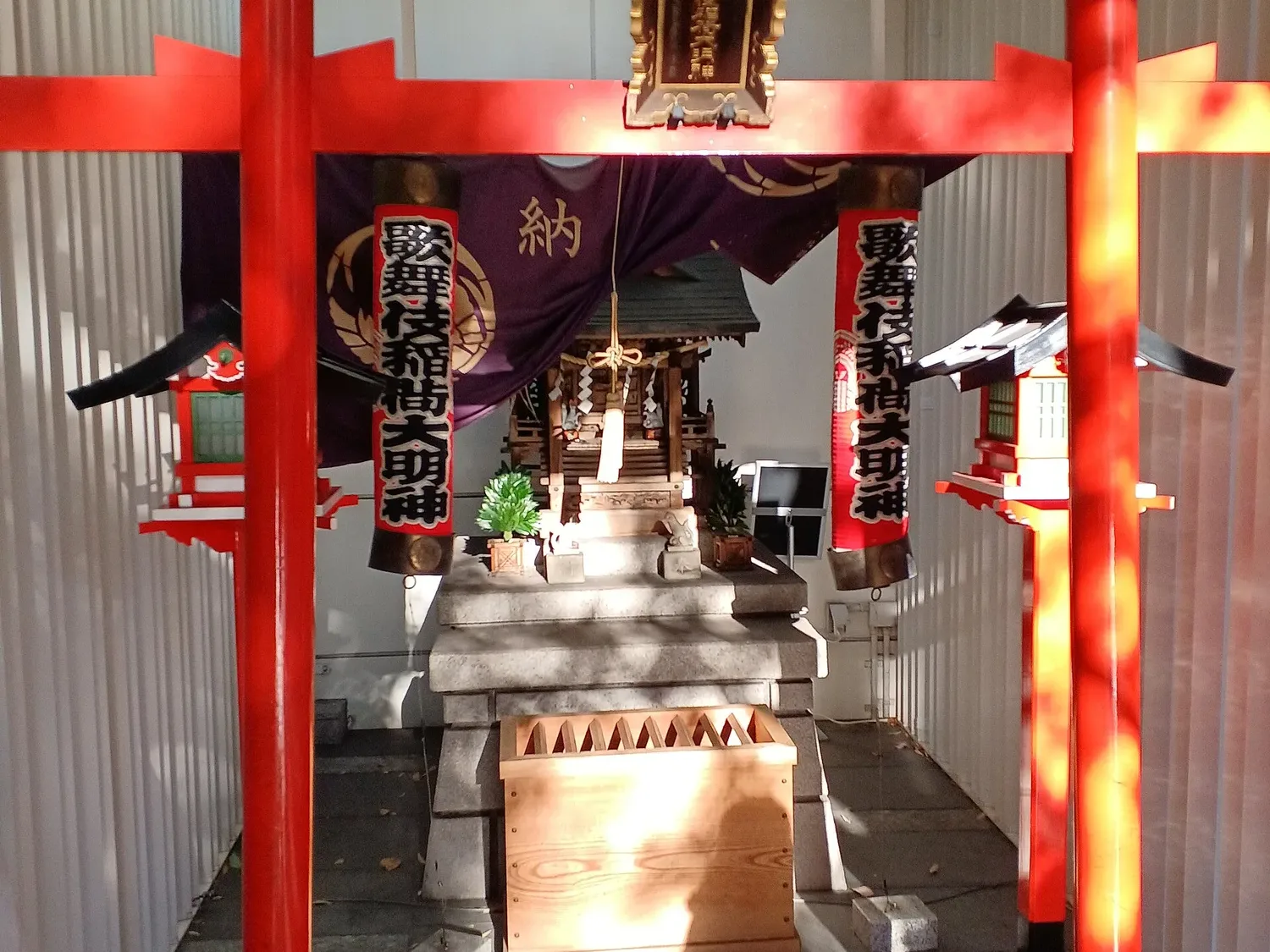
The shrine walk in autumn
If your trip falls in late October or early November, check Ginza’s event page for the Ginza Hatcho Shrine Walk. For a couple of days, shrines that are usually out of reach, on rooftops or inside buildings, open their doors, including Shiseido’s Seiko Inari, which comes down from its rooftop to the ground floor of the Shiseido Ginza Building.
Weekend or weekday
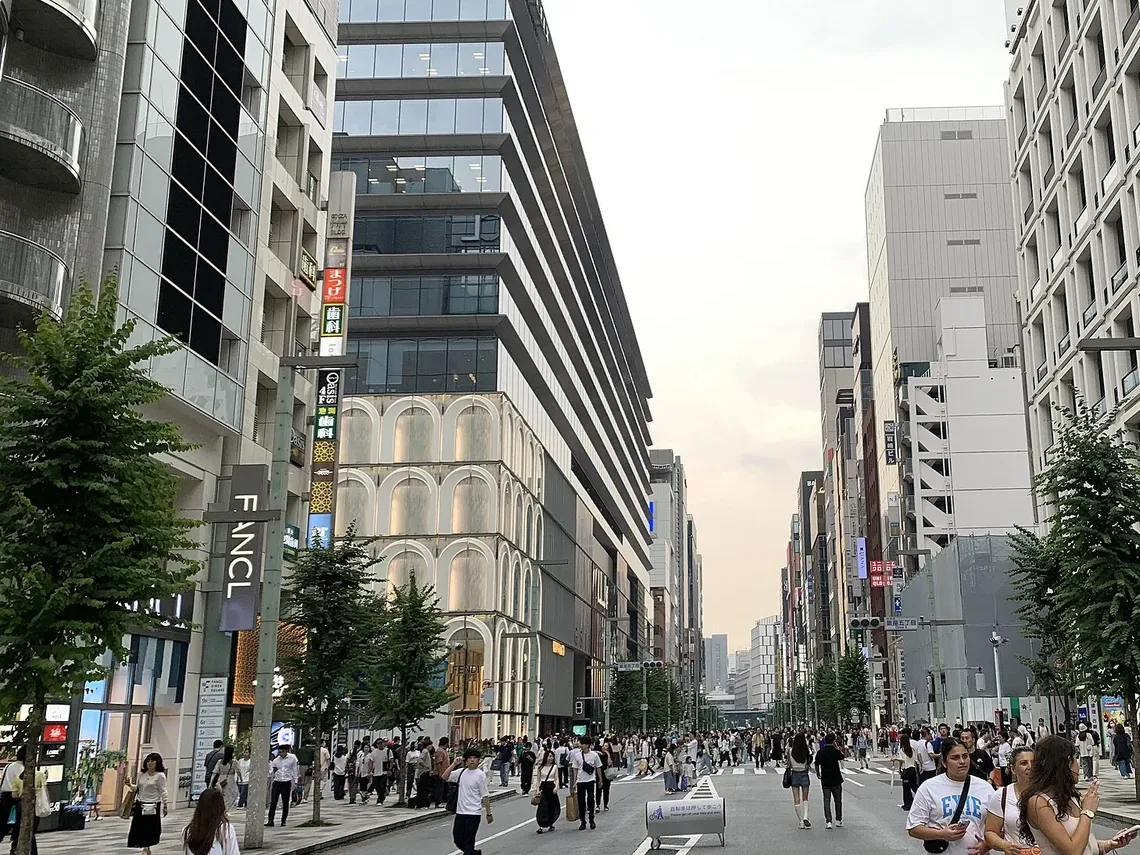
Come on a weekend afternoon if you want Chuo-dori without cars. The avenue through Ginza becomes a pedestrian zone, and you can walk down the middle of it looking up at the buildings. Then turn off into the side streets, where the shrines are.
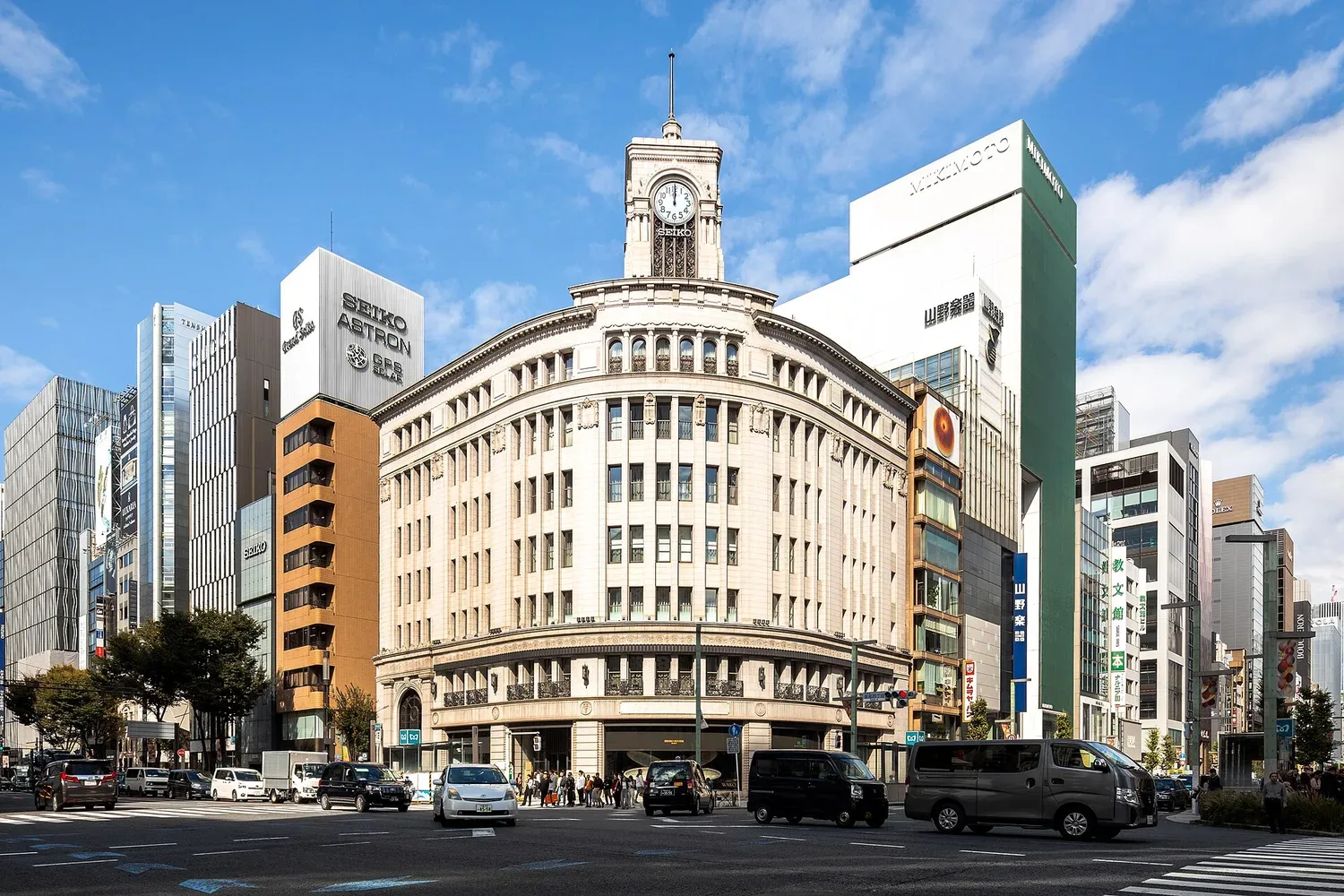
Wherever you are, be at the main crossing on the hour once. The clock tower of the old Wako building starts its Westminster chime about 45 seconds before the hour, and the first deep strike after the melody is the hour itself.
Before you go
| Asahi Inari | Hall on the ground floor, main shrine on the roof; current rooftop access not confirmed. Off Matsuya-dori, east of Chuo-dori. Address: 3-8-12 Ginza, Chuo City, Tokyo (東京都中央区銀座3-8-12), Daiko Asahi Building. Ginza’s official page: ginza.jp |
| Toyoiwa Inari | In the gap between buildings, entered from Hanatsubaki-dori or Suzuran-dori; the shrine office is in the basement. Address: 7-8-14 Ginza, Chuo City, Tokyo (東京都中央区銀座7-8-14). Ginza’s official page: ginza.jp |
| Ginza Mitsukoshi terrace (Mimeguri Shrine and Shusse Jizo) | 9th-floor terrace, inside the department store. Address: 4-6-16 Ginza, Chuo City, Tokyo (東京都中央区銀座4-6-16). Official website: mistore.jp |
| Ryuko Fudoson | A Buddhist place of worship on the roof of Matsuya Ginza; its name echoes ryuko, “trend”. Address: 3-6-1 Ginza, Chuo City, Tokyo (東京都中央区銀座3-6-1) |
| Kakugo Inari | A fire-protection shrine on the roof of GINZA SIX, first enshrined more than two hundred years ago. Address: 6-10-1 Ginza, Chuo City, Tokyo (東京都中央区銀座6-10-1) |
| Kabuki Inari | To the right of Kabuki-za’s front. Address: 4-12-15 Ginza, Chuo City, Tokyo (東京都中央区銀座4-12-15) |
| Seiko Inari | On the roof of the Shiseido Ginza Building; open to visitors only during the shrine walk, when it moves to the ground floor. Address: 7-5-5 Ginza, Chuo City, Tokyo (東京都中央区銀座7-5-5) |
| Ginza Hatcho Shrine Walk | A couple of days in late October or early November; the dates change each year, so check the event page. The 2025 walk was on 24 and 25 October, 11:00–16:00. Event page: ginza.jp |
| Chuo-dori pedestrian zone | Saturdays, Sundays and holidays, Ginza 1-chome to 8-chome. 12:00–17:00 (October–March), 12:00–18:00 (April–September). The police may call it off for bad weather and over the New Year. Performances, selling and gathering crowds are not allowed. Official page: ginza.jp |
| Wako clock tower | At the Ginza 4-chome crossing. The Westminster chime starts about 45 seconds before each hour; the first strike after it marks the hour. Official page: wako.co.jp |
What I would do
In Ginza, I would stop at Asahi Inari’s corner, for the little hall at street level and the pipe carrying earth up the wall to the roof. Look into the windows on the way there, and then look up.
We have visited Ginza for this guide. The practical information was checked against the official sources below on 27 October 2026.
- Ginza official website (Ginza Street Association) (Japanese and English) — the “Ginza Inari Tanbo” columns on Asahi Inari, Toyoiwa Inari, Mimeguri Shrine and the Shusse Jizo on the Mitsukoshi roof, Ryuko Fudoson and Kakugo Inari; the Ginza Hatcho Shrine Walk pages with the list of shrines and their locations; the pedestrian zone: ginza.jp
- Wako (Japanese) — the history of the clock tower and its chime: wako.co.jp
- Photographs: Chuo-dori during the car-free hours by ARandomName123 (CC BY-SA 4.0, cropped); the Wako clock tower by Supanut Arunoprayote (CC BY 4.0); Kabuki Inari by Idutsu (CC BY-SA 4.0, cropped); all via Wikimedia Commons. The lead image and the pictures of the corner shrine, the rooftop shrine, the alley shrine and the Mitsukoshi terrace are AI-generated photo illustrations, not photographs of those places; the clock tower in the lead image is not the real Wako building.
More in Tokyo
- Shibuya Crossing and Shibuya Sky — For the crossing seen from an open roof, with little more than your phone in your pocket
- Senso-ji and Asakusa — For the dragon carved under the Kaminarimon lantern, and the lit grounds after five
- Harajuku and Meiji Shrine — For a forest planted with broad-leaved trees instead of cedar, then a crepe on Takeshita Street
- Tokyo Skytree and Tokyo Tower — For one tower to look out from and one to look at, up its outdoor stairs
- Akihabara — For starting in Radio Kaikan, where figures share the building with vacuum tubes
- Where to Stay — For choosing where to sleep by what you want to see after dinner and before breakfast
Explore other areas
- Hokkaido — Sapporo
- Kanto — Hakone, Tokyo · You are here
- Hokuriku — Kanazawa
- Koshin-Tokai — Fuji Five Lakes
- Kansai — Nara
- Chugoku — Hiroshima
- Kyushu — Fukuoka
- Okinawa — Naha
